


If you think there’s a lot happening in Portsmouth today, you should have been downtown in the 1790s. We’re talking wild animals, tightrope walkers, trick riders, lifelike waxworks, mechanical automatons, a hot air balloon, a genius pig and an invisible lady who could predict the future. Itinerant acts like these blew into town, put on a wild show and quickly vanished.
How did Portsmouth become the hub of what the mid-18th century NH Gazette called “lewd amusements”? First, let’s define our terms. The word “lewd,” back in the day, did not necessarily mean sexual, but could refer to things that were ignorant, vulgar, base or crude. Second, this era of rowdy traveling acts makes more sense if we look quickly at the evolution of early theater in New Hampshire’s only seaport.
We’re not Boston
Portsmouth has long cherished its reputation as a Colonial party town when compared to its moralistic and stuffy Massachusetts neighbor. “Puritanism had little in forming the character of Portsmouth,” Eliza Buckminster Lee, wrote in 1848. “Indeed, in almost all celebrations of public events, instead of a sermon, there was a ball; instead of days of fasting in Portsmouth, all public demonstrations of feeling ended with a feast.”
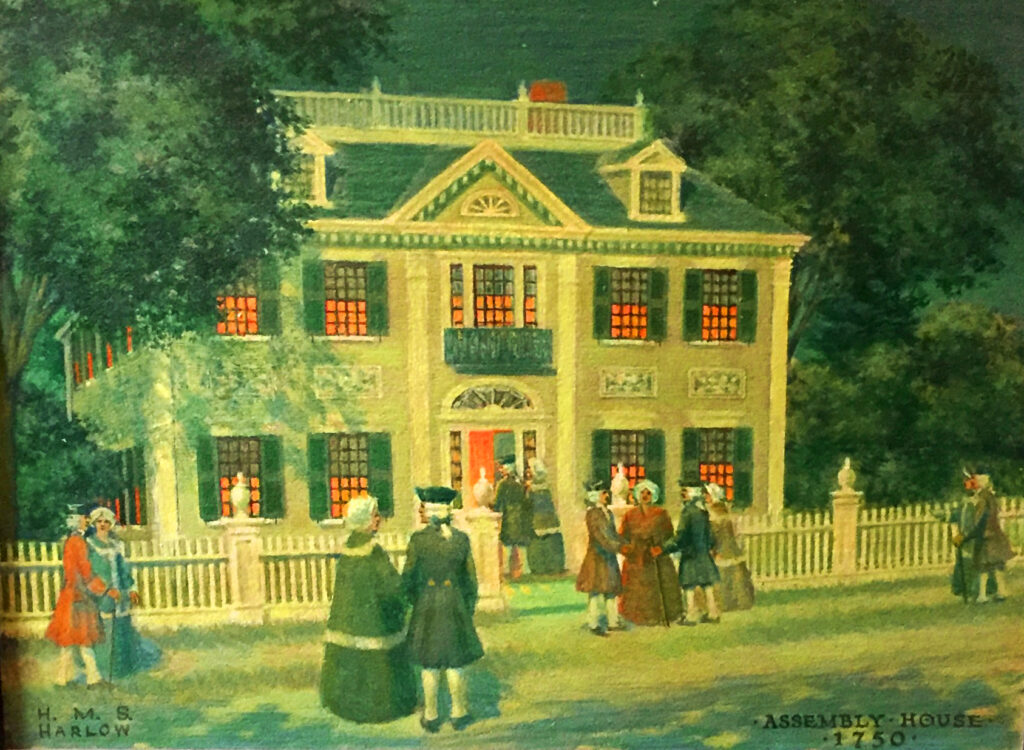
Eliza Lee, the daughter of a Portsmouth minister, was partly correct. We had our share of powerful Puritans in the founding years, but religious leaders had less influence here than did politicians, land owners and wealthy merchants. In 1750, for example, Boston’s city fathers banned all stage-plays, interludes, and other theatrical entertainments. Portsmouth, meanwhile, was enjoying an economic upturn under Royal Gov. Benning Wentworth, and Benning liked the high life. His privileged and wealthy friends lived in a world of powdered wigs, ballroom dances, elegant clothes, fine mansions, liveried footmen, horse-drawn carriages, and enslaved African servants.
In 1760, a new Assembly House, a privately owned function hall, opened on Vaughan Street, site of the Vaughan Mall today. An immense stairway opened onto a huge second floor room measuring 30 feet by 60 feet with tall windows and three chandeliers lighted with wax candles. All but forgotten, the Assembly Hall with its gilded wood carvings became the entertainment center for the city’s upper crust. Private subscribers rented the space for gala dances.
Is theater immoral?
In 1762, a then elderly Benning Wentworth received a petition requesting permission for an itinerant actor “to erect a play-house here sometime hence.” The 47 signers – with names like Atkinson, Livermore and Warner – were largely from the city’s rich upper class. But with the Boston theater ban in mind, local conservatives balked. Two counter petitions signed by a total of 223 citizens opposed the idea of a Portsmouth theater. Gov. Wentworth, following a scandalous marriage to his young housekeeper and rumors of corruption, decided not to support a playhouse.
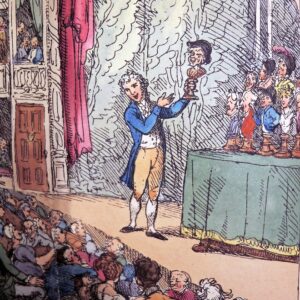
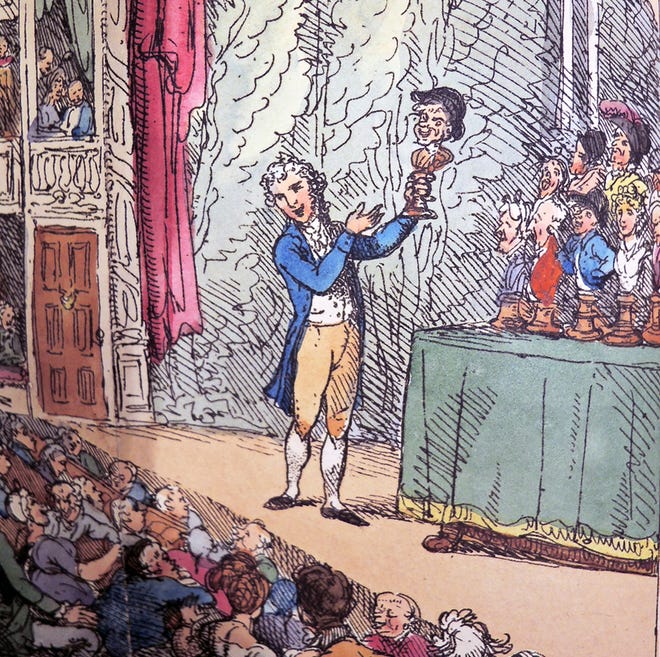
Despite the Boston ban and the lack of an official Portsmouth theater, locals wanted to be entertained. Theatrical performances were occasionally held at the Assembly House and in downtown taverns owned by James Stoodley and John Stavers. By 1769, with Benning Wentworth now replaced by his young nephew John Wentworth, a new act called a “Lecture on Heads” was performed at John Stavers’ tavern. This strange and little-known “curtain lecture,” launched in London in 1764, became a turning point in the evolution of theater in America.
The “Lecture on Heads” was a comedic performance disguised as a moral and educational talk. In the London version, 50 paper mache heads representing different characters, some wearing hats and wigs, sat on a cloth-covered table. Employing props, songs, different voices and accents, an actor satirized each head – a preacher, an old maid, a judge, a quack doctor. The Portsmouth tavern lecture was likely a scaled-down version of the popular London show. But it was a breakthrough. Theater was creeping toward acceptance.
In the fall of 1772, as the American Revolution loomed, a Boston musician and teacher, W.S. Morgan, began offering “weekly exhibitions” very likely at Stavers tavern. Some locals protested “that Mr. Morgan or any other person, exhibit plays or any other shows in this town.” But Morgan’s plays, pantomimes and musical interludes apparently continued for several months, marking 1772 as the port city’s first full theatrical season.

Bow Street Theater
The American Revolution pushed the pause button on most theatrical entertainments. But by 1784 the elite ballroom parties at the Assembly House were back in business. George Washington, who was the guest of honor at a dinner and dance there in 1789, remarked in his journal on the handsome building and the handsome ladies in attendance.
In Massachusetts, the theater ban continued under the aging Gov. John Hancock, who had been the first and boldest signer of the Declaration of Independence. But in Portsmouth, a local named Andrew Halliburton offered a progressive theory. What if the theater, instead of corrupting public morals, was actually a source of moral improvement?
“It is generally acknowledged,” Halliburton wrote, “that a well-written play, well performed and assisted by good and appropriate scenery, is the most fascinating of all mental enjoyments, especially to the young and imaginative.”
By 1790, with a population approaching 5,000, Portsmouth was at its economic peak. But according to one visitor, Portsmouth residents were more interested in billiards, tea parties, concerts and ballroom dancing, than in improving their minds or establishing a college or academy. It was into this entertainment-obsessed society that the city’s first theater was about to open late in the final weeks of 1791. A band of young gentlemen were renovating a warehouse on Bow Street and fitting out a stage. According to the New Hampshire Spy, subscriptions were pouring in for a season of eight performances.
The Bow Street Theater survived one season only. Putting on eight full productions with elaborate scenery was exhausting work for the volunteers. To make matters worse, unruly men without tickets sneaked in from behind the scenery. Others tossed chestnuts and apples onto the stage. The actors, according to a letter in the newspaper, “drink spirituous liquors in order to keep up their strength.” Portsmouth’s first theater soon returned to a “paltry store,” stacked with barrels, boxes, and bales. The warehouse burned in 1806, and the dramatic experiment passed from memory.
Wild & crazy traveling acts
But times were changing. When Gov. Hancock tried to enforce the Boston ban in 1792, locals rioted. Hancock’s death the following year conveniently preceded the opening of Boston’s first playhouse, the Federal Street Theater. Boston quickly became the theater hub of New England. Portsmouth took its place among other “circuit towns” like Portland, Maine, and Salem and Newburyport, Massachusetts, that regularly hosted traveling actors, who now began to flood seaport towns with a fascinating array of short run productions. The Assembly House and downtown taverns were the most popular venues for the “lewd amusements,” now open to participants of every social class.
Samuel Jameson Maginnis, a talented young puppeteer and actor arrived in 1795 with his army of “Artificial Wax-Work Comedians.” His 3½-foot tall marionettes danced robotic jigs and hornpipes in imitation of mechanical animated figures popular in Europe.
On the chilly afternoon of February 18, 1796, a crowd gathered outside the Assembly House to witness French balloonist Jean-Pierre Blanchard’s “Aerostatic Experiment.” His hot air balloon, made from 150 yards of silk taffeta, rose slowly above the rooftops of Portsmouth. Blanchard was not aboard. A wicker basket dangling from the balloon carried a dog, and perhaps a cat, pig, or goat to a height of 50 feet, before releasing them safely by parachute down a long wire to the ground.
That same year citizens thrilled to the acrobatics of Don Pedro Clori. Blindfolded and pretending to be a drunkard, Don Pedro danced the Spanish fandango around 13 eggs without cracking a single shell. Portsmouth then met the “artificial beings” of a man named Mr. Maison, who also presented his “self-driving carriage” centuries before the first self-driving Google car.
The amazing Mr. Spinacutta walked the tightrope amid a fireworks display. Roswell Moultharp’s exhibition featured 20 wax figures, including biblical characters and a likeness of President John Adams. An elaborate device called “The Invisible Lady” was installed at the Assembly House. This popular optical and audio illusion used hidden metal ducts allowing a woman secreted in another room to respond to questions posed by the audience.
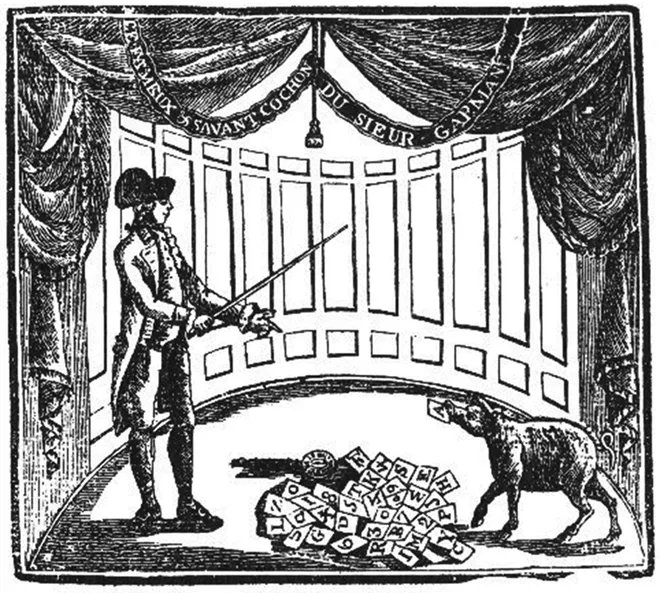
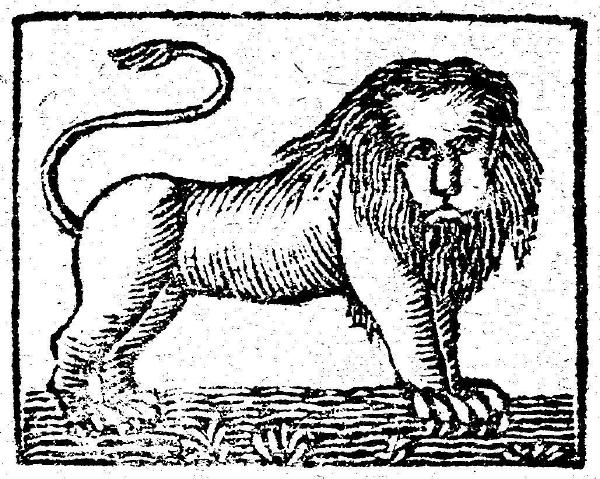
And then there were animals, including the acclaimed “Pig of Knowledge.” Carefully and lovingly trained, the pig could pick up cards, when cued by its trainer, which appeared to answer questions and solve mathematical problems. There were appearances by an elephant, a large male moose, and at least two lions, including an 11-year old, 500-pound African cat. Housed in a sturdy cage outside Stavers’ tavern, the lion was willing to lie down or stand up on command for a fee of nine pence.
In taverns that had previously enslaved African servants and held slave auctions, the public could now view midget acrobats and an albino man. By 1810, the year showman P.T. Barnum was born, a visiting circus promised to exhibit a unicorn, a panther, singing midgets, a two-headed lamb, zebras, zebu cattle, infant orators, and a display of mummified corpses. But three devastating downtown fires and the War of 1812 set Portsmouth entertainment back to more somber performances. By 1820, the Assembly House had been carved into residential units, and both taverns would follow suit. Portsmouth’s first truly purpose-built theater would not arrive until the opening of The Music Hall in 1878.
Adapted from the history of the Music Hall. Copyright 2018 by J. Dennis Robinson, all rights reserved.
 On the Trail of Tom Thumb’s Carriage