

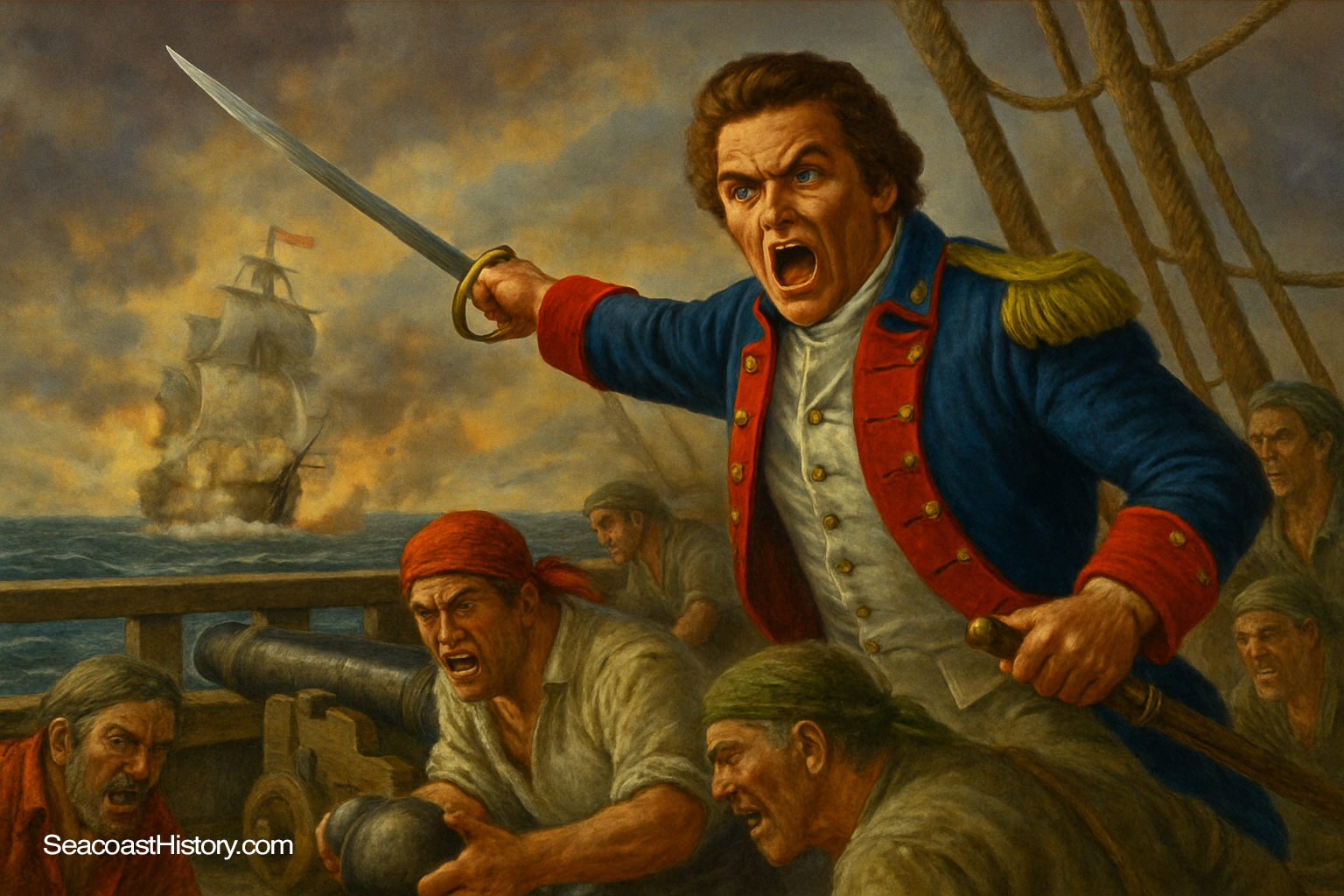
John Paul Jones won’t leave me alone. In a single week, three people from three countries called me to talk about the long-deceased sea captain. A museum in France is focusing an exhibit on the infamous “Chevalier,” who was buried in Paris for 114 years, until we stole his body back to the United States in 1905. Jones was Scottish, by the way, and never a citizen of the USA.
I also had a fascinating two-hour conversation with a former Marine from Virginia who believes he has solved the puzzle of the missing 20 months in the life of Jones. After murdering one of his crewmen in the West Indies, Jones claimed in self-defense, he went on the lam. He popped up a year and a half later as a captain in the budding American Revolution.
And then there was the call from Ireland, where an enthusiastic gentleman wants to rebuild the USS Ranger, the warship first launched from Badger’s Island here in 1777. Ranger carried Jones and a motley crew of local men into history. This is the fourth time I’ve been asked to join a multi-million dollar Ranger reconstruction project. So far, we’ve not gotten off the drawing board.
The Jones legend looms large, and he’s still forwarding his phone calls to me. But the facts about our Scottish-born hero remains largely unknown. The truth is that Jones’ New England crew had no stomach for battle. Most were not Yankee patriots, as they were later portrayed, fighting for liberty and democracy. They were privateers. Jones enticed local men aboard Ranger using an advertisement in the NH Gazette and other newspapers. He promised a quick profitable trip to Europe and back. Most recruits lacked their captain’s passion for a glorious battle at sea. Whatever goods they could plunder with the least risk were fine with them. Grabbing a British merchant ship in familiar Atlantic waters was one thing, but taking on a fully-armored English warship 3,000 miles from home was, to their minds, lunacy.
On the edge of mutiny
His own crew, not the enemy, foiled Jones’ first two attempts to take HMS Drake, a British ship that the Ranger encountered off the coast of Ireland and Scotland in 1778.
The feisty captain proposed surprising the 20-gun Drake in broad daylight as she lay docked in Carrickfergus, Ireland. Speaking through lieutenant Thomas Simpson of Portsmouth, the crew simply refused to go. When Jones revised the plan into a nighttime assault, a drunken mate missed his command and botched the guerilla mission. Instead of secretly grappling the two ships together for a surprise attack as planned, the Ranger missed its mark and anchored 100 feet from its quarry. A sudden shift in weather forced Jones to sail back out of the harbor, leaving the Drake crew unaware and sleeping calmly in port.
John Paul Jones’ vision for the Ranger was three-fold. No British warship had ever been taken in its home waters by Americans. The captured Drake crewmen, Jones reasoned, might be exchanged for American prisoners of war held in British jails. The prized ship and goods could then be sold to satisfy the financial desire of the men aboard Ranger. Finally, this bold show of force might shock the British public into taking the American Revolution seriously. While other American captains were scarcely able to defend their own harbors, Jones was thinking outside the box.
Within hours of the Drake fiasco at Carrickfergus, Jones convinced his reluctant
crew to stage a raid across the waters on the nearby port of Whitehaven, England, a town
he knew well from his youth. Little damage was done to the 400 ships there due, in part,
to uncooperative crewmen. The revised plan was to kidnap the Earl of Selkirk in nearby
Scotland, and hold him for ransom. (Jones had grown up here as a child, and his father
was the local gardener.) The Earl, however, was not home. The crew robbed Lady Selkirk
of a few items, much to Jones’ embarrassment. He later paid for the stolen items and
returned them to the Earl.
Things might have gone even worse. Piscataqua crewmen were so enraged by their rash, glory-seeking captain, that they mumbled about tossing Jones from the Ranger into the sea and returning to Portsmouth. Jones later wrote that he was nearly forced to shoot some of his mutinous men. Both sides backed down.
into the sea and returning to Portsmouth. Jones later wrote that he was nearly forced to shoot some of his mutinous men. Both sides backed down.
Our first major naval victory
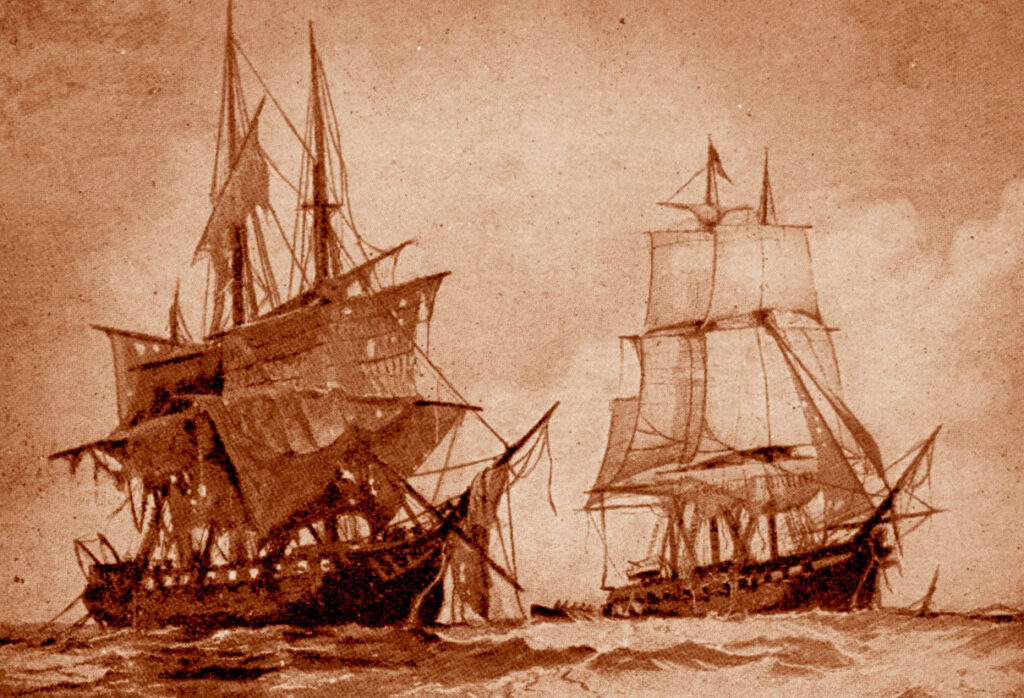
Back at Carrickfergus harbor, after the Whitehaven raid, Jones disguised Ranger as a British merchant ship. When Drake sent a small boat to investigate the suspicious ship, Jones welcomed the party aboard and captured them. This trickery apparently appeased the Piscataqua crew,, who helped their captain lure the Drake into open water. It was a cat-and-mouse chase that took an entire day. Then, in the waning minutes of daylight, the Ranger attacked.
An hour and five minutes later, the battle was over. The enemy captain and his first lieutenant were mortally wounded. The Ranger boarding party had to step over the body of a British sailor. Blood mixed on deck with the burst contents of a barrel of port, brought on deck in anticipation of the Drake’s victory party. Jones’ wild plan and brilliant maneuvering won him the favor of his Yankee crew, but not for long.
Word spread quickly and British ships were soon hot on the trail of Ranger. Towing the captured Drake with its 200 British prisoners, Jones eluded his pursuers by sailing north, then west around Ireland. Heading back to the safety of France, the Ranger spotted small prize ships en route. But when the Drake, now captained by Simpson, was cut loose to allow Ranger to grab more prizes, the Portsmouth captain disappeared in the fog and slipped away in the Drake.
More bad times in France
The discord flared again. When the Drake arrived in France, Jones had Simpson confined to quarters for disobeying orders. Simpson was held in a French prison ship, and eventually in a French jail. Simpson, a brother-in-law of Ranger owner John Langdon, explained that he had misunderstood his orders as Jones shouted to him from the Ranger to the Drake. Jones, however, anticipating trouble, claimed he had given Simpson written orders to stick close by Ranger, no matter what happened.
While Jones celebrated his victory in Paris, the Ranger crew languished aboard ship for three months. A majority of the Ranger’s “Jovial Tars” signed a protest letter, praising Simpson and damning Jones. The Scottish captain, they complained, had threatened to shoot crew members. Jones, “in sallies of passion” had called his men “ignorant or disobedient.” Simpson, it appears, even managed to turn French officers against Paul Jones by disseminating his version of the Drake encounter, in which Simpson was the hero and Jones was a traitor.
Jones, to his credit, was determined to stay “on message” and to return to worry the British with his guerrilla tactics. Jones’ biographer Evan Thomas falls just short of using the word “terrorist” to describe Jones’ methods. French ambassadors Benjamin Franklin and John Adams convinced Jones to let the Ranger return home to Portsmouth under Lieutenant Simpson. Following a disappointing year of inactivity, Jones finally took the Bonhomme Richard into British waters for its bloody victory against HMS Serapis in 1779.
Despite huge losses, including his ship and half his crew, Jones proved that he could command a second major sea victory, and carved himself a top spot in American naval history. Simpson, who stayed on as commander of Ranger, headed back to Portsmouth. Free of captain Jones, at last, the Piscataqua crewmen quickly turned their protest against Thomas Simpson during the long voyage home. The Ranger, under Capt.Simpson, was later captured by the British in South Carolina.
Despite their behavior, Jones sympathized with the Jovial Tars, blaming their actions on Simpson’s negative influence. Jones worked overtime to pay his men with funds from the captured ships. When the impoverished American Congress did not come up with payments to the Ranger crew, Jones had to mortgage his own captured prizes just to pay for their food. The Drake brought in only a small portion of its value, and a year later was in the hands of a wealthy French merchant at the port of Nantes. But the Piscataqua crew – angry, ill-equipped, and largely unpaid — had already taken their small revenge. The Drake, Jones discovered, had been plundered. Even the uniforms of its British prisoners had been stolen by crewmen or sold. Jones’ personal effects, stored aboard ship, were trashed. Lincoln Lorenz, a Jones’ biographer, suggested that the “craven and disloyal” Piscataqua men formed the worst crew Jones commanded in his military career.
Sources: Jones biographies by Lincoln Lorenz (1943), Samuel Eliot Morison (1951), William Gilkerson (1976), Evan Thomas (2003), and “John Paul Jones and the Ranger” edited by Joseph Sawtelle (1994). Copyright © 2016 by J. Dennis Robinson, all rights reserved.
 NH Woman Meets Mormon Founder Joseph Smith