


This week marks a year since my father passed away at 102. I’m still sorting through the bills and legal stuff. We shared a phobia of tax forms and bank statements. He was a math genius, except when the numbers were preceded by a dollar sign. My mother, thankfully, was a bookkeeping wizard. They were married for 68 years.
‘’If I gave your father $20 for groceries,” she used to say, “he might come home with $20 worth of grape soda.”
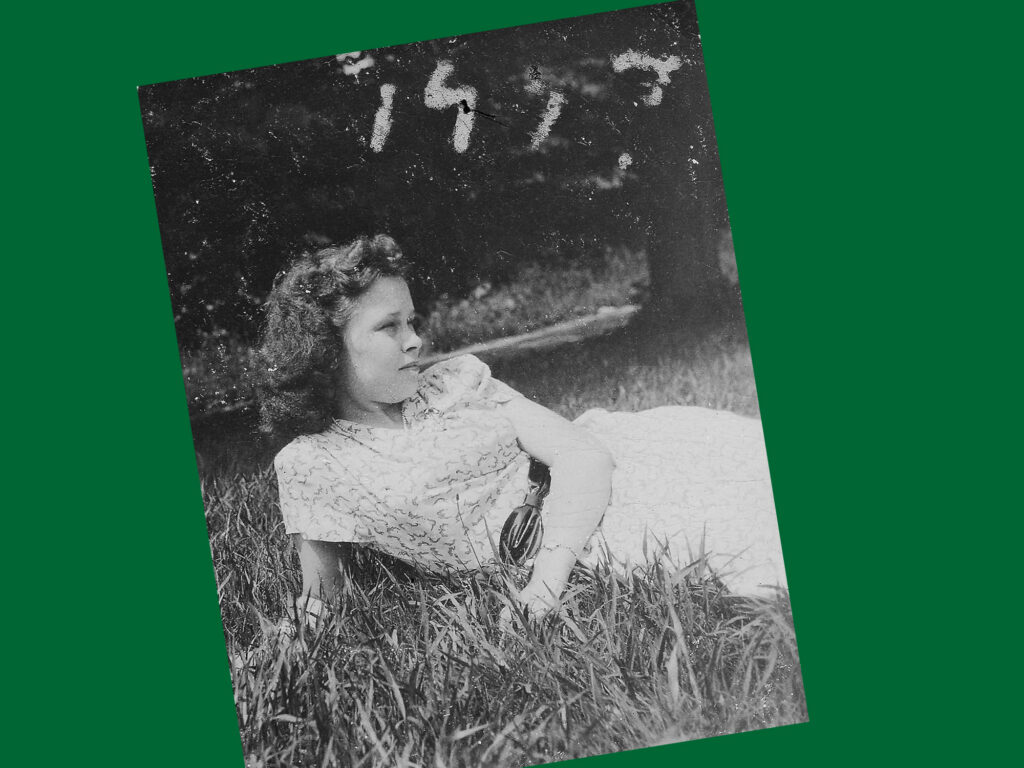
calendar. There were three photos of Phyllis Elizabeth Robinson in my father’s wallet. Two were the standard studio shots taken for the church calendar. The third was tucked out of sight in a plastic sleeve, wedged between a weathered Social Security card and a school picture of my nephew, now retired from the U.S. Navy. The picture fluttered to the floor like a stray leaf. I almost missed it.
The tiny black-and-white image is the size of my thumb, cut crudely from a larger image. I’d never seen it before. Judging from the dust particles, it dates to my father’s amateur photography era. They met, I believe, soon after he returned from World War II. Five years younger, she was just graduating from high school when the war hero returned to Upton.
When John Brewster Robinson turned 101, I asked if he’d ever kept a journal. He proudly produced a stack of spiral-bound booklets chronicling his six years in assisted living. We have equally poor handwriting. Each dared volume was a chicken-scratching account of his expenses, doctor visits, medications, visitors, favorite music, books he was reading, computer passwords and who knows what else. The list included every meal he had eaten while an “inmate” (his word) at the facility.
‘’No, I mean, like a memoir or a diary, you know, in English,” I asked. Him.
“You’ve heard all my stories,” he insisted, but it was far from true. I knew maybe a dozen anecdotes, the ones he told over and over. We hadn’t heard the details of his role at the Battle of Iwo Jima until he was in his 90s. I suggested the memoir idea a few times. “Please don’t hand write it,” I urged. “’Type it on your laptop. Just jot down random memories when they hit you. No pressure.”
But my father was a reader, not a writer. He could knock off a science fiction novel in an afternoon. I never got the memoir…until yesterday.
It was only a start, a single undated, untitled sheet of paper, printed on both sides. Except for a few letters to us kids when he was at a New England Telephone company training session in the 1960s, I don’t recall reading anything my father ever wrote. He was a science and numbers guy. I was a sickly kid, and for years I was his technical assistant. We built radio-controlled airplanes, repaired TV sets, assembled Heatkit radios, constructed Erector Set bridges, developed photographs, and mixed up stuff from my chemistry set. We won the fifth-grade science fair with a proto-computer made out of a cigar box. I was planning to follow in his footsteps
But I went rogue in high school, joined a rock band, wrote poetry, gave up on science, quit the church, and got a D in Algebra. Over the decades, my father would read every word I put down in books, newspapers, and magazines. “He was so proud of you,” one of his caregivers told me recently. Sometimes I wrote about him, but we never once spoke of pride or love. We didn’t have the words, but we never needed them. He was there at my beginning. I was there at his ending.
I found the world’s shortest autobiography tucked up among phone bills, birthday cards, and instruction manuals. He got partway through Chapter 1. And wouldn’t you know it? He had one heck of a prose style. The entire manuscript, my father’s complete works, is transcribed below.
——————-
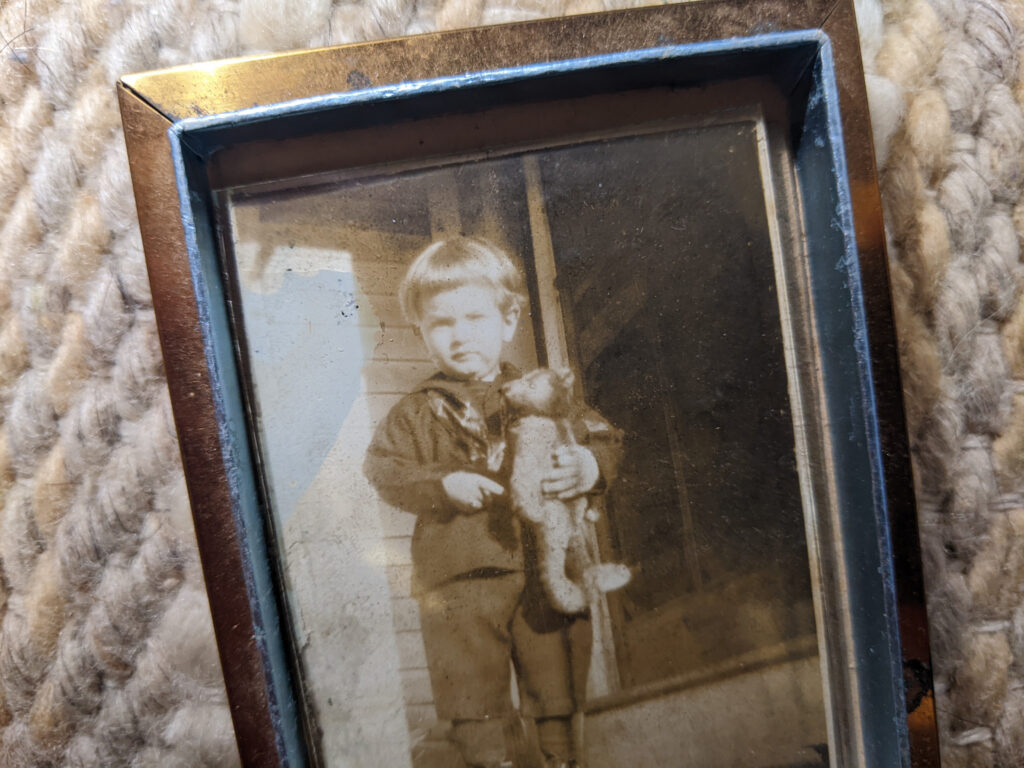
CHAPTER 1
By John B. Robinson
I was born John Brewster Robinson, son of Jason Godfrey Robinson and Nina Florence(Scott) Robinson, on April 30, 1923 at Milford Hospital in Milford Massachusetts, the nearest hospital to the Upton,
Massachusetts residence of Florence’s parents, John Henry Scott and Nina (Blanchard) Scott. Florence Scott was a teacher in the one-room schoolhouse in Hardwick, Massachusetts where she met and married Jason Robinson, one of the many Robinsons, the family that basically established the town.
My first home was my grandmother Robinson’s house near the center of Hardwick. My father’s chief source of income was derived from trapping fox, mink, etc. for their pelts. For years a photo of my father’s greatest catch adorned their home. Reputedly he was paid $200.00 for a rare silver fox pelt. This was probably a year’s income in those days.
I remember little of my life in Hardwick. From birth I was a sickly kid. I do remember many periods of wheezing and gasping for breath, an asthmatic condition that was not treated well in those days. I also spent days with severe earaches and bloody nose problems. Doctors made house calls in those days and the local doctor was a regular visitor. Fourteen months after my birth my brother William arrived. He did not suffer my afflictions. We did not have a close relationship at the time because almost any activity brought on another asthma attack.
My mother’s parents, John and Nina, had moved to Upton in 1921 from Worcester, where my grandfather had been a fireman until retirement at 65. He was about 15 years older than Nina. During my early childhood, frequent visits were common to Upton, and my grandmother could see what a problem I was. She was a person who was happiest when taking care of someone ill. Grandfather had retired with a serious heart condition. With care and daily doses of strychnine as a stimulant he lived a comfortable and useful life.
Nina’s only other child to survive was my mother’s younger brother, Emerson. He had been sickly as a youth but was healthy by the time I arrived and was married to a local Upton girl, Pearl Stearns. At the age of four grandmother Nina volunteered to take me to Upton and care for my ills. I must have been a chore because my parents turned me over to Grandma and I never returned home to live.
Life in Upton was relaxing. The big three story, twelve room farmhouse and nearby barn were on one side of Milford Street, Route 140, the main road through town. Most of the remaining 30 acres were fields across the street. The property abutted Mill Pond in the center of the town. The grocery store, post office, drug store, barbershop and the Congregational Church, girded the local common, all within a five minute walk of the Scott household.
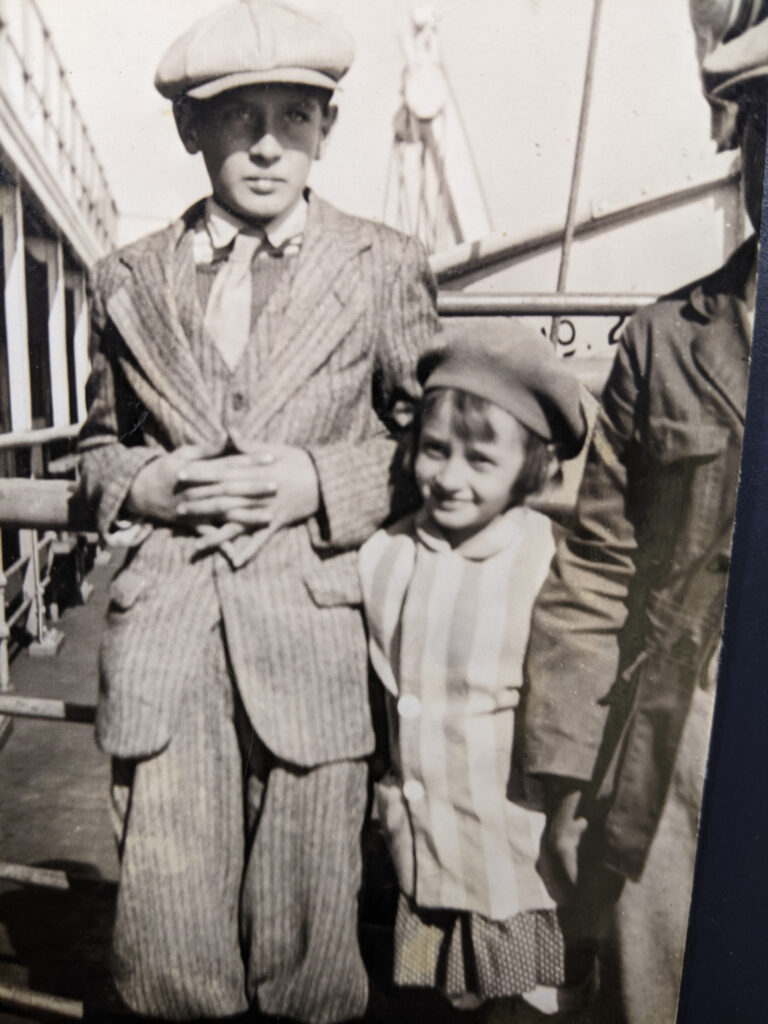
Grandfather never had a drivers license so a trip of any distance required old faithful Dobbin and an appropriate wagon. Throughout my youth in Upton I do not recall an angry word between my grandparents, or with me. My health continued to be lousy. Now the local Upton doctor was a regular visitor. Doctor Capen was a homeopathic practitioner. He also specialized in respiratory problems. I spent years on almost hourly doses of small sugar pills soaked in whatever chemical that was needed at the time to keep me going. These pills were provided by the doctor when he visited, no prescriptions to fill at the local apothecary..
Any condition resulting in the common cold was complicated with an asthma attack. During the Summer months I was sensitive to grasses and hay. Even watching hay being mowed in the fields across the road usually brought on a wheezing attack. Psychologically I was affected too. Any plans for social activities such as visits, picnics etc, if made a few days in advance were canceled when I developed another asthma attack. Everyone soon learned not to divulge any plans ahead of time to me.
If caring for the sick was a pleasure to my grandmother, I must have made her very happy. With her excellent care, I survived. At the age of six I was enrolled in the first grade of the George F. Ball Elementary School, a half mile up the hill from the center of town. Now I was exposed to and contracted the usual (and unusual) childhood diseases. I had them all plus asthma. Grandmother too had been a teacher in her youth, she arranged with my teachers during those early years to provide the material so that she could keep me current with my studies during my absences. My attendance records were atrocious but my marks stayed high.
Of course I was sensitive to school projects. I could not participate in school plays, parties, special events, etc. These were planned ahead and I would be sick by the appointed day. I had no school friends visit me and my classmates knew better than to invite me to visit them. No sports to participate or watch, I was a real bore.
One periodic unplanned activity to enjoy was an occasional bus trip to Worcester with my grandfather to the Fire Station where he sent his working years. This to collect his monthly pension check ($80.00), while I could sit in the fire trucks, slide down the pole from the floor above and enjoy the endless stories that the firefighters traded with each other.
Probably a key factor in my life occurred when I was seven. One of the local variety store owners was running for political office. He stopped at our house and made his pitch for votes. Noticing me he asked about my interests and hobbies. When I could list none he asked if I was interested in model airplanes. I guessed that I was so he promised to send me a kit to build one. My grandparents both cautioned me not to expect anything from him as politicians are always too busy to keep promises.
Sure enough, several weeks later a rather large package arrived in the mail addressed to me. It was one of the popular rubber-powered model planes of the time, a twin-stick fuselage pusher with a built-up tissue-covered wing. The instructions were good and Granddad encouraged me to attempt to build it. I believe it was a pretty crude job, but I took it across the road to one of the open fields, wound the two propellers a number of turns and pushed it skyward. Believe it or not, it flew for a minute or so and landed intact in the grass. I was hooked, from then on most of my spare time was spent constructing balsa model planes. This could even be done in bed while recovering from whatever illness that I had at the time. I recall finishing a model while still bedridden. I could not wait to recover and go out to the field to try it. I wound the prop with a few turns and launched the plane. It flew straight and fast into the opposite wall, crashing the propeller and the entire nose of the plane. It took considerable time to repair the damage.
I believe I was 11 when I managed to add Scarlet Fever to my list of contagious diseases. This was serious in those days. None of Dr. Capen’s sugar pills were of much value. I am told that the patient was kept in quarantine and watched closely for the inevitable crisis when he either lived or died. The seldom used parlor on the first floor was fitted with a bed and I was isolated there for the disease to run its course.
I do remember my grandmother’s constant presence in the room. I was told, she maintained a vigil for 72 sleepless hours until she knew that I had survived the crisis. I survived the fever and several bouts of pneumonia, apparently the fever was the scariest. In those days the policy was to destroy all extra items in the fever room as the quarantine was lifted. The parlor contained a number of cabinets of books and grandmother was told that everything must go. Dr. Capen said that was not necessary and arranged to have the room fumigated and the books were saved.
[The manuscript ends here.]
© 2026 by J. Dennis Robinson. All rights reserved.
 Portsmouth Lyceum was TEDx of the 1800s