


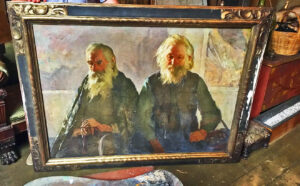
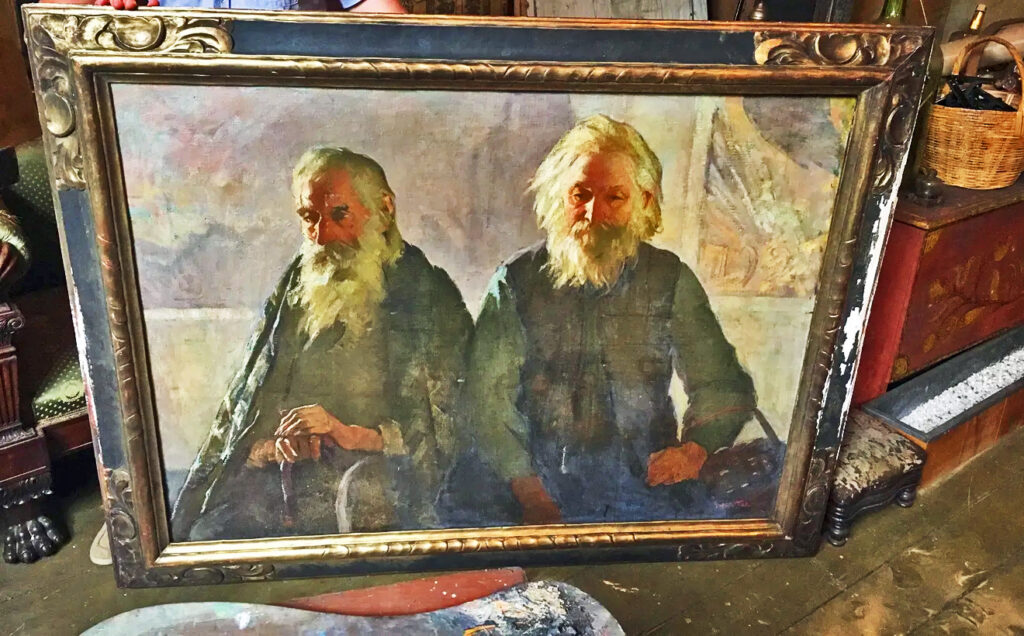
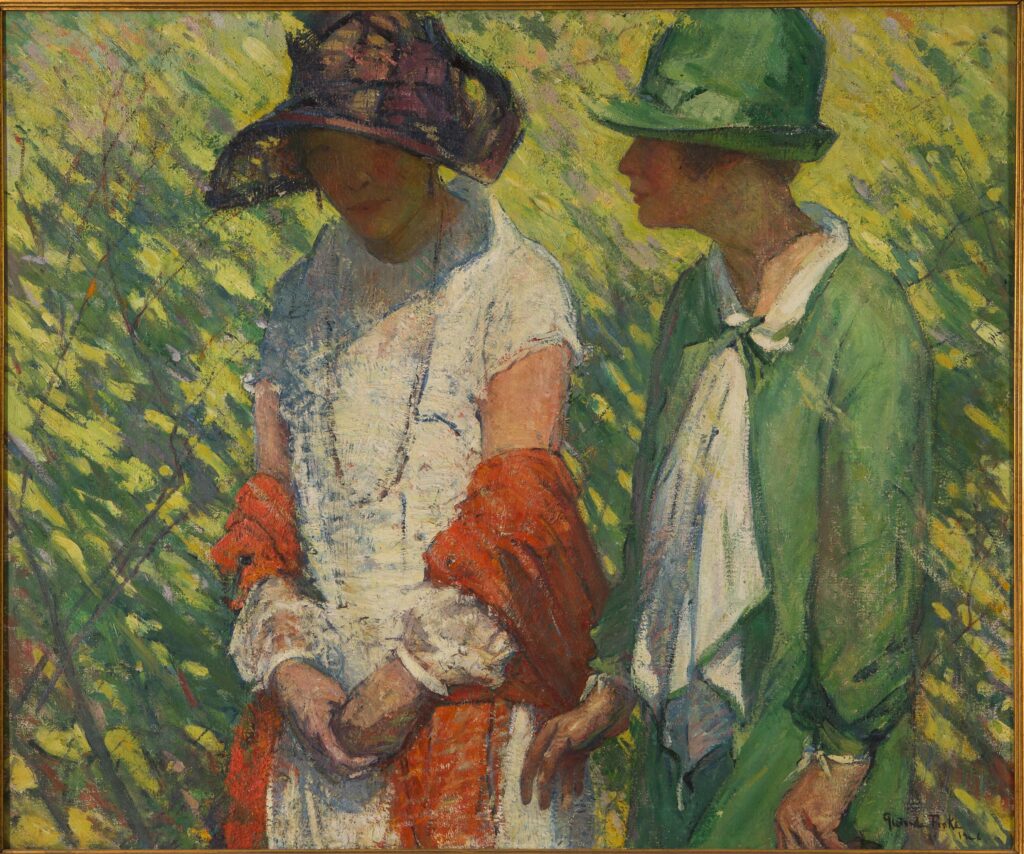
The Brethren” by Gertrude Fiske before restoration in its original 1923 frame (Jeremy Fogg photo)
He’s had a long day restoring fine art paintings, but Jeremy Fogg is ebullient. The more he talks about reviving the works of Gertrude Fiske, the more excited he gets.
His lecture at Portsmouth Historical Society in 2018 focused on a 1923 masterwork titled “Brethren” that had been set aside in the artist’s studio and untouched since her death in 1961.
“Things had been leaned up against it,” Fogg recalls. “It had been sunken in. There were big dents, but only a small tear. It was very cloudy. The varnish had started to go. It looked a mess. But once I got to study it, I thought – you know, this isn’t so bad. I think we can fix this. It’s going to be great.”
And it is great. Fully restored by Fogg, “The Brethren” hangs among dozens of extraordinary works by American master painter Fiske. It depicts two older bearded men sitting side by side. The details in their faces, clothes and hands, Fogg says, show an extremely accomplished artist at work and developing her own unique style. In fact, he suggests, Fiske sometimes out-shined the work of her mentors, Edmund C. Tarbell of the Boston Museum School and Charles Woodbury of Ogunquit.
“I can see the direct influence of both of them,” Fogg says, having restored many paintings by Tarbell and Woodbury. “There’s the influence of both of those artists, but there comes a point where it’s just her, it’s all her.”
The relationship between conservator and fine art is an intimate one. In bringing this faded masterwork to life, Fogg sees Fiske’s painting at a micro level. He is deconstructing her painting brushstroke by brushstroke and getting to know the late artist like few people ever have.
“In conserving, I’m literally touching the work when it’s out of the frame,” he says. “We can see where sometimes Fiske would come back and repaint parts of the painting while it was still in the frame.
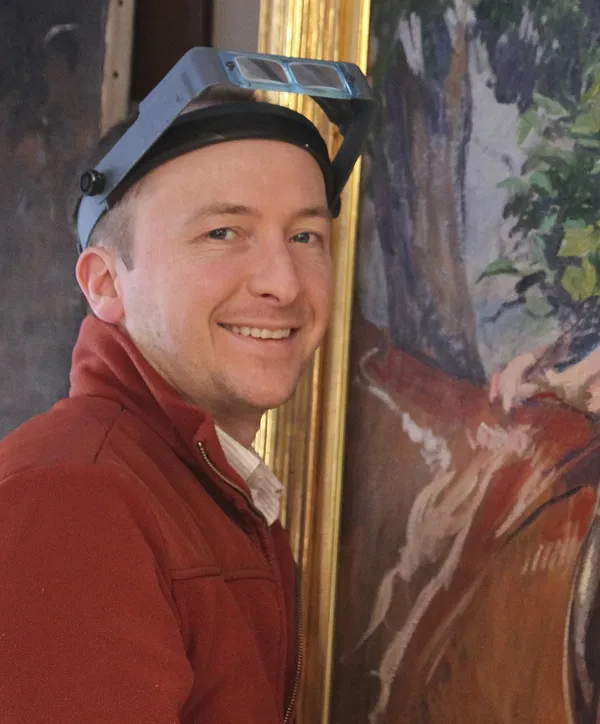
“Sometimes she washed out parts of the painting that she wanted to soften a bit. She was reworking these things, experimenting. She would literally scrape down a surface with a blade and glaze over the top of that with another color to just get this weird depth as she did with ‘Brethren.’”
A painting conservator and manager of Anthony Moore Painting Conservation in York, Maine, Fogg brings an expert’s eye to Fiske’s work.
“There’s a lot going on in that one painting that you wouldn’t notice if you hadn’t seen it out of the frame or tried to clean it,” he says.
Fogg, who worked with exhibition curator Lainey McCartney and exhibition director Adam Brooks, has become an admirer of Fiske.
“What do you do when you walk into a house or a barn and a painting has been sitting there for so long,” Fogg asks. “Where do we start?”
Finding the original frame to “The Brethren” made by well known Boston framemaker Walfred Thulin was an exciting moment, Fogg recalls.
“This was a beautiful exhibition frame. I saw it in the corner and said wouldn’t that be great if that fit? The frame was severely worm-eaten, bug-eaten on one side. It was almost hollow, full of sawdust. You could touch it and the whole middle section was barely hanging on. But it was an important frame, worth saving, and it fit.”
Fogg called frame conservator Jared Tuveson, who restored the original frame that once again surrounds “The Brethren.” Fiske was experimenting, Fogg explains, adapting what she had learned, stretching the boundaries set down by her mentors and finding her own way.
“I think she deserves more notoriety,” he says.
“The Brethren,” Fogg suggests, likely involved two models, perhaps painted at separate times, giving the two men a strangely aloof appearance. The work won several awards in its day, but was never sold. It didn’t have the commercial value of a beach scene or beautiful nude, and may have been a more personal statement and a display of her skill, Fogg notes, adding she was painting for herself, testing herself, and finding her voice.
“She’s amazing to me, clearly talented,” Fogg concludes. “Some of the things she did were moderately successful, and some were so damned successful. I think I’m still processing.”
Copyright J. Dennis Robinson
 A Brief Guide to Sea Serpents