




Picked up the phone to call up my friend.
Wondered if I would ever see him again.
Well it’s hard times in the U-S-of-A. Hard times.”
– Harvey Reid, Woodpecker Records
So begins the latest song by Harvey Reid, unarguably the region’s most prolific and uncompromisingly independent travelling musician. Other than a brief stint as a teenaged lifeguard and as a college math teaching assistant in 1974, Reid has strummed and picked and sung his way through much of the last half century as a full- time professional musician.
The stats are impressive. In 2020, at 66, Harvey Reid estimates he has performed over 6,000 gigs, travelling millions of miles to perform throughout the nation – with the exceptions of Alaska and Washington State. He has toured in eight other countries. He has recorded 520 tracks on 32 albums and self-published another 30 instructional books about stringed instruments. His virtuosity centers on guitar, autoharp, and banjo, and extends to the mandolin, bouzouki, mandocello, lap steel, and dobro.
Then along came COVID-19. Venues closed and gigs were cancelled. Reid and his wife Joyce Andersen, a dynamic singer, songwriter and fiddle player, have been sheltering in place with their sons Otto, 15, and Levi, 12. Their weekly virtual concerts, broadcast live from their barn in York, Maine, now attract a worldwide audience. We’ll get to those shows momentarily.
The Troubadour Chronicles
Being forced entirely off the road by the pandemic in 2020, Reid found himself pulling old instruments out of closets, reviving forgotten songs, and writing fresh new music. Among his stash of unfinished projects was a book, already four years in the making.
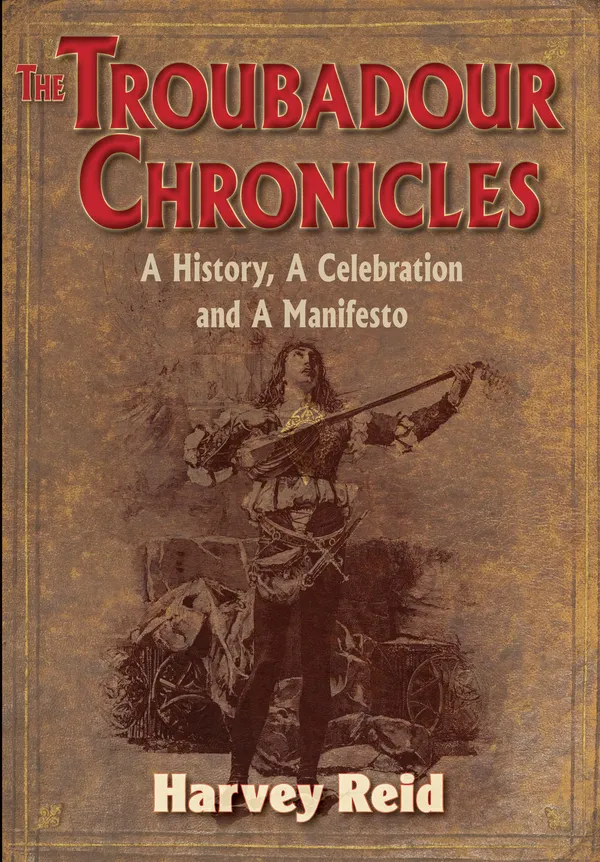
“The Troubadour Chronicles,” begun as an online blog, is Reid’s epic quest through time and space to define and understand what he does for a living.
“I don’t have the faintest idea why I became a musician,” he says today. “I came from a family of teachers. I went to college and all I did was play guitar.”
Reid traces his troubadour roots to history’s first “self-accompanied solo singers.” He finds himself wandering the villages of Italy as a lute player in the 1500s. He imagines a kinship with an Appalachian banjo artist, an Hawaiian singer with a ukelele, the African kora player, a Celtic balladier, a singing cowboy, and a Delta bluesman.
During his research, the author read roughly 300 books and countless web pages, examined early sheet music online, and listened to tens of thousands of recordings. “I gradually realized I had a very worthy story to tell, and that I was as qualified as anyone to tell it,” he says.
Harvey Reid’s labor of love is also a manifesto. He rails in defense of what he calls “peasant music” played by talented solo professionals. These are the vast majority of working, but largely unheralded, troubadours, he says. They fill the gap between angst-ridden, druggie, starving artists and the million-download-selling pop stars who dominate the headlines. The author takes on the commercial recording industry, musical elitists, college music departments, and even the high school band program.
His 500-page book “is not aimed at a market or money stream and hard to explain or sell,” Reid admits. But it is only half the length of “War and Peace,” he points out.
“It sort of mushroomed,” he says of “The Troubadour Chronicles.” “A lot of the self discovery stuff began when we had our first child. I started deconstructing myself about 15 years ago, trying to understand – why am I playing music anyway? I don’t read music. I haven’t had a music lesson in my life, but I practice my ass off.”
Married with children
In the past, Reid recalls, he frequently picked up a plane ticket on Wednesdays and flew off to perform four or five gigs from Thursday through Sunday, somewhere like Michigan, Wisconsin, or Indiana. He self-recorded, self-manufactured, and sold a lot of CDs in the 1980s and ’90s. He flew at tree-level, he says, under the radar of the traditional music business. He bought a house and saved a little money before the recording industry collapsed, replacing vinyl and CDs with free downloads.
Reid’s unquestioned virtuosity is still on display in his many albums and online performances. But in 2020, he rarely travelled beyond the local grocery store.
“Last year was the first year in my life in which I didn’t buy any plane tickets. The joys of rest areas, motels and roadside restaurants are vastly overrated,” he jokes.
“The pandemic has completely upended our lives as musicians, but we have no choice but to adapt,” Reid says, and counts himself lucky among his peers. “I’ve owned my house for 27 years and have no rent, and we drive older cars, and have no student loans eating us alive like many of our younger friends,” he says.
First married at age 49, Reid claims he didn’t want to be the kind of dad who was gone all the time. “I never wanted to be part of the national or international music industry crap. The real struggle was how to fall in love, get married, raise a family, and have a normal life – and still be an artist. That was the real rub.”
“I’m grateful,” the artist says after a pause. “I was lucky enough to find one of the most talented musicians on earth to spend my life with.”
Live from home
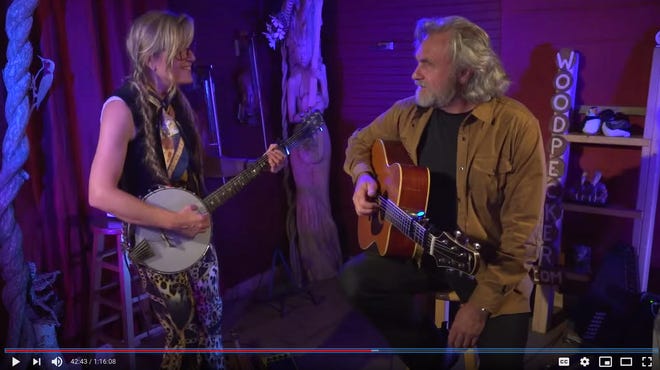
Well before the pandemic struck, the husband and wife team had given a few small concerts in their converted Maine barn, dubbed the Puffin and Loon Lounge. In 2020, they experimented with broadcasting one-hour concerts from the same tiny stage. A single unmanned camera on a tripod links them directly to the Internet. Viewers access the shows via YouTube, Facebook, or Joyce Andersen’s website JoyScream.com.
“It was mostly Joyce’s idea to do a weekly show,” Harvey Reid says. “It was a Hail Mary move for us. It’s about as pure a channel as there ever has been, like live radio was in the 1930s or vaudeville before that. We’ve removed all the middle men. There’s not even a sound guy. It’s all we can handle.”
The format is bare naked, Reid explains, no opening titles, no special effects, no editing, guest stars, video clips, or rolling credits. It’s just two seasoned performers, taking turns or harmonizing together.
Seated on a stool, eyes clenched, motionless, prayerful, Reid embraces his autoharp as if it were a lost child. Joyce Andersen, eyes wide, perpetually swaying, animated – alternately caresses and attacks the fiddle tucked beneath her chin. There is lots of tuning, twisting of knobs, plugging of cables, and swapping of instruments. The web viewer misses nothing.
“Hey, how do you tell if a couple is married?” Reid says, filling time between tunes.
“They’re both yelling at the same kids,” Andersen replies. “Our kids already made a snowman,” she says. “And the dog knocked it down,” her husband adds.
Then they launch into something completely different. It could be an ancient ballad, a blues or bluegrass standard, a gospel hymn, hot jazz, a sea chanty, folk song, or country classic. In recent weeks, they have performed over 250 different songs.
“We’re delighted to be playing unpopular music,” Reid says with pride. “We’re finally getting rewarded for being versatile. Most of our lives we’ve been punished for that.”
“People think that, when we play traditional music, all we want to do is pass it on the way our ancestors did it. Heck with that! The most fun thing about old songs is that there’s no rulebook at all. You’re free as you wanna be to do anything you wanna do.”
The two performers are clearly impressed with one another. Andersen is the bouncy smiling host. Reid is often somber, then suddenly elated. It’s as if, in the middle of a complex and well-practiced tune, he realizes he is having fun. He tells stories with ease, lectures on the origin of songs, or unwraps the history of a musical instrument.
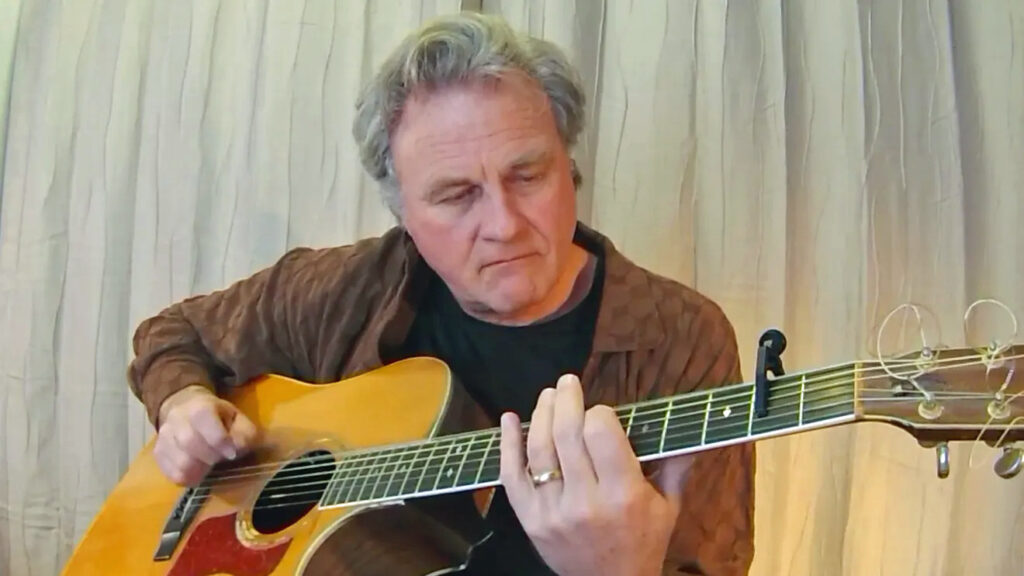
The virtual troubadour
The Joyce and Harvey show plays like the live-feed from an early folk club, minus the smoke, murmuring and clinking glasses. Between 500 and 1,500 viewers tune in to each live show, or catch the recorded version online. The shows are free, but there is a “donate” button, the internet equivalent to a street busker’s open guitar case.
“We were immediately struck with how well-received our shows have been,” the stay-at-home troubadour says. “People were very enthusiastic. They are surprisingly generous. I was flabbergasted. It was kind of utopian.”
But the formula makes sense. Saturated with slick video productions, repeat audiences appear captivated by this raw folksy format. The duo is talented and charming. The material is diverse. The audience is international thanks, in part, to Reid’s decades of traveling and keeping in touch with fans by mail and email.
If it takes 100 gigs a year with 100 viewers paying a cover charge, how many digital donations will keep a two-musician family afloat? Subtract the cost of plane tickets, motels, hauling equipment around, and lonely nights on the road. It’s a touchy and unexplored calculation.
“We get no unemployment or business help from the government, other than the stimulus check long ago,” Reid says. “It feels like my early days of being a street musician, though now we’re playing on a digital street.”
“It’s a very different world. I can sell worldwide to my scattered audience, and the books even get printed in other countries when people there buy them, without issues of shipping, customs duty, or inventory. I’m reveling in the freedom and power it gives me.”
But is it sustainable? Reid shakes his head. For a troubadour living day-to-day, the term has little meaning.
“This year has been both disorienting and energizing,” says the renegade musician. He is happy to be home with his kids. Time is wealth. This week, he adds with undisguised pleasure, he and Joyce wrote three new songs together.
“It’s a much better lifestyle than the more celebrated traveling musician thing,” Reid concludes. “If there weren’t an invisible and deadly disease swirling around us, this new reality would be pretty awesome.”
Copyright 2020 by J. Dennis Robinson, all rights reserved.
 Flags Fraught with Meaning and Confusion