

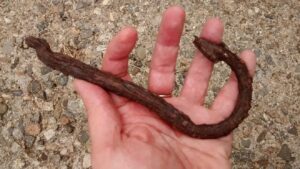

Warning: the following statement might offend the 10 million living Americans who claim to be descended from the settlers who arrived at Plymouth aboard the Mayflower in 1620. In my humble opinion, this giant fishhook tells us more about the founding of the New Hampshire Seacoast than all the Pilgrim journals combined. It turned up this summer on the Isles of Shoals, forced to the surface by time and tide.
It isn’t the first huge metal fishhook uncovered on the Isles. It measures seven and a half inches long by three inches wide. The metal loop at the top that once connected to a taut fishing line is missing.
I’m no expert, but the two archaeologists I showed it to agreed the rusty barbed hook is likely from the 17th century. The 1620s to about 1700 was the heyday of fishing for giant cod at the Shoals. As many as 500 English fishermen swarmed the islands seasonally according to early accounts, pulling in fat cod weighing up to 150 pounds each. Big hooks for big fish.
As early as 1597, one European captain who was cod fishing in what is now the St. Lawrence River wrote, “in little more than an hour we caught with four hooks two hundred and fifty.” Word spread quickly that there were an incredible number of even bigger cod to the south.
Captain John Smith noted the size and abundance of fish during his visit to this region in 1614. It was Smith’s famous map of New England that helped kick off settlements at Plymouth in 1620 and at Odiorne’s Point at Rye in 1623. Archaeological evidence now proves that the Isles of Shoals served as a seasonal fish factory where men split, cleaned, salted and dried this profitable catch before shipping it back to Europe. Recent professional digs also confirm that as the 17th century progressed, the size of the fish grew smaller and smaller.
I thought our ancestors drove the giant cod into extinction, but according to Google, the wily fish moved on. You can see photographs of codfish weighing up to 103 pounds still being captured off the frigid coast of Norway.
I’m not knocking the Pilgrims, even though they were lousy fishermen. But I like to point out annually as Thanksgiving approaches that the American mythology surrounding the Plymouth Separatists often falls far from the facts. The Pilgrims with the tall hats and the buckled shoes who didn’t drink or dance and were kind to the Indians are imaginary. The founding of our nation as a Christian enclave is a tiny sliver of truth in what was mostly a search for wealth, land, adventure and political power.
The rough and tumble men who caught and sold the monster cod, however, were real. They arrived by the hundreds, year after year, traveling thousands of miles each way. They were searching, not for religious freedom, but for a job, a paycheck, and a ration of rum. And unlike our Pilgrim neighbors, they left almost no written records, only an occasional broken fishhook cast aside on a rocky shore.
Copyright J. Dennis Robinson, all rights reserved.
 New Castle Breaks Up With Portsmouth in 1693