


(Photo copyright Portsmouth Athenaeum)
The furor over “fake news” and “alternate facts” is nothing new to historians. The past is packed with so-called facts that, on closer analysis, turn out to be legends, myths, hoaxes, errors, mistakes, propaganda, misprints, false interpretations, or downright lies. So for those who think the daily news now reads like a tea party from Alice in Wonderland— welcome to my world.
Journalists, good journalists that is, routinely double and triple-check their facts. That’s tricky when alternate interpretations are presented as the unvarnished truth by powerful people. But then again, Mark Twain had his own view of the media when he said, “If you don’t read the newspaper, you’re uninformed. If you read the newspaper, you’re misinformed.”
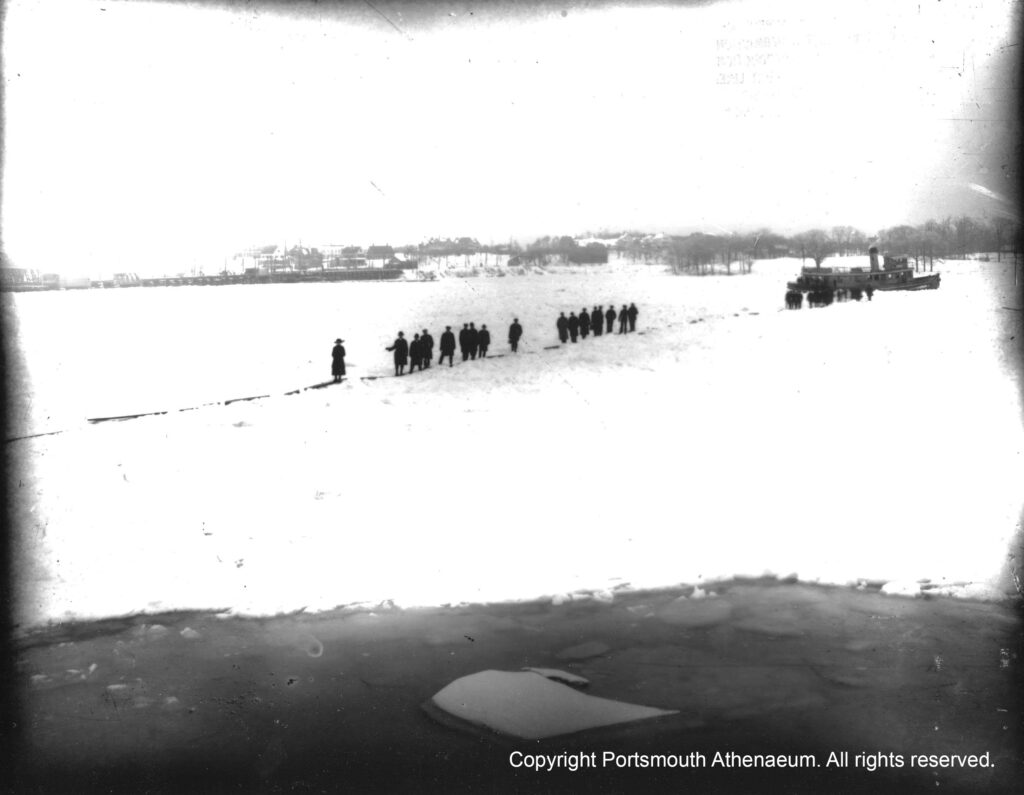
The local history writer, besides making the past interesting and relevant, must debunk false impressions of the past. And those impressions shift and drift like icebergs as new data is collected and public perceptions evolve. So let’s start with something small. If you think this February is cold, let’s remember February 11, 1918, almost a century ago. Although this is often referred to as the day the Piscataqua River froze, technically, it didn’t. Then why does the photograph above show a stuck ferry? Passengers of the ice-bound Navy Yard ferry #1048 did walk to the mainland on wooden planks spread on top of the ice-choked river.
Technically, however, the fast flowing Piscataqua River did not freeze. In fact, floating chunks of ice from Great Bay collided with the outgoing tide. The collecting ice jammed together creating a solid but temporary crust that trapped the ferry. Remember this was five years before the Memorial Bridge opened in 1923. The ferry broke loose hours later with the shifting tide.
Portsmouth and Kittery were not alone. A New York newspaper reported on February 11 that a relief ship sent out from Woods Hole at Cape Cod was also imprisoned in ice floes. On Penobscot Bay a government steamer smashed through the ice jam to bring supplies to islanders stranded at Vinalhaven, Maine. And on the Monongahela River, an avalanche of trapped ice reported to be 10 miles long and 30 feet high, threatened Pennsylvania residents. History was also made in Stamford Connecticut when publisher Louis Kennedy successfully drove his 3,000 pound automobile across the blocked-up bay to the Stamford Lighthouse and back two times. Now let’s tackle the truth about Global Warming. Sorry, we’ve run out of space.
Copyright J. Dennis Robinson.
 When Noah’s Ark Stood on Daniel Street