



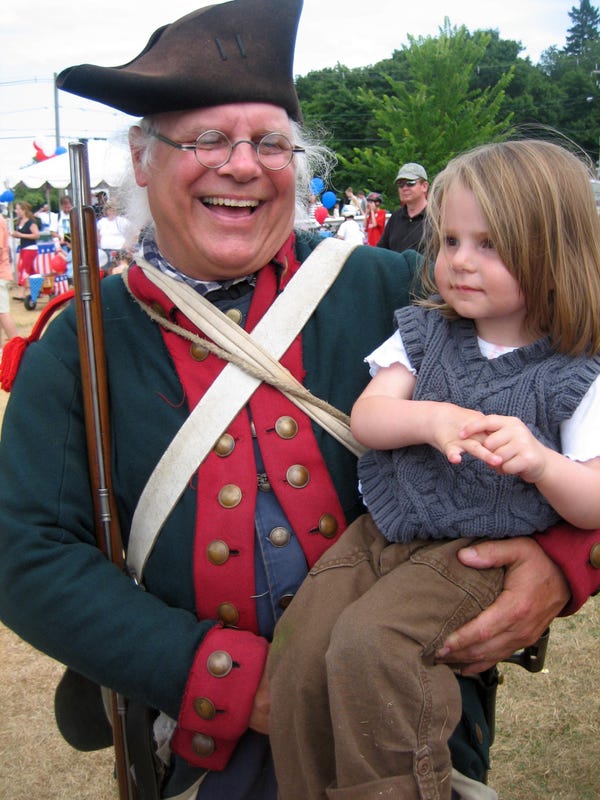
Portsmouth ranks high in the history of the Fourth of July. The Moffatt Ladd House on Market Street, of course, was home to Gen. William Whipple, a New Hampshire signer of the Declaration of Independence along with Matthew Thornton and Josiah Bartlett.
One of the first public readings of the Declaration, still unsigned just two weeks after its adoption, took place from the balcony of the Old Statehouse that stood in the center of Market Square. That was July 18, 1776. The statehouse was demolished in the 1830s. Rotted timbers of a small portion of the building still rest in a trailer in Concord, while the salvaged iron balcony remains in private hands.
A year later on July 4, 1777, Captain Thomas Thomson, whose house still stands on Pleasant Street, invited guests to celebrate with dinner aboard a Continental frigate.
Ten days later on July 14 the first Stars and Stripes flag design was adopted in the same Congressional decree that sent John Paul Jones to Portsmouth to captain the frigate Ranger. Back in Portsmouth in 1782, Jones threw a July 4th party for the city at his own expense with toasts, salutes, fireworks, and dancing aboard the USS America being built at Kittery.
Thomas Bailey Aldrich recalled how in the 1840s young boys in Mr. Grimshaw’s class feverishly anticipated the annual holiday. “There was very little hard study done in the Temple Grammar School the week preceding the Fourth of July,” Aldrich wrote. “For my heart and brain were so full of fire-crackers, Roman candles, rockets, pin-wheels, quibs, and gunpowder in various seductive forms, that I wonder I didn’t explode under Mr. Grimshaw’s very nose.”
Local history buffs will recall that in another chapter of his fictionalized memoir, “A Story of a Bad Boy,” Aldrich noted that the Portsmouth town fathers banned the use of fireworks during the July holiday in 1847. In protest, Tom Bailey and his gang of friends set an old stagecoach ablaze in the middle of Market Square.
The summer of 1873 marked the city’s 250th anniversary. While American cities were expanding rapidly, the population of Portsmouth had plateaued at just under 10,000 residents. Hoping to profit from a homecoming festival, the city sponsored a “Return of the Sons and Daughters” celebration during the July Fourth weekend.
Another homecoming on July 4, 1888 celebrated the battleships Kearsarge and Alabama. An estimated 5,000 visitors arrived by train including many Civil War veterans. “Never was seen in Portsmouth such a gathering of battle-scarred heroes as composed the Grand Army division of the parade,” a local newspaper reported. The highlight was the dedication of the Soldiers and Sailors Monument now fully restored on Islington Street. Residents complained of a plague of public drunkenness during the festival and one boy was tragically killed during a fireworks accident.
Portsmouth organized a huge Fourth of July celebration a century ago in 1910. The highly orchestrated “Return of the Sons and Daughters” opened with “The Grand Military and Civic Parade” at 10 a.m. As was the tradition, entrances to the city were decorated with giant arches.
A 1908 cover story in the Portsmouth Daily Herald rambled on about the danger of fireworks capable of blowing a man to pieces. These items, the writer noted, should probably not be sold in the stores. But the reporter was more concerned with new fangled noisemakers that, in the hands of marauding Portsmouth boys, were keeping decent citizens awake. The kids, it seems, were tying large brass cowbells to strings and sticks to create a hellish Fourth of July racket. Worse, according to the newspaper, was the introduction of blank cartridges for guns of all sizes. The loud repeated explosions were enough to wake the Revolutionary War dead, the newspaper complained.
But for all its holiday events, the city’s greatest July 4th tribute to the signers of the Declaration has to be the annual Naturalization Ceremony held at Strawbery Banke Museum. Immigrants and their families become American citizens on the same grounds that have welcomed new arrivals since 1630. Through four centuries, as former museum president Larry Yerdon pointed out, Puddle Dock remains “a neighborhood of newcomers.”
Copyright 2021 by J. Dennis Robinson, revised 2025, all rights reserved.
 Rye Gets Transatlantic Cable in 1874