


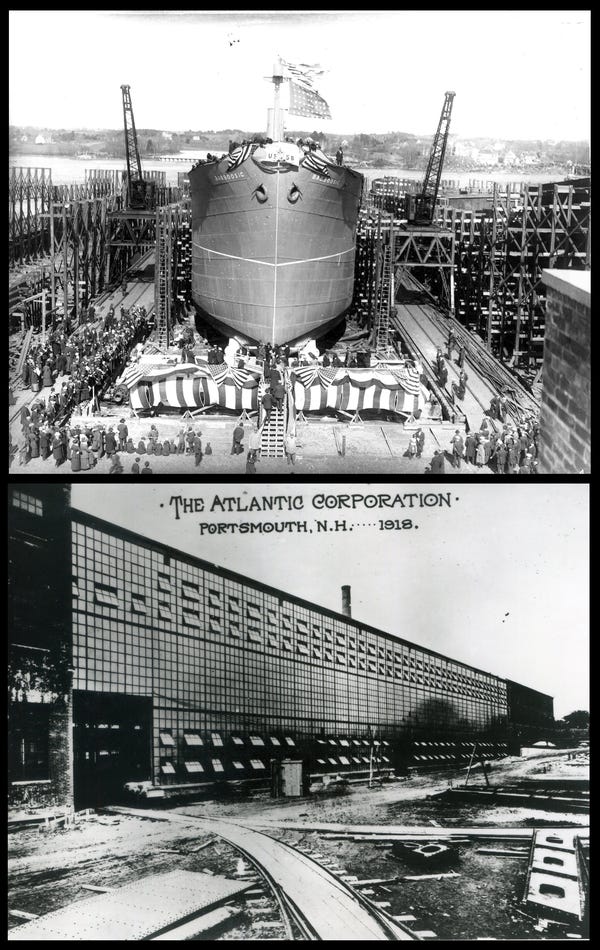
Visitors to the tightly packed Atlantic Heights neighborhood rarely notice that the streets here – Kearsarge, Raleigh, Rander, Crescent, Congress, etc.–are all named for ships built on the Piscataqua. This was, after all, a federally funded project specifically designed to house workers at the nearby Atlantic Corporation.
I think about that a lot because visitors are always asking me how all these cute little brick houses got here. I tell them how the Atlantic Corp. was located on the site of a failed paper mill nearby during World War I (now a gypsum plant). The company built 10 cargo ships before going out of business by 1920 when the war ended. We don’t honor those hulking vessels that were named, in order of launch: Kisnop, Babboosic, Portsmouth, Nipmuk, Norumbega, Brookline (pictured above), Springfield, Tolosa, Pachet and Pagasset. I can say, without hesitation, that after 25 years living in Atlantic Heights, I have never heard a neighbor tick off those names by memory.
I repeat the history of how Atlantic Heights got here often, but to be honest, I never really think about the Atlantic Corporation or the ships it created. Most of them were scrapped in the 1930s. One was lost in a collision in 1941. Three were torpedoed in 1942 during the Second World War. One of those, the S.S. Pagasset, survived its attack, was repaired, and carried on until it was scrapped in 1960.
You can read all about it in Richard Candee’s book, “Atlantic Heights: A World War I Shipbuilder’s Community,” recently reprinted by the Portsmouth Marine Society Press. Many of us in “the Heights” keep a copy on the coffee table, and copies are often passed on from one house owner to the next.
But do we really thank the Atlantic Corp. or think about its progeny? I don’t. The neighborhood is bordered now by a power plant on one side and an an oil terminal on the other. But heck, it could have been a paper mill. Uncle Sam sold off all the houses in Atlantic Heights in 1925.
Earlier this week I caught my neighbor to the right shoveling the snow off the strip of sidewalk in front of my house. “What’s up?” I asked her. Turns out her neighbor to the right had shoveled her sidewalk, so she was passing it forward. That left me to shovel out my neighbor to the left. But he had already cleared his sidewalk plus the bottom of my driveway. I was trapped in-between good deeds. And so it goes in the quaint, historic, tightly-packed neighborhood, created by a long defunct shipyard that we almost never talk about.
Photo courtesy of Portsmouth Athenaeum, all rights reserved.
 The Smiths and the Strawbery Guild