



It has been a rough week of research here. Shocking, embarrassing, and sad. I’m working all this year on a history of the performing arts in Portsmouth, NH, from the city’s settlement to the present day, and I’m loving the trip. But facts can tear up the page like bullets.
Truth is, the most popular form of mass entertainment in America in the late-1800s was blackface minstrelsy. White actors and musicians, their faces blackened with burnt cork, were as familiar to audiences as television sitcoms or rock and roll today. A typical show opened with dancing, joking and singing, followed by slapstick routines, a “plantation skit,” or a parody of a popular stage play.
During the two decades that the Peirce family owned the new Music Hall, at least 30 different minstrel teams took the stage in Portsmouth. Companies like Duprez & Bendids Gigantic Minstrels lured audiences with troupes that promised to be mammoth, mastodon, famous, operatic, gigantean, cool, spectacular, monster, and magatheria. For many New Englanders, their only contact with African culture was the mocking, racist stereotypes they saw at minstrel shows, read in books and magazines, or heard in popular songs.
Even as minstrelsy faded, those stereotypes lingered in vaudeville, in film, on radio, and into the television age. When I was 10, my piano teacher sold me “rag-time” sheet music decorated with grinning black-faced musicians. The last minstrel show in Portsmouth was performed in 1960, four years before the passage of the Civil Rights Act.
It’s confusing stuff, since the genre was created, in part, because white performers genuinely admired black musicians and dancers. Their music was often more joyous, more tuneful, more rhythmic, more feeling, more spiritual, and more honest than the bland parlor songs like Stephen Foster’s “I Dream of Jeannie with the Light Brown Hair.” Historians generally agree that it was after the Civil War, during the Jim Crow era of segregation, that minstrelsy did its greatest damage. It was during this era, peaking in the 1890s, that mocking black-faced minstrel shows became accepted as entertainment for white families.
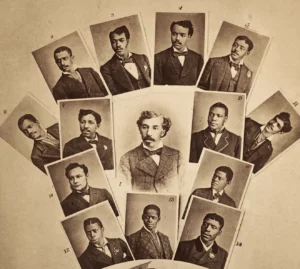
Finding an acceptable image for the newspaper was no easy task. But there were black minstrels who had success in New England theaters like Portsmouth during the late 1800s. Troupes of black performers, usually with white managers, were billed as “true Ethiopian” or “all-colored” or “jubilee” acts. They offered more authentic versions of “Negro songs,” some by African American composers.
The group pictured, the Original Georgia Minstrels, was unique in that their founder and manager, Charles B. Hicks (center) was also African American. Billed as “The Only Simon-Pure Negro Troupe in the World,” their success and international tours led the way for other black minstrels to make a living. Many were welcomed onto the Portsmouth stage, but were still banned from patronizing local hotels and restaurants even in the 20th century.
Copyright 2018 by J. Dennis Robinson, all rights reserved.
 Who Were Our Heroes in 1947?
Leave a Reply