

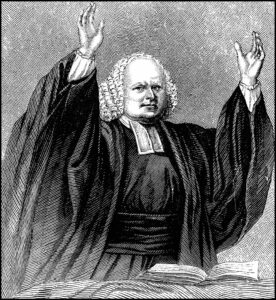

Reverend. George Whitefield is hot again. Born in 1714, the traveling evangelist with crossed eyes and a threadbare robe now has his own Facebook page and almost 150 YouTube videos. Prof. Thomas Kidd of Baylor, a private Christian University, calls George Whitefield “America’s spiritual founding father” and claims: “He was the best known person in colonial America– period!”
So where did he go? Why is he back? And why should we care?
Born in Gloucester, England, in 1714, the tireless “prince of preachers” delivered an estimated 18,000-30,000 dramatic sermons. By a twist of fate, the famous preacher, gave his final sermons in seacoast New Hampshire.
Ordained at Oxford and a studied actor, Whitefield rebelled against the dull “dry-bones” Calvinist ministers of his age. He criticized fellow clerics for gambling and drinking in taverns while doing little to save the souls of common people. With John and Charles Wesley, Whitefield joined the Holy Club at Oxford. Club members worked to define a method for living a holy life through fasting, abstaining from frivolous entertainment, being charitable, and preaching to the poor and to prisoners. This group became known as the Methodists.
An early evangelist, Whitefield, insisted that good deeds and attending church won’t get you into Heaven. Faith is emotional, not intellectual, he said. True Christians, he insisted, must experience a “heart-level relationship with God.” This personal born-again state, or “new birth” as he called it, required a deep emotional conversion. Salvation was accessible to anyone, rich or poor, Whitefield promised, including women, children, Indians, and the enslaved.
“All men are under sin and obnoxious to the wrath of God,” Whitefield warned. Banned from preaching in many churches, George Whitefield took to the open air. He converted souls in fields, in the marketplace, along highways, on hillsides, and in private homes. The “boy parson” delivered sermons from atop ladders, roofs, tombstones, stools, and wagons.
In London, Scotland, Ireland, and Wales, Whitefield drew huge crowds. Even as attendance in traditional Protestant churches flagged, Whitefield, according to contemporary accounts, preached to 20,000 spectators at a time. In 1739 he made his first of seven trips to America (clocking a total of 782 days at sea). Traveling to the “tail of the world,” he established an orphanage in the wilds of Georgia. He continued to raise money for the orphan school for the rest of his life.
The wonder of the age
Today, Whitefield is remembered, along with Jonathan Edwards and the Wesley brothers, as a key figure in the First Great Awakening, a grassroots cultural movement that shook up traditional Protestants and launched Christian revivalism in America. Whitefield was still in his twenties when the movement turned him into a celebrity on two continents. “Never since the Apostle Paul,” one 19th-century historian wrote, “has a man given himself so entirely to Christ.”
In his first year in America, Whitefield traveled 5,000 miles, often where there were no roads, preaching for hours multiple times a day. Thin, handsome, and boyish, George Whitefield was a unique figure. His dark-blue eyes were crossed, the result of a childhood disease and, to some 18th-century minds, an indication of his supernatural power. A cast in his left eye also caused many to believe that he was staring directly at them.
Whitefield sometimes gestured wildly, often pushing himself to exhaustion in what he called “a good pulpit sweat.” His booming voice was frequently described as a cross between beautiful music and the roar of a lion. Whitefield improvised without notes, boldly impersonating characters from the Bible, including Jesus, with such power and realism that he reportedly could hold a large crowd spellbound. He wept openly and frequently. Such theatrics, one historian notes, were all but unknown to Americans in the mid-1700s. In an era when the human face was seen as the mirror of the soul, and men did not flail or cry, Whitefield was a cultural phenomenon.
Crowds reacted, sometimes violently, to Whitefield’s spirited sermons. People twitched, laughed, cried, prayed, and fainted, causing one contemporary observer to wonder if the religious contagion of the Holy Ghost might be caused by electricity. Most of his converts fell between the ages of 16 and 25, with twice as many women as men. The more emotion Whitefield elicited, the more souls he counted as saved. “Weep-out!” he shouted to his audience, and “Come, come to Jesus.” He would go to prison or to death, he told them, simply to save one more soul.
While preaching nearby at Exeter, Hampton, and York, Whitefield’s first Portsmouth sermon was a flat-out failure. He got no reaction from a polite and unconcerned crowd gathered in an open field. The locals were like “dead stones,” Whitefield wrote. He questioned whether he “had been speaking to rational creatures or beasts.” But on his return visit the next day, thankfully, Portsmouth residents began to weep and respond to his words.
That same year, Whitefield boosted his American reputation by backing Sir William Pepperrell of Kittery, Maine in his military campaign against the French fort at Louisbourg in Nova Scotia. Whitefield encouraged New England men to enlist and, when Pepperrell’s campaign succeeded, Whitefield’s popularity grew. New England, the widely-traveled preachers once wrote, “exceeds all other provinces of America.”
What would Jesus do?
Unlike traditional preachers of his day, Whitefield talked openly about himself. His sermons and journals, published in America by his friend Benjamin Franklin, frequently make biblical comparisons. He was born at an inn, he often said, not unlike Jesus in the manger. Little children clustered around wherever Whitefield went, as they did with Christ in the Gospel of Matthew. God had sacrificed Whitefield’s only son too (the preacher’s boy died when he was four months old). When Whitefield spoke to thousands on a hillside, like Christ at the Sermon on the Mount, spectators claimed his voice could be heard a mile away.
Historians credit Whitefield with taking religion out of the church and into the marketplace. His open-air preaching earned enormous sums for his Georgia orphanage. A week of sermons could bring in four times the annual income of a British country pastor. He was often accused of embezzling funds. A 1763 political cartoon shows a devil crouching beneath Whitefield’s pulpit, picking up coins, while another evil sprite siphons lies into his ear. And yet, in the best Methodist tradition, there is no indication that Whitefield kept anything except paltry living expenses. According to his biographer, Harry S. Stout, Whitefield was “without equal in American philanthropy to that time.”
He was also exceedingly chaste. Although many of his supporters were wealthy British socialites, George Whitefield never gave in to temptation. He appears to have been repulsed by any mention of sexuality, and his love life was nothing to write home about. “I want a gracious woman that is dead to everything but Jesus,” he once told a friend. He was married in 1741 to a widow named Elizabeth James, who was 10 years his senior. After their one son died, she had four miscarriages. Their relationship is scarcely mentioned by Whitefield’s many religious biographers.
Whitefield’s epic suffering is well documented in his journals. He lived a harsh life on the road and was often very sick. He preached 40 to 60 hours a week in all weather.
As a young man, he dared to call traditional bishops “false prophets.” They struck back in force. He was labeled a quack and a “false Christ,” who “vomited that spiritual poison” to the common people. As he matured, Whitefield apologized to the bishops he had offended, and realigned himself with the Church of England and with the King. He was never, as some revisionist historians claim, a political revolutionary.
Witness for the persecution
Half of Whitefield’s audience, it has been suggested, came to listen, while the rest came to jeer. His detractors beat drums and heckled as he spoke. At one site, a man climbed onto a tree limb above Whitefield and mimicked his every gesture. Men exposed their backsides to the crowd and urinated in his direction. He was knocked into the mud and sprayed with water from a hand-pumped engine. He was rendered almost deaf by guns fired close to his ears. He was chased and almost killed by a mob in Ireland. Before boarding a ship for one transatlantic visit to America, the preacher was beaten unmercifully by a detractor using a gold-headed cane. Six-weeks later, arriving in York, Maine, Whitefield had not yet fully recovered and would carry the scars for life.
And yet, the more he was attacked and derided, the more justified and resolute he became. He was suffering, Christ-like, in the service of his religion.
“I was honored,” he wrote in his journal after one well-attended sermon, “with having a few stones, dirt, rotten eggs, and pieces of dead cats thrown at me.”
To die while preaching the gospel, Whitefield often noted, would be a blessing indeed. And in 1770, after 30 years on the road, the most famous religious celebrity in America got his wish. The beginning of the end took place in Portsmouth, NH, where the sickly “shepherd of souls” gave four exhausting speeches.
Then on the morning of Saturday, September 29, he left Portsmouth on horseback to preach the next day at Newburyport, just over the border in the province of Massachusetts. En route, he was asked by a friend to speak in Exeter and, although he was deathly ill, George Whitefield could not refuse. He would never stand in the pulpit again.
[To be continued in two weeks: “The Last Days of America’s Forgotten Founder — or was he?”]
Copyright © 2014 by J. Dennis Robinson, all rights reserved.
 A Tale of Two Port Cities