

Screenshot
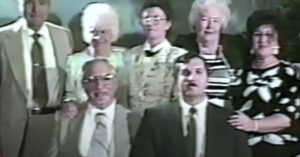
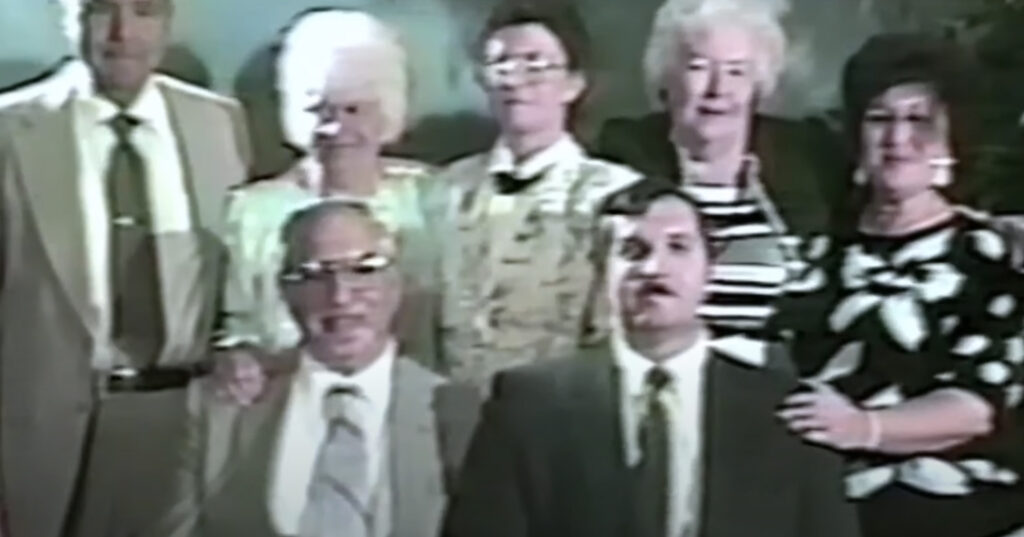
Forty years ago, the late Joseph “Albie” DeStefano asked me to direct a videotape. He wanted to record a reunion of Italian-American families who once lived in the Russell Street area of Portsmouth’s North End. Memories of the wholesale destruction of “Little Italy” were still fresh as former residents and friends gathered at Yoken’s Restaurant on July 12, 1986.
It was to be an evening of dining (fish, roast beef or chicken) and dancing, hugging, kissing, drinking (cash bar only) and catching up. My job, along with videographer Paul Gould, was to condense hours of emotional reconnecting into a 30-minute tape. No pressure.
As we expected, the sound of 162 largely Italian guests packed into one room was “fortissimo.” So we arranged to tape our oral history interviews in a less noisy spot next door. We set up our painted backdrop, camera and video lights behind two pianos in the “Twilight Room” at Yoken’s. We taped as many quick interviews with former North Enders as time allowed.
I haven’t viewed the North End Reunion tape in ages. We shot it back in the pre-digital days using the ancient VHS format. But who owns a VCR these days? Luckily, the Special Collections department at Portsmouth Public Library made a transfer copy onto CD. I borrowed it and spent the rest of the day hunting in the attic for my old DVD player. The production values are horrible, bubt the spirit of the night survives.
Roll camera
Those who spoke on the tape came prepared. Some read from notes or brought mementos. They recited anecdotes, polished over years, of playing games in the street, swimming in the mill pond, attending Farragut School, hanging out at the neighborhood barber shop, social clubs, and restaurants.
They were all “materially poor, but culturally rich” Azio Ferrini said.
Delfo Cominati, born in the North End in 1911, told the camera, “We had a great life.” Mary Succi Ciotti shared stories of vendors delivering ice and live chickens to her tenement home, and learning to dance the jitterbug in the hot streets in summer. Despite the easy-going nostalgia, an undercurrent of sadness and anger ran just beneath the surface for a neighborhood vaporized by federal and local decree.
“We were all happy people,” Mundo Zoffoli said. Then pausing, he added, “When urban renewal came through and took our houses, they put us all in debt, because they didn’t pay us enough.”
I was struck, again and again that night, by a deep sense of pride in a shared heritage, a shared journey, and a shared language. Speaker after speaker played homage to a respected patriarch who had transplanted the family name to a new world.
Albie DeStefano spoke of his father Ferdinand who left his little village between Naples and Rome in 1907 and, at age 23, came through Ellis Island and settled in an unknown place called Portsmouth. A year later, Ferdinand had saved enough money to send for his fiancé, Victoria, who made the third-class ocean voyage in 30 days. They were married by the captain before she was allowed to leave the ship, and they settled into a home at 28 Russell St. The DeStefanos had five children and Ferdinand became supervisor of the Daniel Street Power Station, now Harbour Place.
We heard from Bill Marconi, Tesca Zamarchie, Mary Ciotti, Joe Addorio, Elvira Maldini, Anna Richie and two dozen others.
Marty Quirk of the Franzoso family was born on Deer Street in 1934. He remembered a tough neighborhood of crap games and street battles, but it was tough in an innocent way, he said, not like the violent toughness of today. His “gang” used to climb over Mr. Cavalieri’s fence and steal tomatoes. The next day they raided Mr. DeStefano’s peach tree. On alternate nights the boys sneaked into Mr. Camuso’s yard and took grapes from his arbor.
“I guess my only regret,” Marty Quirk concludes on the video, “is that my children don’t have any roots like we did at Russell Street – and it’s too bad because you had a sense of belonging, and you knew that whatever house you went into, you were going to be accepted for what you were.”
The last rampage
With the Puddle Dock “slum” transformed into the Strawbery Banke Museum campus of historic buildings in the mid-1960s, city officials began to see the “blighted” North End as the ideal spot to create a commercial center. Preservationists, meanwhile, argued many North End buildings were as architecturally significant as those that were saved in the South End.
Distant newspapers like the Manchester Union Leader and Worcester Sunday Telegram offered detailed articles on the historic significance of the North End. But even though citizens opposed to the urban renewal project outnumbered proponents two to one, the Portsmouth Herald pushed for the blanket demolition and total modernization of the North End.
Avoiding the human interest angle, the newspaper promoted plans to build a glorious new industrial center to replace the shabby neighborhood. Front-page articles featured an artist’s conception of a gleaming glass $2 million complex proposed for the North End. It included a 100-room motor hotel, swimming pool, underground parking, offices and a two-story shopping mall. City councilors, hoping to locate new city offices in the complex, passed the urban renewal plan with only one dissenting vote.
Born out of urban renewal, Strawbery Banke was in no position to protest, especially against the combined forces of the city, the media, the business community, and the Portsmouth Urban Renewal Authority. Portsmouth Housing Authority chief executive Walter J. Murphy vehemently insisted all houses in the identified area were “substandard” and “a program of total renewal” was the only sensible avenue.
In 1969, a group called Portsmouth Preservation, Inc. quickly raised $200,000 and aggressively lobbied to save up to 100 structures in the North End. As the urban renewal project dragged on, the number of houses diminished. In the end, Portsmouth Preservation Inc. was able to purchase and “mothball” just over a dozen buildings on “The Hill,” now converted to office space.
What remains
I never saw the North End filled with people. By the time I moved to town “Little Italy” had been bulldozed into a weedy rubble-filled vacant lot. Close to 400 buildings, large and small, were torn down. All 221 families and 78 individuals in the largely Italian neighborhood were relocated to new apartment houses, or they moved away. The planned space age complex of commercial shops and city offices that the Portsmouth Herald trumpeted on its front page never materialized.
Instead, Portsmouth got acres of asphalt that stood empty for more than a decade until the arrival of the Portsmouth Sheraton Hotel. Across the street the Parade Mall, a stark, new 25,000-square-foot industrial building that included an A&P supermarket, quickly went bankrupt.
I know the North End was much more than Little Italy. Readers regularly remind me there were also French and Irish, Greek and Asian, Italian and Canadian, Jewish and African-American families in the North End “melting pot.” They lived and ran businesses on Bridge, Congress, Deer, Hanover, High, Hill, Jackson, Market, Russell, School, Vaughan and Wall streets, Raitts Court and Raynes Maplewood avenues.
When a decade ago I proposed writing an investigative book on exactly why the city turned a low-income neighborhood into a vacant lot, I was warned to back off. “Better not,” I was told. “It’s still too fresh.” Portsmouth was not unique. The same thing happened all across the country, I was reminded. There was federal money for the taking – and we took it.
Visitors to the “new” North End today may discover a memorial bench dedicated to the families of Little Italy. We have an historic plaque posted among blocks of modern high rise buildings. We have 13 of the original North End houses saved on “The Hill.”
The Portsmouth Athenaeum has archived hundreds of images drawn from family scrapbooks in its online North End Neighborhood Collection. The Portsmouth Public Library has digitized the federal records depicting 175 occupied buildings photographed in 1967 before the North End fell. That “North End House History” collection can be seen online
.And for what it’s worth, we have my little tape. At the opening of the Russell Street Reunion video, former library director Sherm Pridham appears on camera. Although a Puddle Docker from the South End, Sherm made frequent childhood visits to see his godmother on the other side of town.
“The North End was a beautiful neighborhood with some really wonderful people there,” he said. “I hope that people who view this tape can really learn something from it, something about being a neighbor, something about being close.“
I hope so too. And to Albie DeStefano, from a former small-time video producer, thanks for giving me a glimpse into your world.
Copyright 2018 by J. Dennis Robinson, all rights reserved.
See the excellent LOST NORTH END production released 2023
 Ornate Olympia Theater Lost to Progress