

Written on request for SeacoastHistory.com By the American Independence Museum
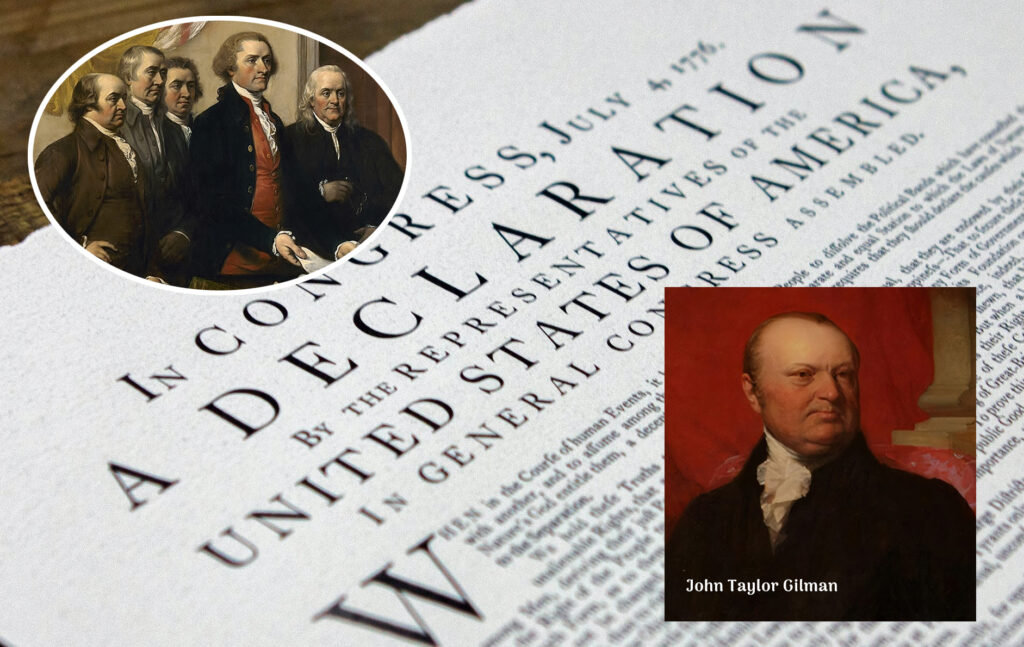
On the night of July 4 (into the wee hours of July 5th) a1776 Philadelphia printer, John Dunlap, printed approximately 200 copies of the Declaration of Independence. The broadside copies were couriered by horseback to each of the thirteen colonies, to General George Washington and his troops, to other important colonists, and by ship to England. A broadside is a poster printed on paper. It took several weeks for the Dunlap Broadside of the Declaration to reach its destination in New Hampshire.
The broadside arrived in Exeter, the Revolutionary War capital of the province, on July 16. The state treasurer’s 22-year-old son, John Taylor Gilman, was given the honor of reading the document to the residents of Exeter from the town house steps. It is not clear what John Taylor Gilman actually did with the Dunlap after he read it, but it is assumed that the document stayed with the Gilman family after it was reprinted in the local newspaper.
The Gilman’s of Exeter
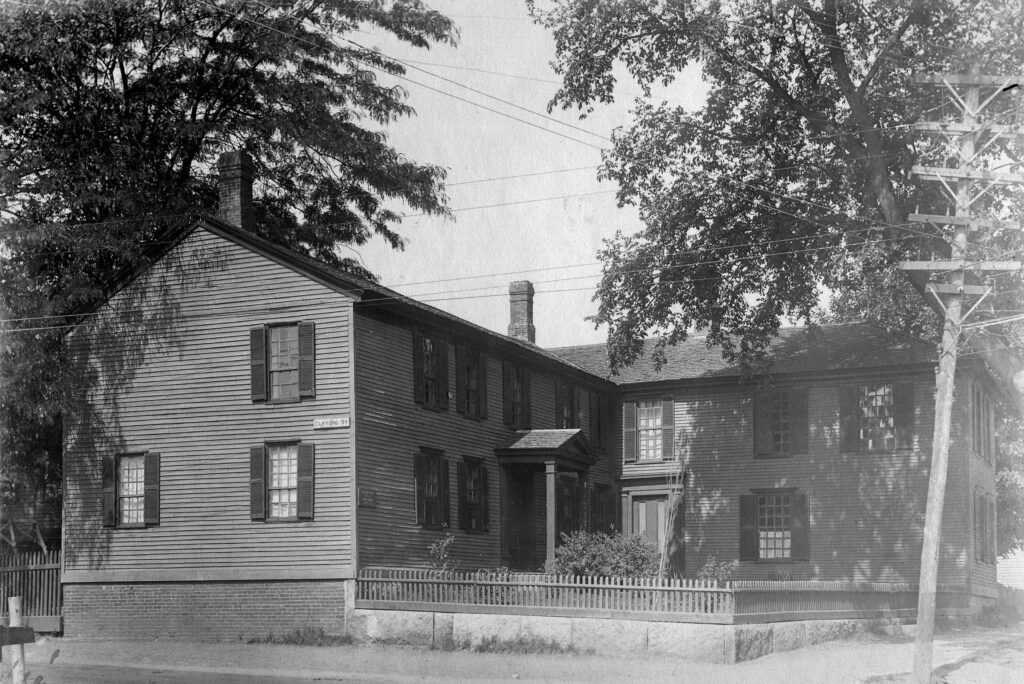
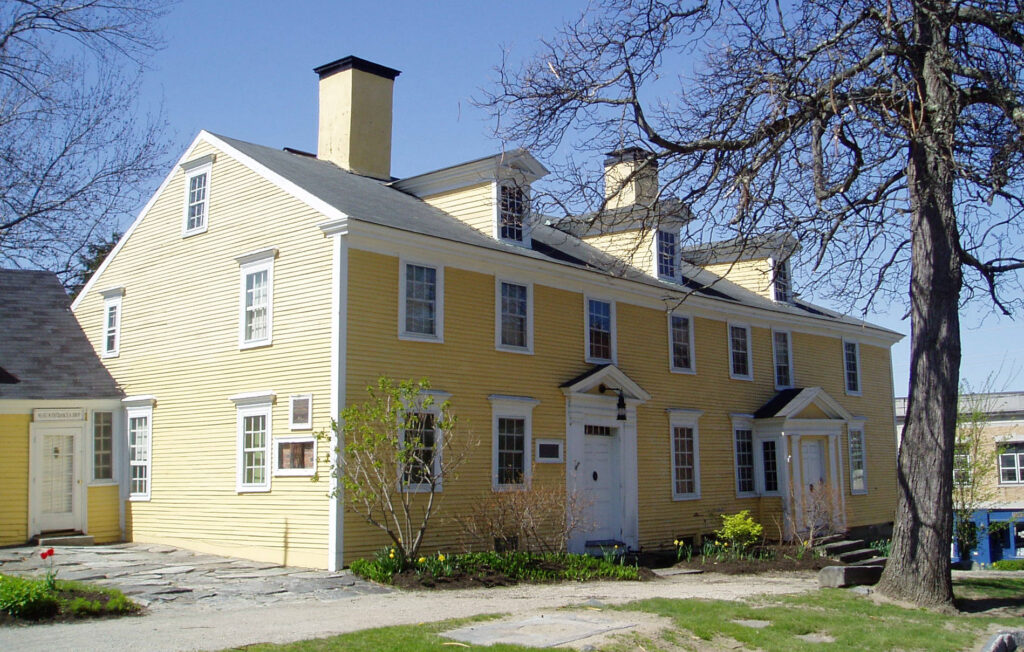
John Taylor Gilman and his five surviving siblings grew up in Exeter in the home now called the Ladd-Gilman House. The Gilmans were destined to be active in politics. John Taylor’s father, Colonel Nicholas Gilman, served as the treasurer for New Hampshire from 1775 until his death in 1783. During that time, the family home became the state treasury. His three eldest sons assisted Colonel Gilman in the financial affairs of the state. John Taylor became the state pension agent in 1776. He served as a state representative to the Continental Congress for one term, became state treasurer after his father’s death, and served as governor of the state for fourteen one-year terms.
Nicholas, Jr. served in the New Hampshire militia and the Continental Army during the war, becoming an aide-de-camp to General George Washington. Nicholas later became one of two state delegates to the Constitutional Convention and went on to become a US senator in the newly formed nation. Nathaniel assisted his mother during the war and would later become active in local politics and as a member of both the US House of Representatives and Senate.
The Ladd-Gilman House stayed in the Gilman family until 1902 when the Society of the Cincinnati in New Hampshire purchased the house. The Society used the house as their club house for annual meetings and also created a small military museum in one room of the house. The Society of the Cincinnati is a fraternal military organization founded by officers of the Continental Army in 1783. Nicholas Gilman was an original member of the New Hampshire chapter.
Treasure in the Attic
In August of 1985 Dick Brewster, a local electrician, and his assistant Rod Compagna were hired by the Society to install a security system in the house. They were working in the attic laying wires while trying to protect the ceilings below when they made their discovery.
Dick Brewster explained that, “In order to do any drilling at all, we had to expose the upper side of the ceiling, and in order to do this we had to rip up flooring and take out everything between the roof rafters. And a very common practice back then was anything that you could jam in between the rafters was insulation. So we were finding everything from paper to cloth to old pieces of uniforms and whatever, in between the rafters.”
Dick was on the second floor of the house when he was called to the attic by his assistant. He continues: “So I went upstairs and said — ‘What’s the problem?’ and he’s standing with a whole arm full of paper and I said — ‘What’s the matter?’ and he said — ‘There’s something in this pile of paper that I don’t understand.’ He said — ‘it’s not the same kind of paper as everything else.”
As they went through the newspapers they found a folded document which they began to open slowly. When theysaw “DECLA” printed on the page,Dick told Rod not to old it any further so that it wouldn’t be damaged. He called a member of the Society of the Cincinnati and immediately stopped work on the project. Dick and Rod refused to continue the work until someone looked at what they had discovered to determine whether it was the Declaration of Independence.
A Museum is Born
“As I recall, it was some two weeks or so before I finally got a call from anybody. And I was told that they had come down here and checked the thing out. It was in truth the Declaration of Independence,” Dick said.
What Dick and Rod found was the New Hampshire Dunlap Broadside of the Declaration. The discovery of this valuable document touched off a dispute between the New Hampshire Society of the Cincinnati and the state. The Society saw the value of the unique document and wanted to sell the Dunlap Broadside at auction to raise money to make repairs and to preserve the Ladd-Gilman House. State officials said the broadside belonged to New Hampshire and should be available for the public to view and study.
The four year debate over ownership ended in 1990 with an agreement reached by the state and the Society. The Society was to establish a museum to display and educate the public about the founding of the nation, and so in 1991 the American Independence Museum was born.
The museum’s mission is to be “a premier center for learning about the role that one state, one town and one family played in the founding of the new republic and the relevance of the ideals of the American Revolution in every state, every town and every family today.” A reproduction of the New Hampshire Dunlap Broadside is on exhibit and the original is displayed each year at the museum’s American Independence Festival in July.
ABOUT THE AUTHOR: Wendy Bergeron is a former curator at the American Independence Museum and also teaches United States History at Winnacunnet High School in Hampton, New Hampshire.
 I Saw the FB-111A Crash in Portsmouth