


in Portsmouth, NH. (Rich Beanschne photo for the Portsmouth Herald)
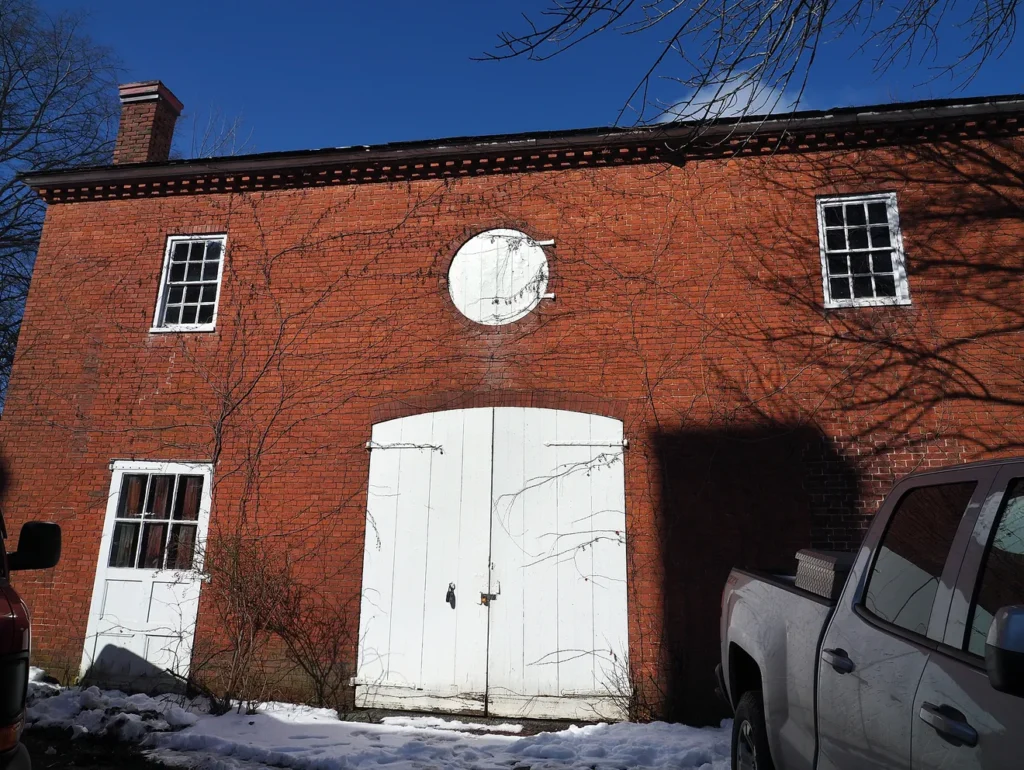
The padlock on the towering brick carriage house fought back, but eventually the key turned and the shank popped. Charlie Seefried hauled open the huge white doors to reveal a cold cavernous interior, empty save for an ancient stove and a few bits of furniture. Built in 1815, the former stable and barn, like the adjacent Larkin-Rice mansion, is huge. My entire home at Atlantic Heights would fit inside the carriage house with room to spare.
The new owner of this iconic Portsmouth property at 180 Middle Street., pointed to two intact horse stalls, now stacked with discarded doors and windows. I followed Charlie up a steep wooden stairway to the equally cavernous loft, still uncertain why I was there.
“From reading your pieces in the Herald,” Charlie had written to me, “I welcome the opportunity to show you a wall which I believe you will find interesting.”
When walls talk
An interesting wall? That was all I knew.
But after decades of staring up at the stunning Larkin-Rice House just off Haymarket Square, I wasn’t going to miss a chance to peek inside. It has been privately owned for the last 200 years.
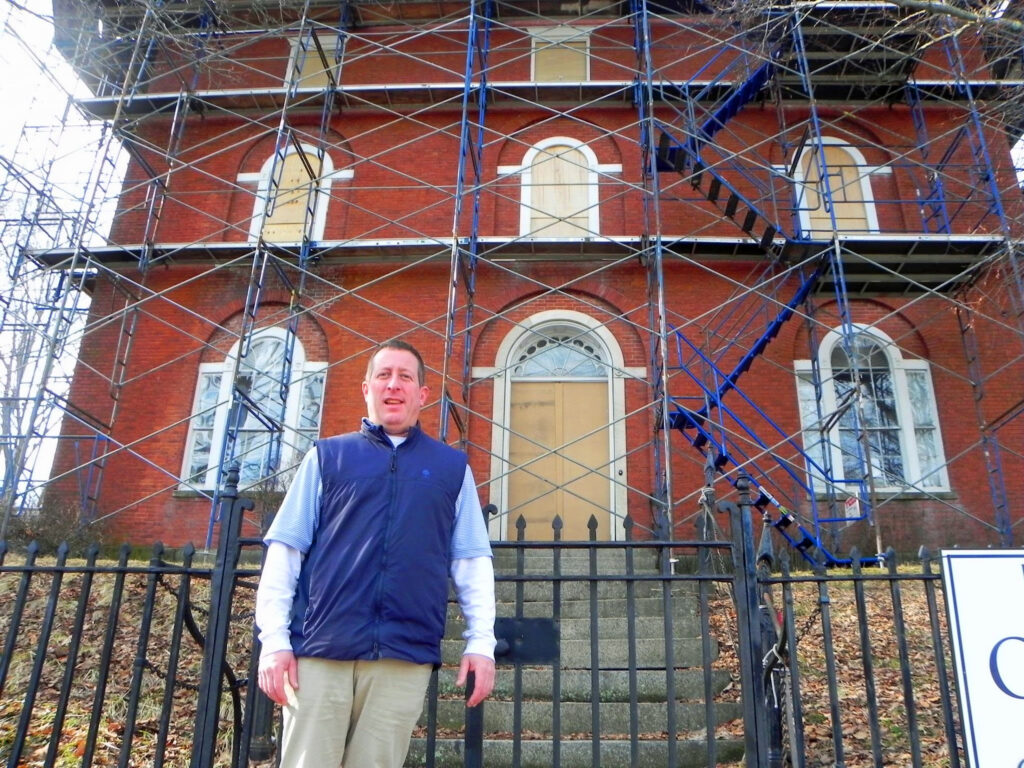
We’re talking about that handsome three-story brick building with the massive Palladian windows and the matching arched doorway. The carriage house at the top of the muddy unpaved driveway has a distinctive, perfectly round hayloft door, like a wooden porthole, on the second floor. Although it will look exactly the same from the street, by the end of this year, the carriage house will contain a modern condominium, with four more units in the house.
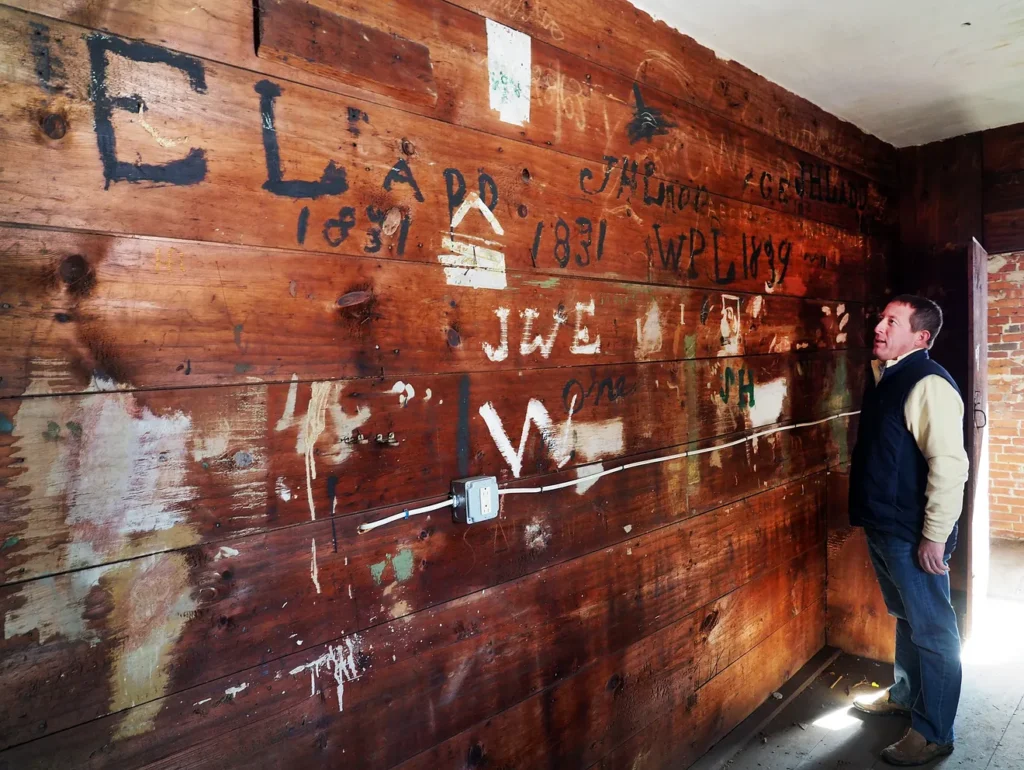
Above the horse stables on the second floor is a small room. Charlie Seefried paused, as if for a drum roll or a blast of trumpets, then threw open the crude door to reveal a rough-hewn wooden room, barely lit from a single window. And there it was. One entire wall, maybe 18 feet long by 8 feet high, was covered with large hand-lettered initials, most dated in the 1830s. Very cool.
We know Samuel Larkin, or more accurately his wife, Ann Jaffrey Wentworth, had 22 children. Yes, 22, although not all survived to maturity. The initials and names marked on the loft wall, however, belong predominantly to members of the Ladd family, with a few Caswells, Cutters and others thrown in. I didn’t see a single Larkin. The graffiti, though cryptic, matches the history of the house.
(Rich Beauchesne for the Portsmouth herald)
The house that Larkin built
Portsmouth was once dominated by a few intermarried and wealthy families. The maritime city hit its economic peak around 1800. Then came the great downtown fires, a crushing federal embargo on shipping, and the War of 1812. Samuel Larkin was among the few wheeler-dealers who made a fortune in hard times.
Born in Massachusetts in 1773, Samuel Larkin opened a Portsmouth bookshop, but was burned out by the fire of 1802. A decade later he gained fame as an auctioneer. Larkin made a fortune selling off the English ships and their cargoes seized by Portsmouth privateers during the war. An estimated 419 British ships were taken by 14 Portsmouth privateers from 1812 to 1815. Converted to modern dollars, Larkin earned his commission from sales totaling as much as $380 million today.
A 19th-century newspaper reporter recalled attending one of these thrilling auctions as a boy. Goods from a captured prize were laid out along Portsmouth Pier as Mr. Larkin’s “clear and sonorous voice” rang out. Larkin, a friend of Gov. John Langdon, used his newfound money to build his grand house on Middle Street, next door to a smaller house he already owned. This hot new neighborhood was populated by rich and famous families named Peirce, Boardman, Hart, Long and Rundlett. Each house was a conspicuous display of money and social status, but unlike today’s McMansions, these were structures of architectural excellence and integrity, built to last.
The rumor that Charles Bulfinch, who designed a portion of the Capitol in Washington, D.C., also designed the Larkin House and the Academy Building (now Portsmouth Historical Society) nearby is untrue. In fact, Larkin hired designer and master builder Jonathan Folsom, formerly of Exeter, who is also credited with creating the stone South Church on State Street, the Old Custom House on Daniel Street, and other prominent city buildings. Architect Steve McHenry, who has adapted the Larkin-Rice House and carriage house into five condominiums, calls it “a very special building, built by a very special, creative genius.”
But the second war with Britain ended and Samuel Larkin’s fortune dwindled. An entry in his diary dated Aug. 31, 1829, reads – “This day I moved (back) into the house from which I moved in 1817, having lived in the brick house almost 12 years.”
Meet the Ladds
Larkin reluctantly sold his beautifully appointed home to an elderly man named Joseph Hurd, who, like Larkin, hailed from Charleston, Massachusetts. Hurd’s oldest daughter, Hannah, was married to Henry Ladd of Portsmouth. Henry’ Ladd’s father, Capt. Eliphalet Ladd, had been a noted local privateer during the American Revolution.
As a young man, after attending Phillips Exeter Academy, Henry Ladd traveled widely, learning the merchant trade. A family genealogy describes him as “a trifle over six feet in height” with wavy hair and large blue eyes. In Europe, his calm and dignified demeanor earned him the nickname “Prince Harry.”
Returning to Portsmouth,NH, Henry Ladd set up a shipping business with his brother. When his father died in 1806, Henry inherited one of the largest estates seen in New Hampshire to that date. He married Hannah Hurd two years later. They had eight children. And I can say with some certainty that the Ladd kids liked to hang out in the little room above the stable.
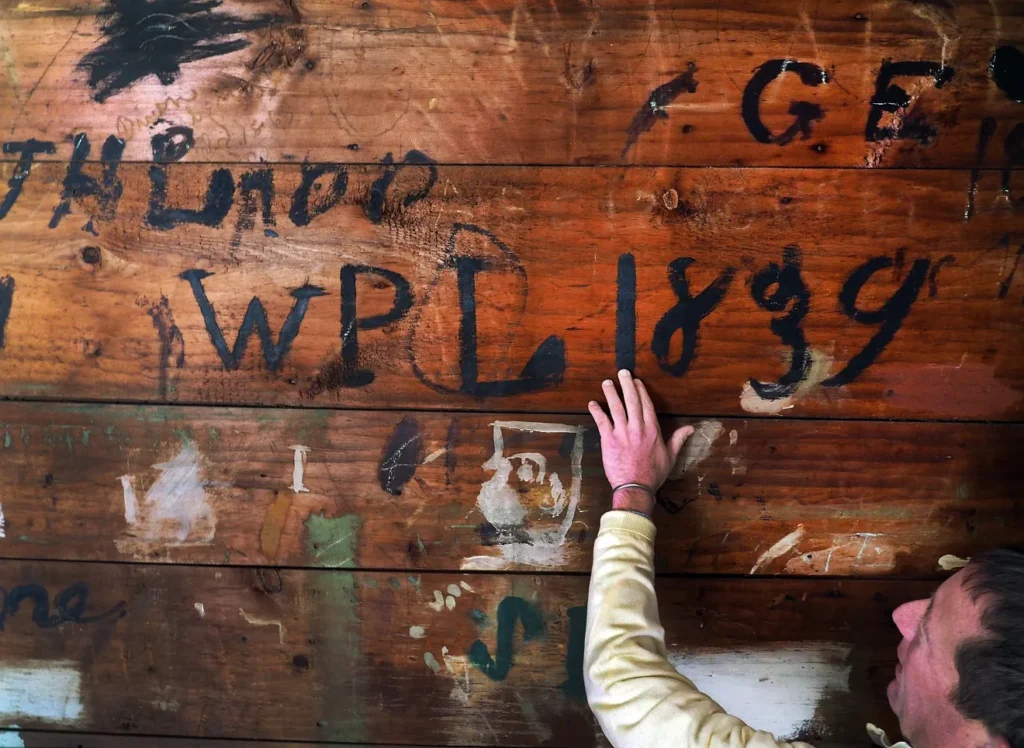
A few of the signatures are obvious. “E. Ladd, 1831” has to be 9-year-old Eliphalet Ladd (born 1822), grandson of the famous privateer, who became a merchant in New York City. “JH Ladd” is Joseph Hurd Ladd (born 1820) who married and moved to Brooklyn. The scrawled “Sophia” may be a cousin. Better scholars than I will track down “JWE” and “WP Ladd” and “Sophia Poole” and others painted on the wall.
I’m intrigued by the name “Cutter” carved near the ceiling. A beautiful Cutter family mansion at the corner of Middle and Congress streets was torn down in the mid-1950s amid much protest, and replaced by a significantly less attractive building. Could the boy (I’m guessing it’s a boy) who signed the wall be Ralph Cross Cutter (born 1810) who attended Phillips Exeter and then started a business in Haiti. Cutter then married Henry Ladd’s daughter Hannah Ladd (born 1811 and named for her mother), and went into the coal business in Portsmouth.
For decades the brick mansion was known around town as the Henry Ladd House. It has been pictured in guides to historic Portsmouth houses since the 1870s. It is on the National Register of Historic Properties.
Henry died in 1842 “without an enemy in the world,” leaving an ample fortune to seven surviving children. His widow lived in the house another 30 years. It was sold to Dr. Moritz Emil Richter around the turn of the 20th century, then renovated and elaborately decorated. His daughter Ellnora Ingebretsen Richter married Arthur Hopkins Rice Jr. in 1911 and remained in the family. Thus the name, Larkin-Rice.
Preserve, protect and progress
Charlie Seefried was right. I love that wall and all the stories still hidden within. My first clubhouse was an abandoned truck body just behind an old stone wall. I’ve never been without a hideaway or man cave since.
In his popular 1869 novel about Portsmouth, “A Story of a Bad Boy,” Thomas Bailey Aldrich recalls joining the secret Centipedes Club. The initiation was held in the barn of a fictional character named Fred Langdon. The children in Aldrich’s book ran an amateur theater in the hayloft above the carriage house of a young friend. As a boy, Aldrich was wondering Portsmouth, getting into heaps of trouble, only a few years after the Ladds signed the walls of their carriage house. Could he too have left his initials here?
The wall will survive. Detailed photographs will be donated to the Portsmouth Athenaeum. This spring, when renovations begin, the loft wall will be carefully moved to the first floor of the new condominium. Charlie Seefried says he is passionate about preserving as many original details of the property as possible. When I was there, workers were repairing the chimneys despite a brisk winter wind.
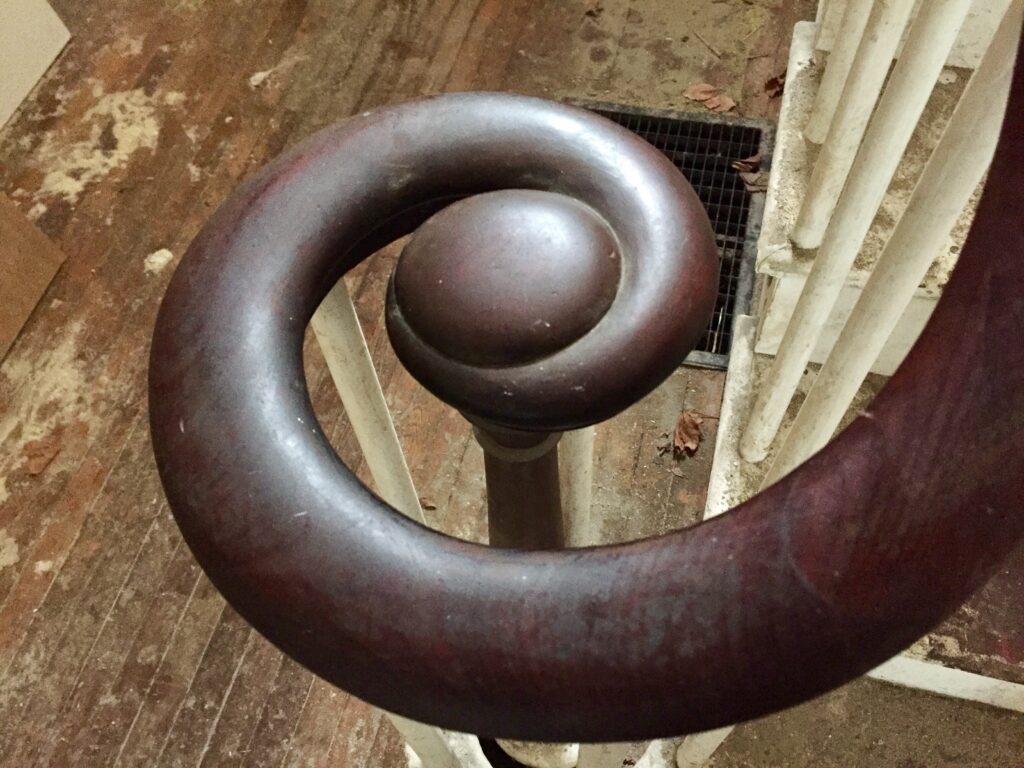
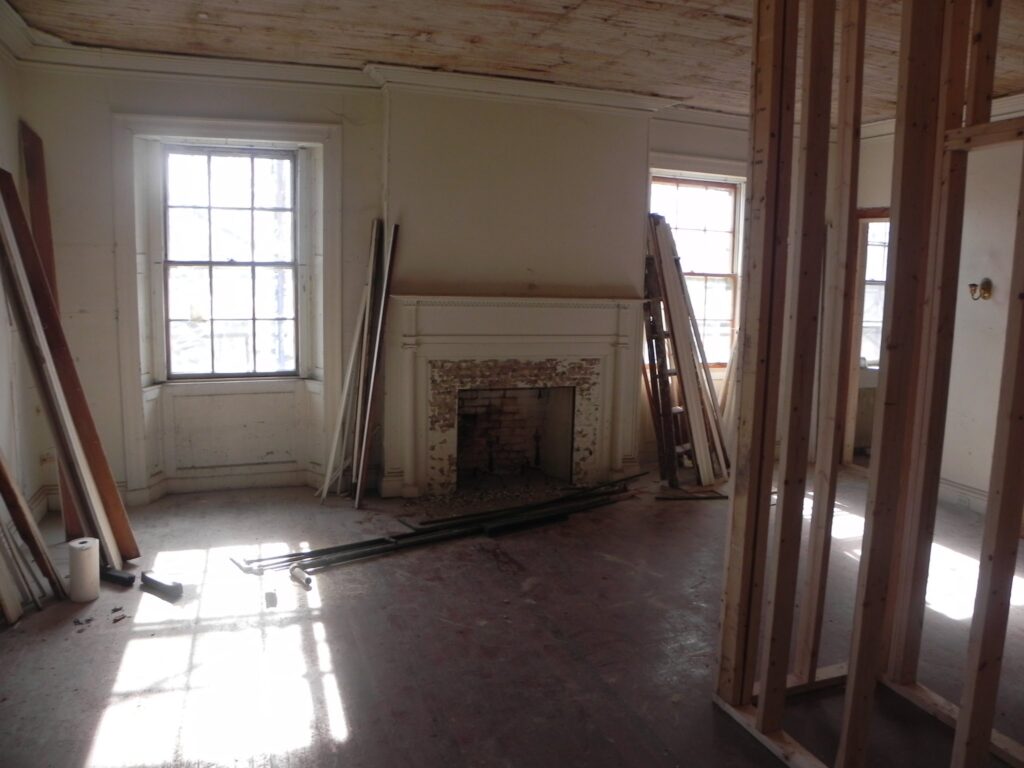
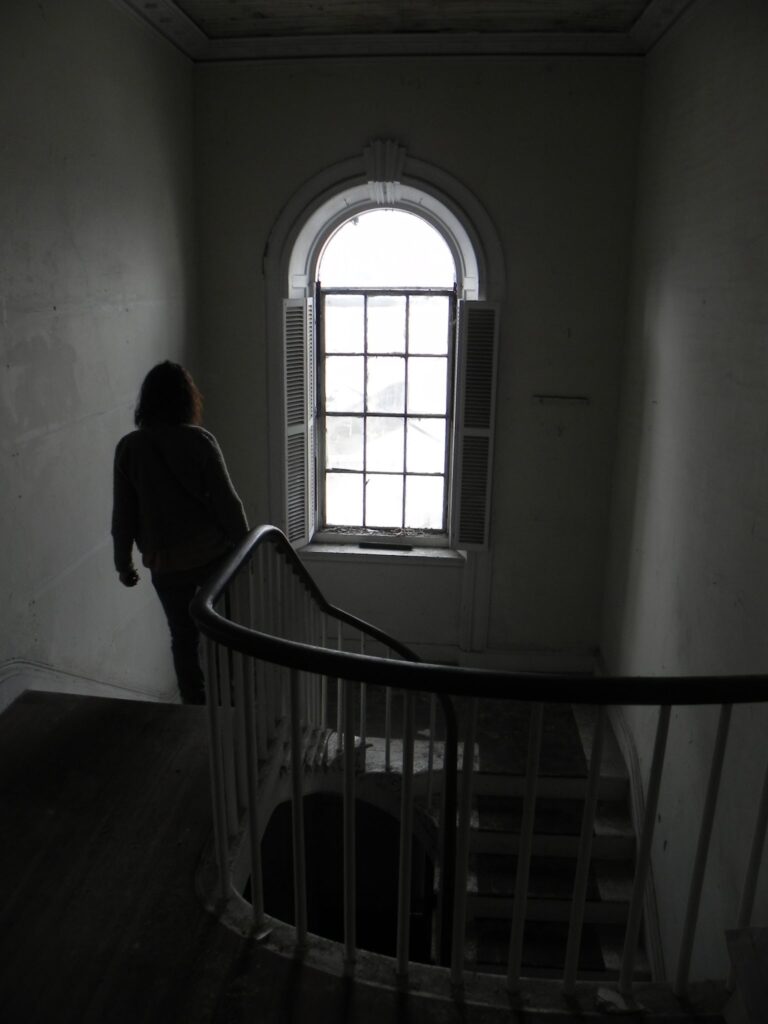
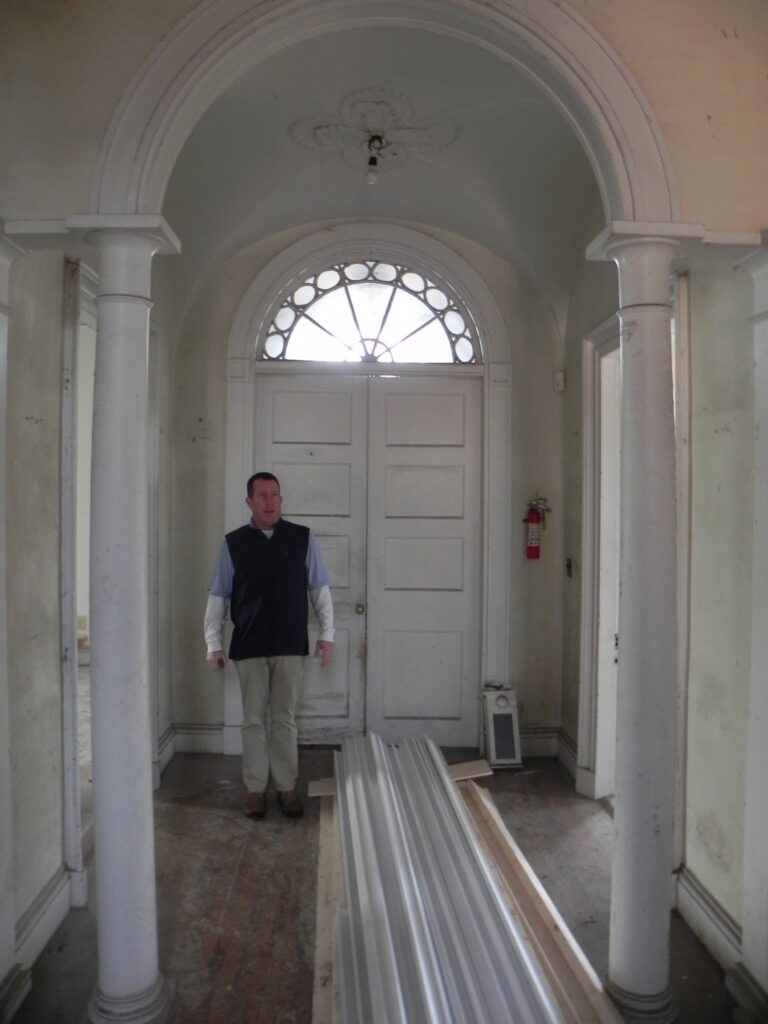
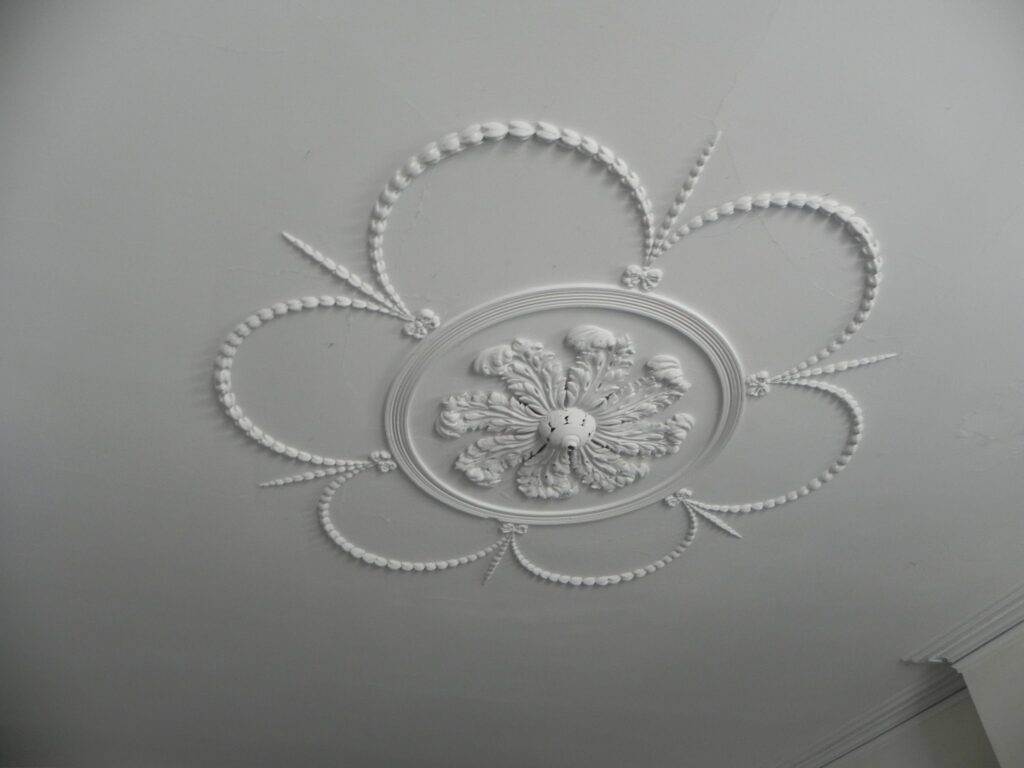
Inside, the Larkin-Rice House is a treasure trove of architectural details created by Jonathan Folsom. The elaborate entrance way with its stark white columns will become a common area. There are grand fireplaces, decorative moldings, built-in nooks, and extremely rare louvered shutters that slide in and out of the wall. According to a local expert, the right front parlor contains the last surviving Federal period molded plaster ceiling in Portsmouth. A massive steel safe is built into one wall while, on the roof, the reconstructed widow’s walk will offer a unique view of the city center.
During a recent walk-through with the owner and me, Portsmouth Athenaeum “keeper” Tom Hardiman pointed out intricate designs built into the right front parlor. Then he showed Charlie the early design books, published in the mid-1700s and early 1800s, that inspired Jonathan Folsom’s work.
Steve McHenry of McHenry Architecture told me how rare it is to work with an historic property that is in such “pristine condition” after two centuries. “It’s pretty amazing,” he said, “that it was in the shape it was, and hadn’t been greatly altered.”
After the tour, I asked Charlie Seefried why he chose to tackle this complex and costly project, and why he asked me to see the carriage house wall. His motivation, he said, his challenge, is “to renovate a property that had lost some of its luster.”
“With all the new construction taking place downtown,” he added, “I saw an opportunity to renovate a grand old property that has long ties to the city. I stress that this is a renovation, not a tear-down. The goal is to preserve the details within the house that make it unique.”
Among those unique details is the wall of an old barn where, for decades, children long gone to dust left their mark. “We were here,” they said. “Don’t forget us.”
Copyright J. Dennis Robinson, all rights reserved.


 Our Ancestors’ Opiate Addiction