


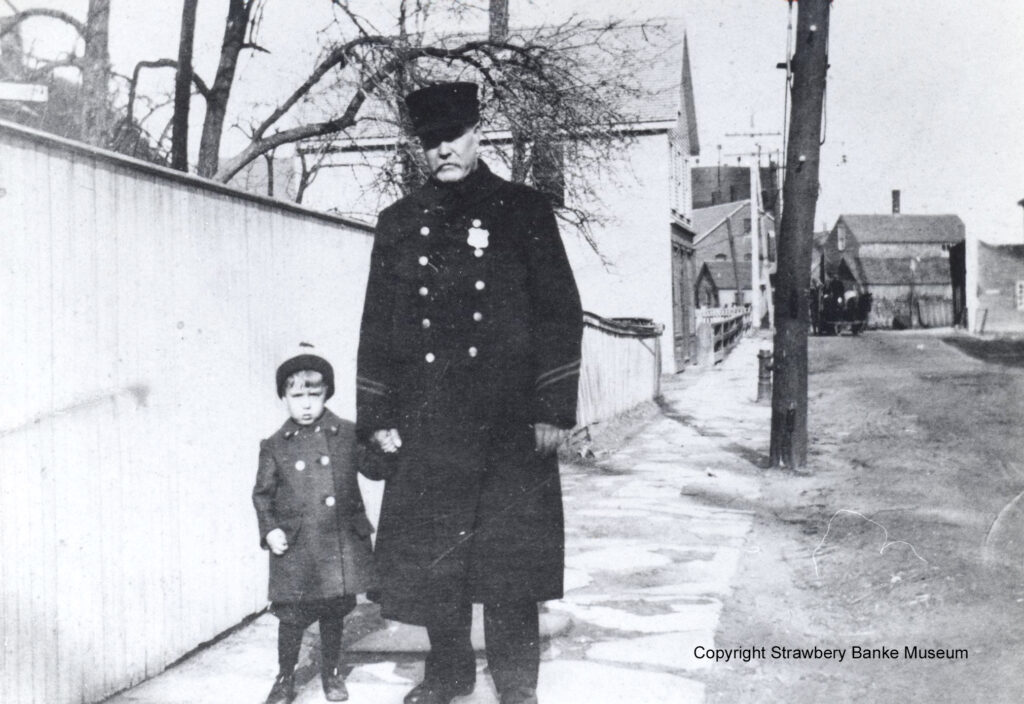
I’ve been pretty tough on Thomas Entwistle, Portsmouth’s longest serving deputy marshal and arguably the most famous cop in the city’s history.
I mentioned him by name no less than 42 times in my book about the 1873 Smuttynose Island ax murders. He comes off as both corrupt and cantankerous when in 1912, after a series of unsolved murders rocked the city’s South End, Marshal Entwistle refused to shut down the “houses of ill fame” that lined the tumble down waterfront area. He was effectively driven out of office that year and the brothels were closed by town decree.
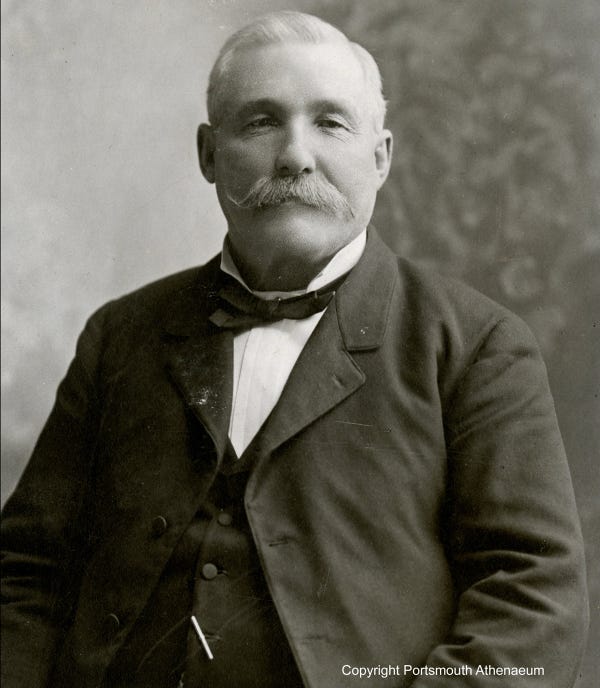
So imagine my surprise when, flipping through a photo album of about 80 men who belonged to the Portsmouth Odd Fellows Lodge around 1895, there he was. I had seen Marshal Entwistle before, but only in grainy Xeroxed magazine and newspaper articles. It’s a charming portrait of a handsome, impeccably groomed and serene-looking gentleman in his fifties. He has white hair, small narrow eyes, and a classic “copper” mustache, waxed into a curl on one side. You can almost smell the aftershave. He could be anyone’s kindly grampa.
Civil War hero
There was no official Portsmouth Police Department until the mid 1800s. Our first city marshal, Andrew Beck, was paid $200 per year. Born in Hyde, a town in the Greater Manchester area of England in 1840, Thomas Entwistle emigrated to Portsmouth as a boy. By 1860 he was working at the Kearsarge Mills, a textile factory (now gone) on the city’s northwest area that employed 300 people and used 2,500 bales of cotton each year.
Entwistle joined the Union Army in 1861 and served in roughly 20 battles throughout the Civil War. He was shot in the ribs in 1863 and in the leg the following year. Captured by the Confederate enemy, he served nine months under horrific conditions at the infamous prison camp at Andersonville, Georgia. Entwistle escaped and, after 21 grueling days, found his way to Union lines. Back in Portsmouth, the decorated veteran worked as a blacksmith at Portsmouth Naval Shipyard before signing on as a beat cop in the fledgling police department.
Guarding a killer
By March 6, 1873, Entwistle was assistant to Marshal Frank Johnson when news of the two murders on Smuttynose Island reached Portsmouth. Entwistle was among the coroner’s team that examined the mangled bodies of two women at the Isles of Shoals. Alerted by Entwistle, Boston police captured killer Louis Wagner and shipped him back to Portsmouth the following morning.
Hoping to evade a Portsmouth lynch mob at the station, Entwistle (just back from surveying the grisly scene at Smuttynose) and Marshal Johnson stopped the train 15 minutes before it reached the depot at the outskirts of town. Flanking Wagner on each side the two officers smuggled the prisoner through the back streets to the police station.
Two days later, to get Louis Wagner to Maine for trial, the officers again had to run the gauntlet through thousands of angry citizens gathered at the train station. Wagner, wearing Entwistle’s police cap, was flanked by three Maine deputies and Portsmouth mayor Thomas Marvin, all armed with pistols and “billies” to protect the prisoner.
By the time they reached the church at the center of Market Square, about 200 fishermen from up and down the seacoast, also armed with pistols, clubs and brickbats, began shouting and fiercely jostling the small posse of officers. “Tear him up,” someone cried. “Pull him to pieces.” Others called for a rope to hang Louis Wagner on the spot.
A flying object hit Marshal Johnson, but only nicked his nose. Entwistle was hit on the shoulder, the leg, and then on the side of the head, the blow stunning him momentarily. At Hanover Street, now the city’s new hotel district, Entwistle cocked his revolver and threatened to shoot anyone who tried to lay hands on the prisoner. The crowd scattered briefly. The officers took shelter in the freight office until the train pulled into the station and then, forming a human shield, they hurried their prisoner onto the Pullman smoking car. Moments later, a brick crashed through the train window in a spray of broken glass, but no one was injured.
At his murder trial, Wagner accused Entwistle, whom he derided as “that little man” of trying to trick him into confessing. When Wagner’s attorney argued that police had unfairly focused all their efforts on convicting his client, Entwistle was unapologetic. “I never asked him [Wagner] to tell me whether he committed the murder or not,” Entwistle said. “We were satisfied he did.”
Early police force
Historian David “Lou” Ferland, former Portsmouth chief of police, says Wagner was treated courteously and with no roughness or abuse. Ferland, an expert on the history of local crime, notes Portsmouth’s early officers were entirely untrained and poorly paid. Patrolmen often worked solo. They usually carried only a foot-long wooden “billy club,” as much a symbol of authority as a weapon.
“I think they were terrific people,” Ferland says of the city’s early force. “They were popular and they were fair. You could not walk a beat by yourself in a small tough town like this back then if you were an ass. You had to have a good sense of justice and be respected by the community. If you were brutal, you would be railroaded out of town.”
Ferland says murder was uncommon in the city in the Victorian era. When it occurred, the police were wholly unschooled in crime scene analysis. Besides the usual drunkenness, brawling and robbery found in a hard knuckle seaport, Portsmouth police officers routinely dealt with abusive husbands, vandals and runaways. A typical day might include complaints of lewd behavior, profane language, bathing in public, cruelty to animals, violating lobster laws, giving away liquor and stealing railroad ties.
Good cop or bad cop?
Thomas Entwistle first served as Portsmouth city marshal from 1877 to 1884. He left to become captain of the watch at the Portsmouth Navy Yard, but the staunch Republican was soon replaced under a Democratic president. He worked briefly as a blacksmith on the railroad, but got his shipyard job back under President Benjamin Harrison. He returned to his job as Portsmouth city marshal from 1895 until his fiery forced retirement in 1912.
It is during this period that historians, myself included, may have unfairly demonized Thomas Entwistle. He was, after all, a married man, father of five, mostly daughters. He served as a vestryman at the local church, and a state senator. He was a member of just about every fraternal group in town.
“His life career has been one of heroism and manly courage,” the Granite Monthly reported in 1910. And yet, Thomas Entwistle is remembered today primarily as the corrupt enabler of the city’s illicit sex trade, more interested in preserving Portsmouth’s lucrative prostitution business than protecting its citizens.
Marshal Entwistle did not create the combat zone on Water Street, but its “fancy houses” appear to have thrived under his administration. Police records indicate almost no arrests and fewer fines for owners of the Water Street brothels and their female sex workers, who, research indicates, were as young as 12 and 14.
Ferland says Entwistle was not so much a villain as a scapegoat. For decades, city leaders had turned a blind eye toward the waterfront bordellos until public sentiment shifted and the mayor was running for re-election on a campaign to clean up corruption.
“It was political. The whole Water Street debauchery had run its course,” Ferland says. “But up until that point, Entwistle was exactly the marshal the city wanted him to be. Everybody was looking the other way because they were making money. I think Entwistle was a remarkable police officer, probably our most famous.”
In memoriam
History oversimplifies, and it is as unfair to blame one man for this city’s corruption, I guess, as it to blame a modern president for the nation’s racism or political corruption. They are symptoms, as much as participants.
A quick spin through the Portsmouth Herald during Entwistle’s regime shows a man more respected than maligned. During the first three months of 1900 the city marshal reported only seven assaults. That same year, the marshal’s celebrity testimonial appeared frequently in an advertisement for Doan’s Kidney Pills.
“I was suffering from much distress. It hurt me to make any sudden movement,” Entwistle claimed in a newspaper ad, “and sharp twinges seized me in the small of the back when rising from a chair. I took but a few doses when I found they were helping me, and before I had finished the whole box, I was quite free from pain.”
In another human interest article, in 1909 the Herald reported a Confederate veteran who had attempted to shoot Entwistle during the Civil War had sent a letter to the city marshal. The letter from South Carolina included a $5 bill by way of apology, but the repayment was in Confederate currency, and of no value.
The more the temperance and morality groups called for action, it seems, the more Entwistle upped his promotional campaign. In 1912, he vowed to crack down on speeding automobiles and people riding bicycles on the sidewalk. In an extremely rare news item, the marshal led a raid on a “disorderly house” on Washington Street. It is telling that, of more than a dozen brothels operating at the time, the police closed the one operated by “a colored woman” named Adaline Colson. A further crackdown on brothels was promised, but I could find no follow-up reports. Entwistle had been on the job too long and by 1912 he was gone.
On June 22, 1922, a Herald headline announced, “Grand Old Man Called by Death.” The extensive but rather passionless obituary concluded, “Few men were better known in this city than Mr. Entwistle and his hosts of friends will miss him and long revere his memory.”
For many years thereafter, a small paid advertisement “In Loving Memory of Thomas Entwistle” appeared in the newspaper. It read, in part “Loving and kind in all his ways, Upright and just in all his days.” The message was signed “Son & Daughters.”
Sources: Portions of this essay are adapted from “Mystery on the Isles of Shoals: Closing the Case on the Smuttynose Island Axe Murders of 1873” by J Dennis Robinson (Skyhorse Press) now available in paperback, ebook, and Audible.com versions. See also “Historic Crimes and Justice in Portsmouth, NH” (History Press) by David Ferland, for a detailed background on the local police force.
Copyright 2019 by J. Dennis Robinson, all rights reserved.
 Who Really Ran the Underground Railroad?