


(Author’s Collection)
This engraving comes from the 1882 book titled The History of Strafford and Rockingham County. I picked up a copy of this 10-pound monster decades ago at a book sale and have been lugging it around ever since. I’ve never read a word of the nearly 900 pages. The print is tiny and condensed and among the zillions of portraits of prominent local people, no women are represented.
The volume also includes illustrations of the homes of a few prominent men. The most prominent of all at that time was, of course, former Portsmouth mayor and NH congressman Frank Jones. I bike by his house frequently on Woodbury Ave. While Jones’ mansion survives as apartments today, the grounds of his 2,000-acre estate have long been divided into lots and populated with homes stretching all the way to Pease Tradeport in Newington.
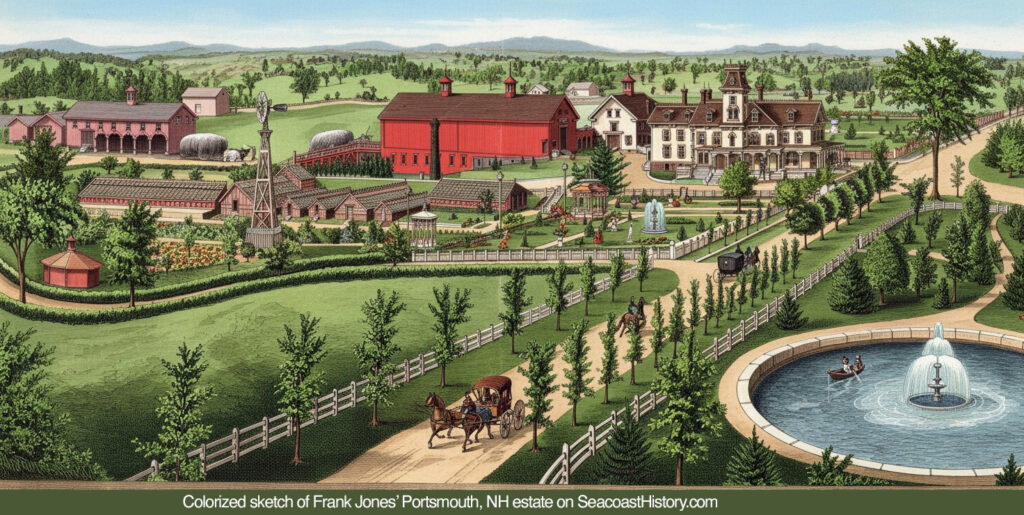
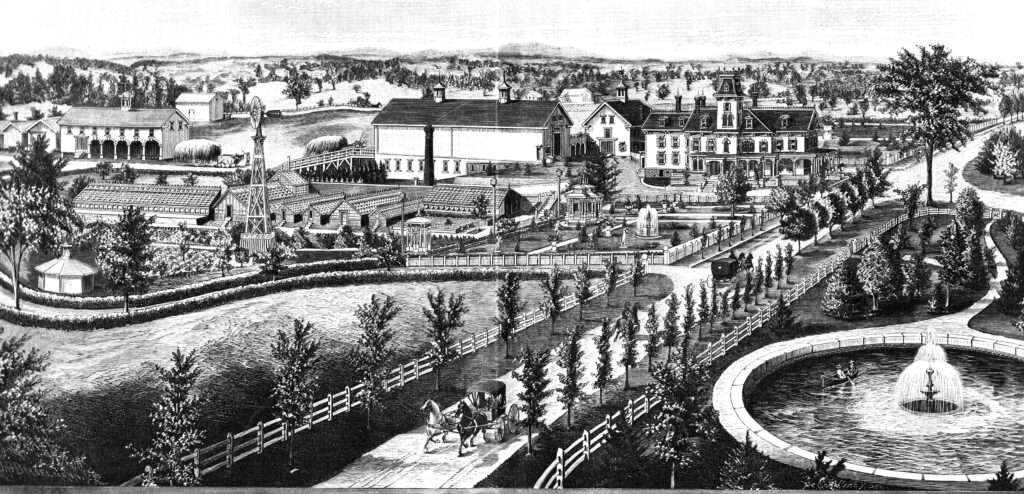
The largest illustration in the 1882 volume is a two-page spread of the Jones’ estate at its peak. I’m no scholar of Frank Jones, but in his biography of the region’s richest and most powerful man, historian Ray Brighton noted that the family usually spent only the month of August there. As a person who lives comfortably in less than 1,000 square feet on less than one-tenth of an acre, this illustration makes me wonder WHY? I mean, who needs that kind of excess?
Against my better judgment, I carefully removed the illustration from the book. It didn’t entirely fit in my scanner. And I’m afraid a newspaper print won’t do this picture justice. Engravings don’t reprint well unless they are huge. And maybe adding asking an AI robot to add color will help.
For more details, track down a vintage copy of Ray Brighton’s book, FrankJones: King of the Alemakers (1976). Here’s a little of what I see in the illustration blown up on my giant computer monitor.
In the upper left a farmhand appears to be driving an oxcart full of hay into a gigantic barn with two cupolas. Below is a row of greenhouses and what look like cold frames. Elaborate birdhouses are hoisted in tall poles surrounded by statues of human figures and a floral garden. There is a fountain, ponds, stone walls, hedges, fences, ironwork, racing stables, a pair of gazebos, and a variety of imported trees.
Towards the bottom right of the engraving are two carriages, each drawn by two horses. One is leaving the Jones’ estate, and the other is arriving. A man made pool in the lower right contains another fountain, and there are two people canoeing inside the circular pool. Jones home, like his life, was a picture of excess. And this wasn’t his only mansion.
Copyright J. Dennis Robinson, all rights reserved.
 Tom Thumb Wedding Still Inspires Mock Marriages