



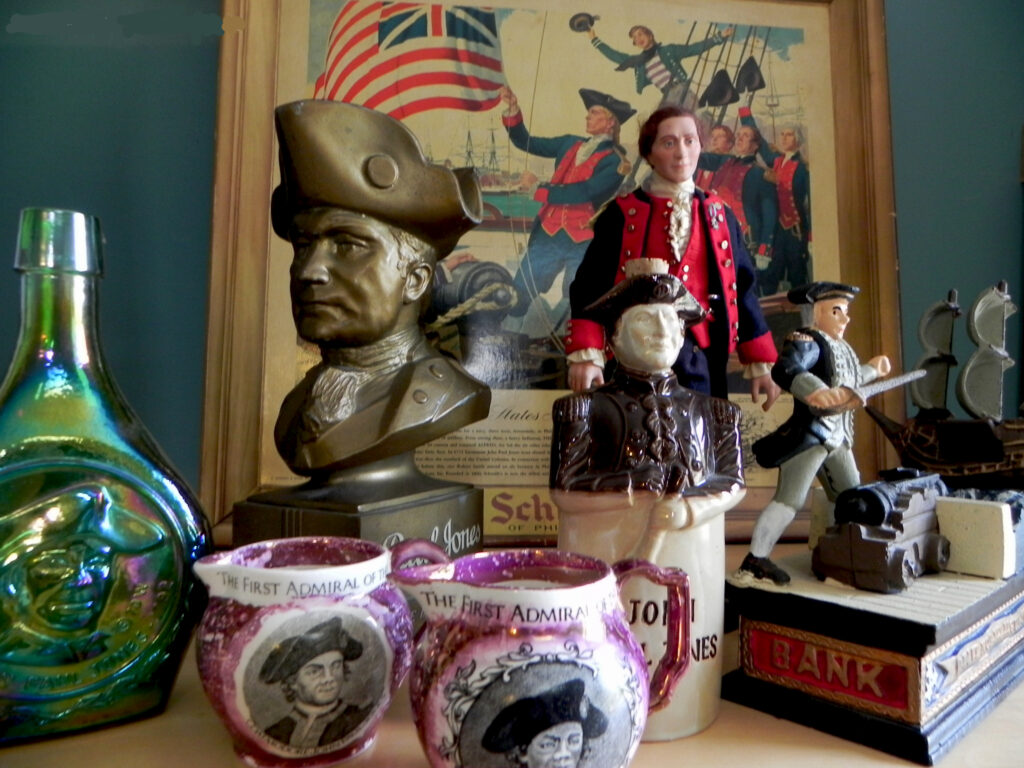
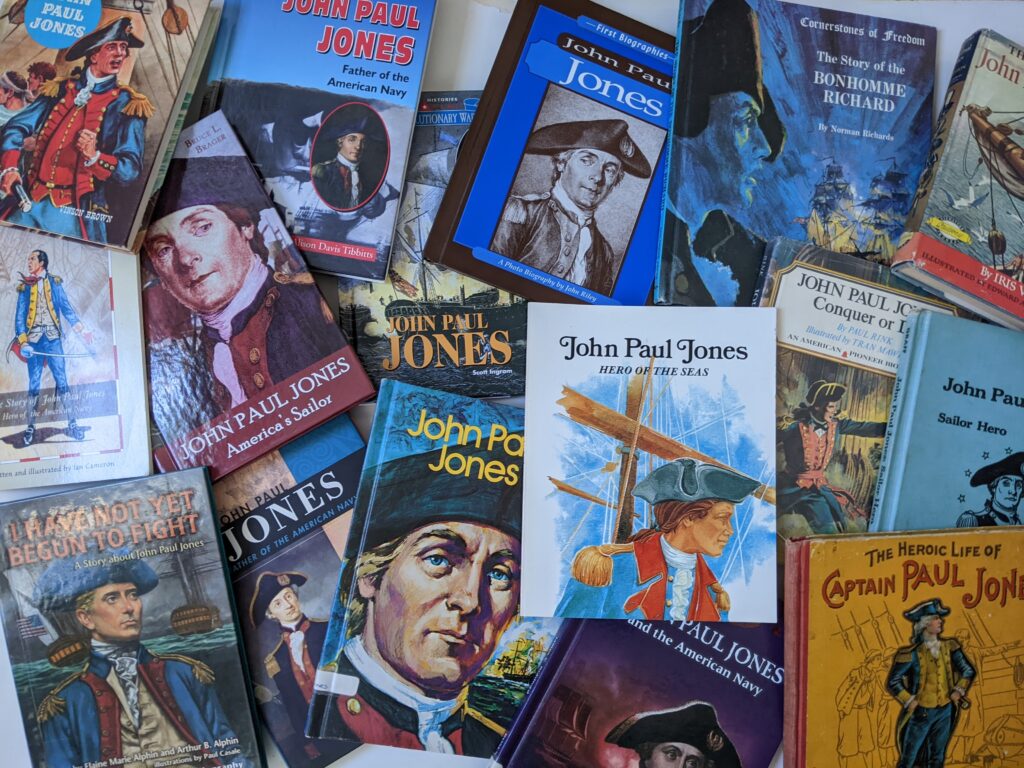
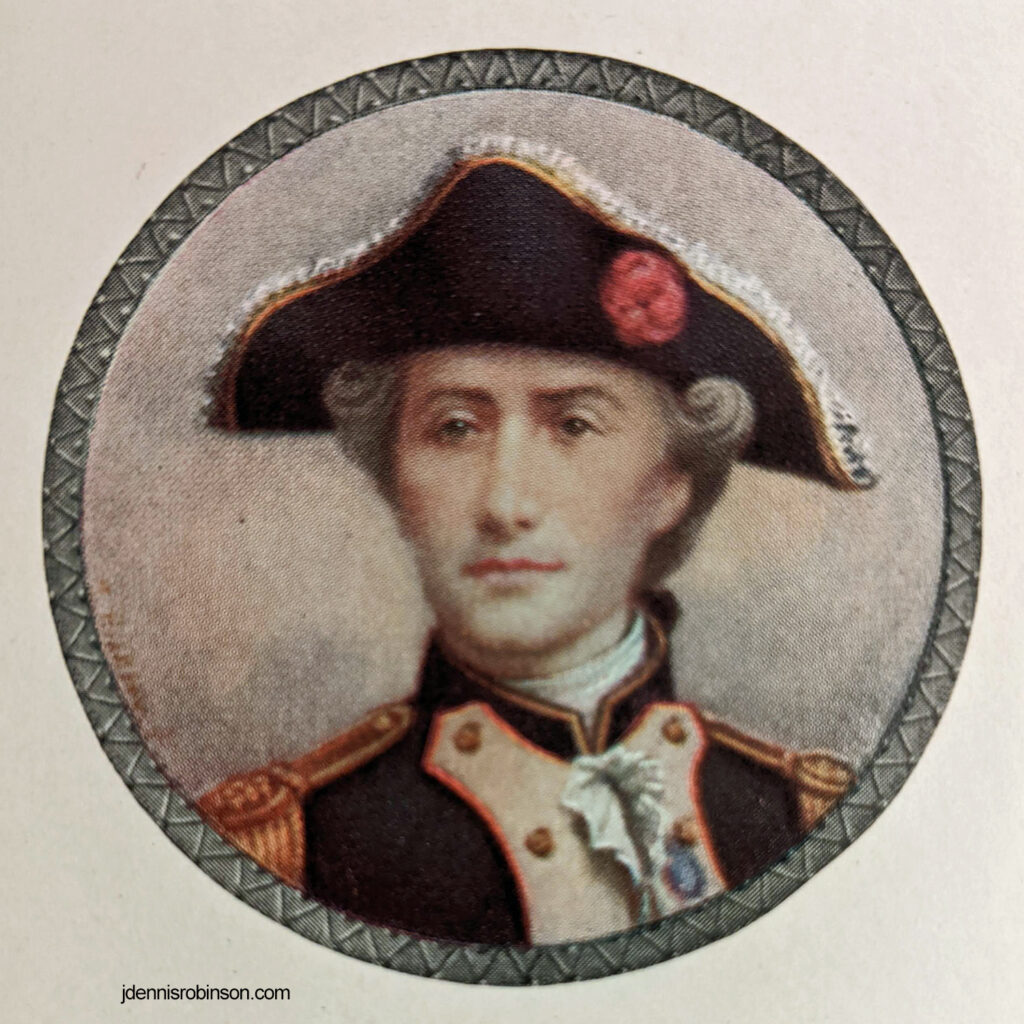
His image appears in hundreds of books, on calendars, posters, whiskey bottles, and cigarette packs. His name is known around the world as the man who sailed into harm’s way in the American Revolution. But collecting “Jonesiana” tells us more about America than about the mysterious man himself.
“I have not yet begun to bid”
John Paul Jones, for my money, is the most famous man who ever lived in Portsmouth, NH. His name still rings out across the globe. Born as John Paul in Scotland in 1747, he attacked Britain as a captain with a single ship in the American Revolution, served in the Russian navy under Catherine the Great, and was buried in France in 1792. His body was exhumed from below the streets of Paris in 1905 and transported with great pomp to Annapolis, MD where it rests today.
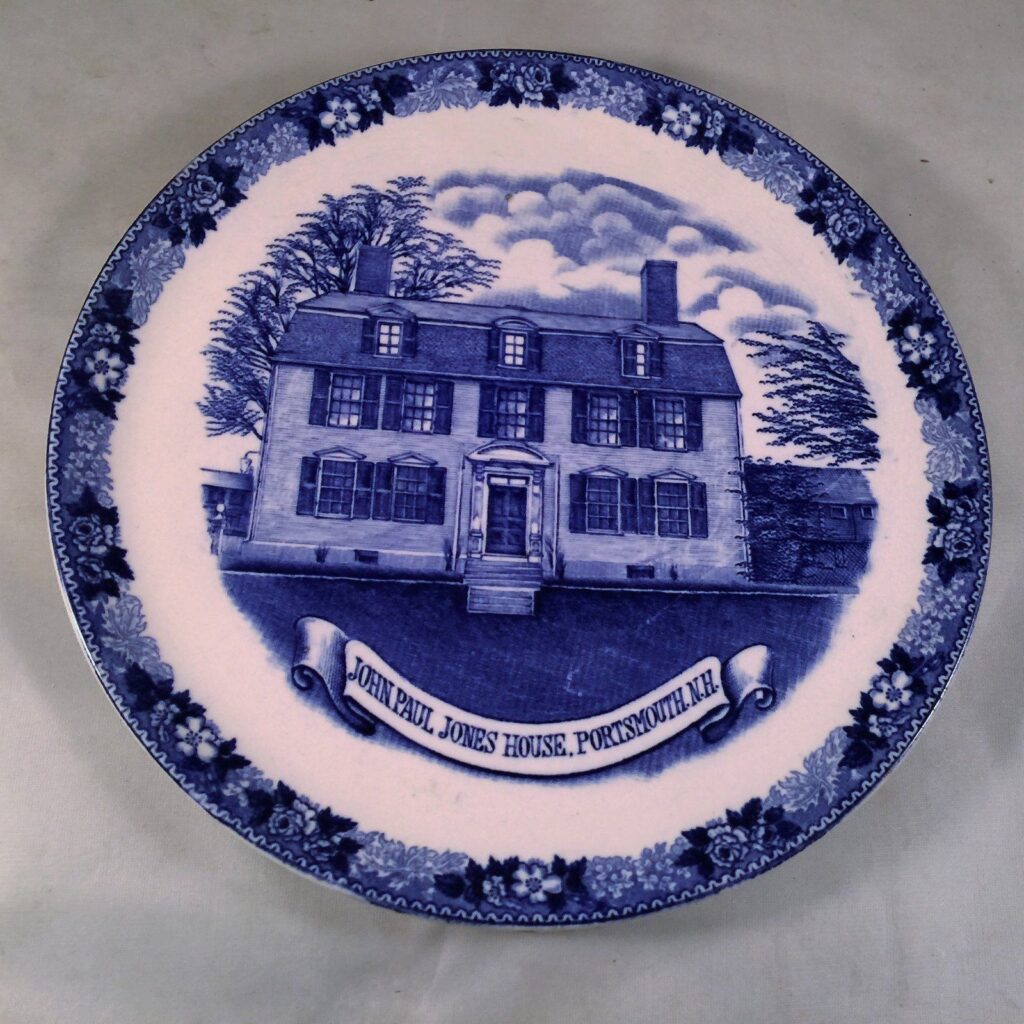
Jones has great name recognition, but few people know much about him. I lived in Portsmouth for 20 years before visiting the John Paul Jones House on Middle Street, home of the Portsmouth Historical Society. That’s when I caught Jones Fever. The more I learned about the complex and mysterious John Paul Jones, the more I wanted to know.
The man beneath the legend
I served two terms as a trustee at the museum there. I rented the little carriage house at the back of the garden as my writing office. I watched out the window for ghosts, but none came. I wrote a novel about Jones, but no one published it.
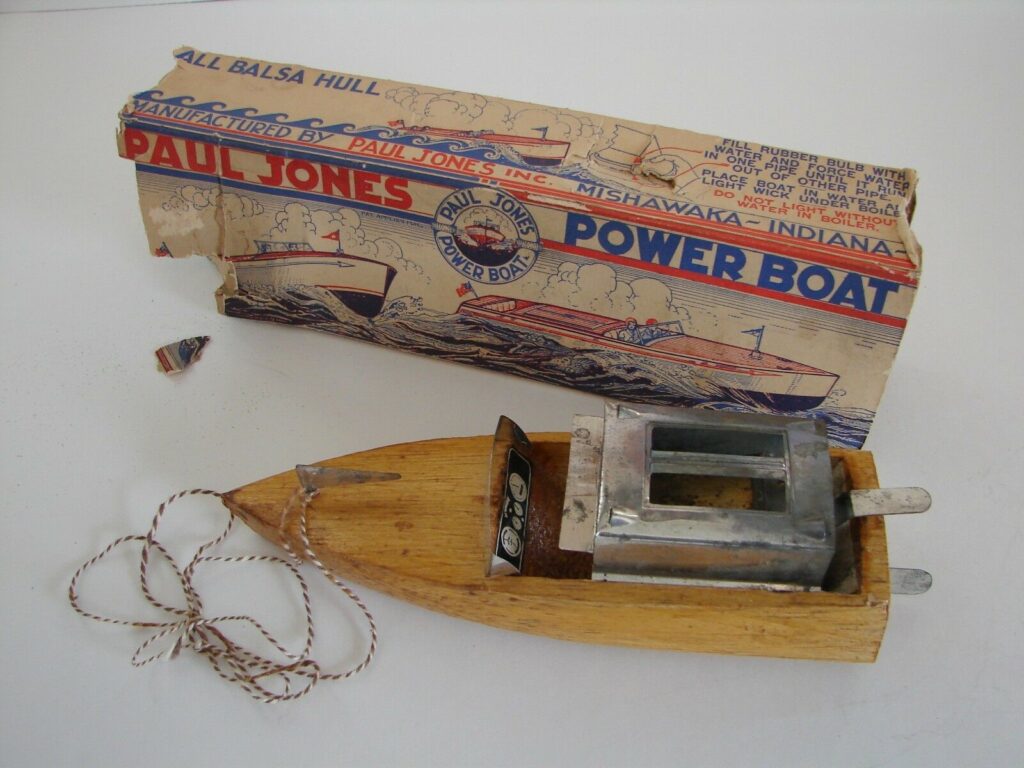
Many of the best stories about Jones are exaggerated, clouded in mystery, or false. My Jones library now contains over 100 books. I have a filing cabinet thick with articles, clippings, and strange objects. The collection incudes old bottles shaped like John Paul Jones, commemorative plates and cups, puzzles and posters, toy banks, ship models, plastic statues, calendars, medals, coins and postage stamps – all bearing the likeness of Captain Jones. Somewhere hidden among the kitsch and the pop culture, I hoped to find the man himself.
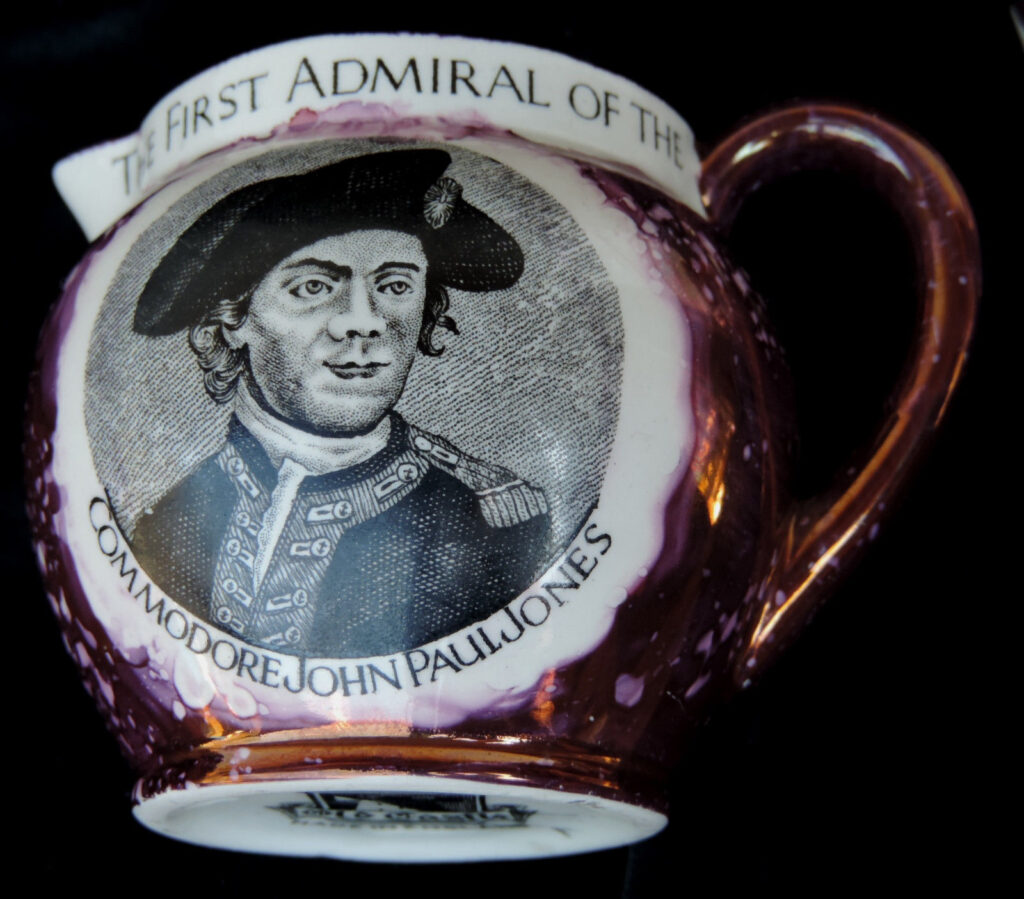
A 100-year old cream pitcher with Jones’ portrait, for example, reads: “The First Admiral of the American Navy.” But Jones was never an Admiral in America, only a Captain, a fact that made him hopping mad. And during his brief service to this nation, a service for which he was never fully paid, there was, technically, no United States Navy. When it comes to souvenirs, you can’t even trust a cream pitcher.
Jones in Portsmouth
Captain Jones did not own the 1758 mansion that bears his name. He was never an American citizen. A former slave trader, Jones arrived in the Colonies in 1775 just as the Revolution broke out. Truth is, he was running away from a murder trial in the West Indies where he was accused of killing a member of his crew. That’s possibly why he changed his name from John Paul, to John Paul Jones, not the most effective secret identity, A brilliant mariner, Jones signed up to support the American cause.
He was assigned to command the frigate RANGER built by John Langdon of Portsmouth. After a risky raid on Britain, he returned to English waters in 1779 with the BON HOMME RICHARD and captured a British warship. He lost half his crew and his own ship in one of the bloodiest battles in American maritime history. Jones returned a conquering hero to Portsmouth, this time assigned to captain the ship AMERICA, but he lost that command as the Revolution ended.
Legend says Jones rented a room on the second floor of Sarah Purcell’s home in 1777 and again in 1781, staying a total of 18 months. It is possible. Jones was definitely in town twice, supplying and outfitting his two ships. Purcell was a recent widow with debts to pay and lots of children to feed. Jones reportedly carved his initials on a pane of window glass at the Purcell House, but no one alive has seen it.
Myths are often more powerful than facts. A plaque on the side of the building says that a group of young Portsmouth women sewed the first American flag ever seen outside the country. They sewed this flag, the story goes, from their own silk gowns and presented it to John Paul Jones. It is a good story, but it never happened. One of Jones’ biographers appears to have made the story up in 1900 and claimed Jones was the “Father of the American Navy.” Five years later, Jones’ mummified corpse was shipped from France to the USA. In 1905, everyone had Jones Fever.
First American action hero
Scholars gasp when I say I use eBay to study history. Little can be learned, I’m told, from commemorative Coke cans, lamp shades, and cigar boxes. I respectfully disagree. There is a wealth of information buried within this rubbish heap of cultural debris. We learn, by its sheer volume, for example, how famous Jones has been for more than two centuries. Despised as a pirate, a terrorist, and a traitor by the British, he became an instant icon in a brand new nation that was desperate for heroes. By defeating a British ship within sight of the British coastline, Jones symbolized the spirit of the upstart American Revolution. By taking on the world’s largest navy with a single American-made ship, Jones became, in my opinion, one of the nation’s first action figures. He predates the American cowboy, GI Joe, John Wayne, Rambo, even Superman. Jones created his own military outfit, had a secret identity, seemed invulnerable to flying bullets, circled the globe, and was a loner.
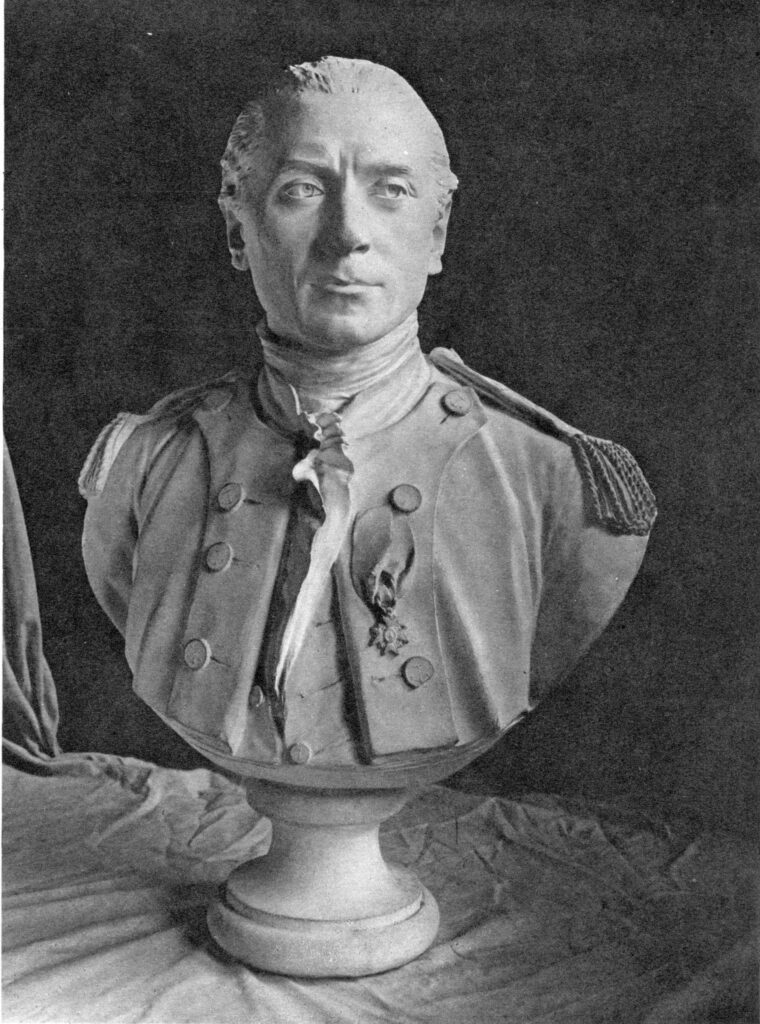
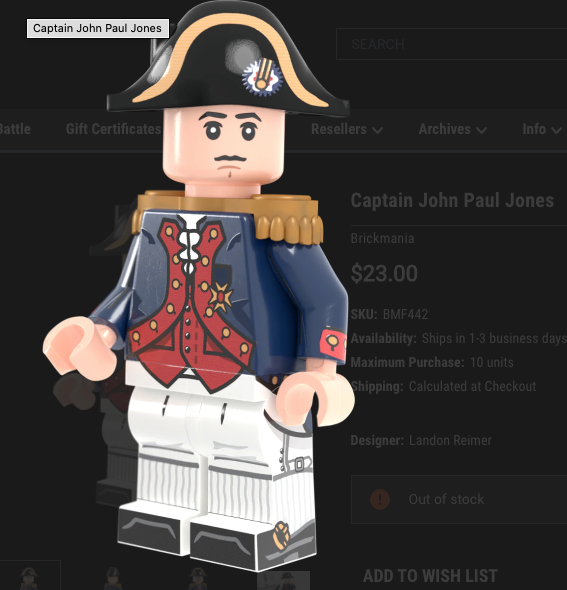
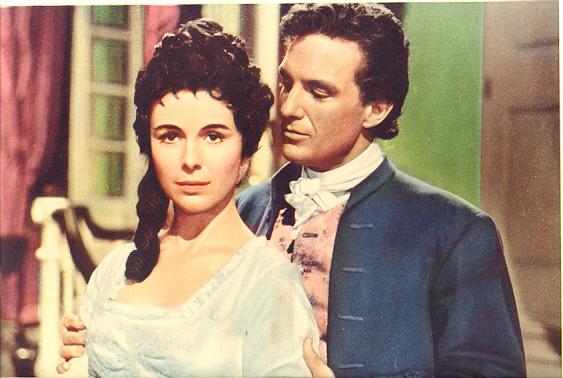

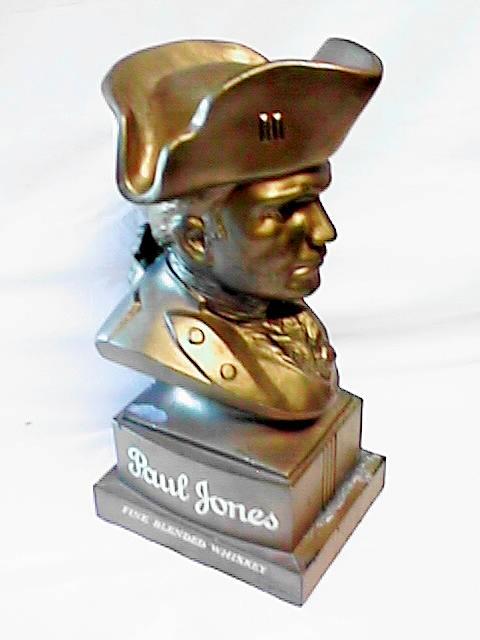
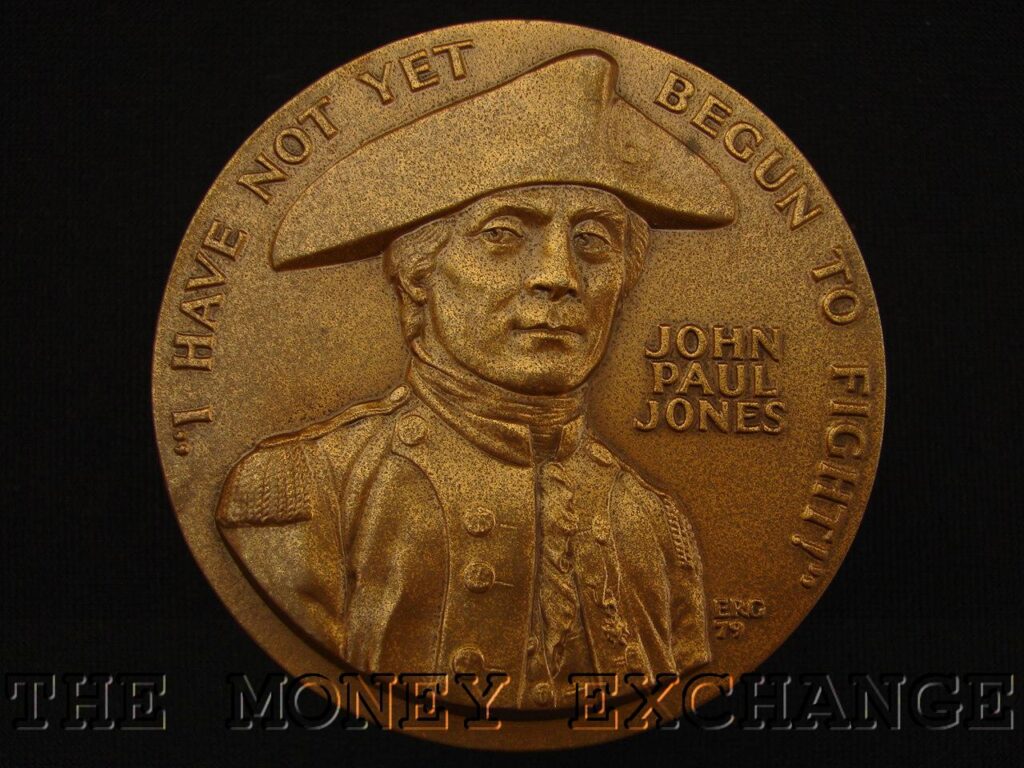
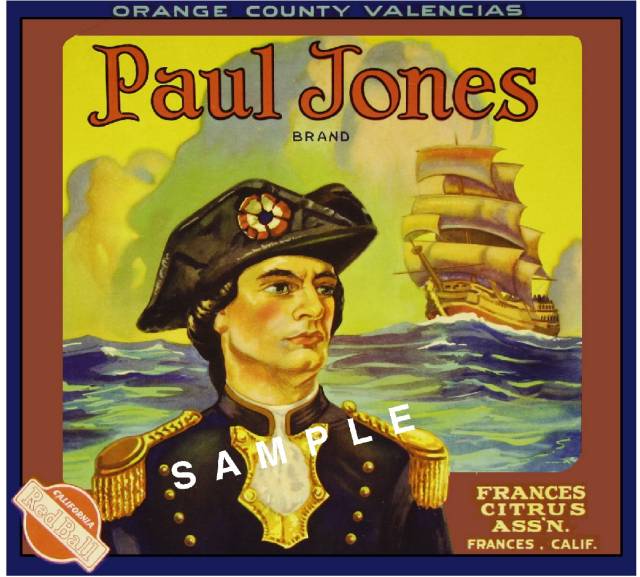

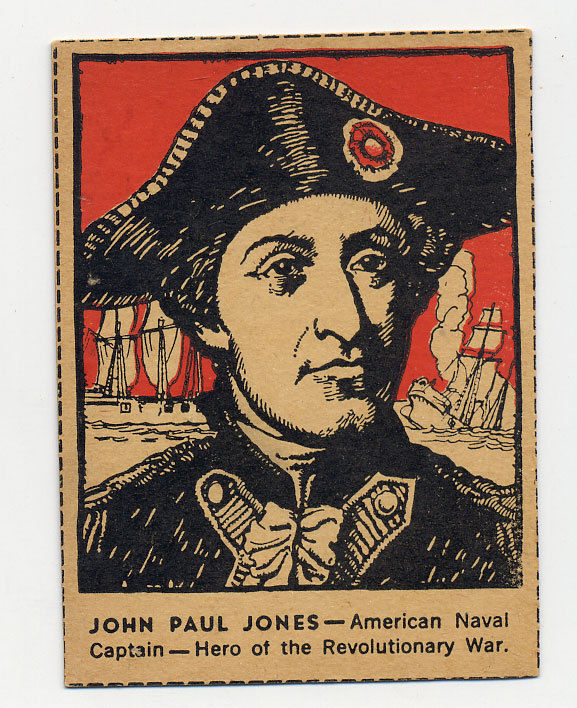
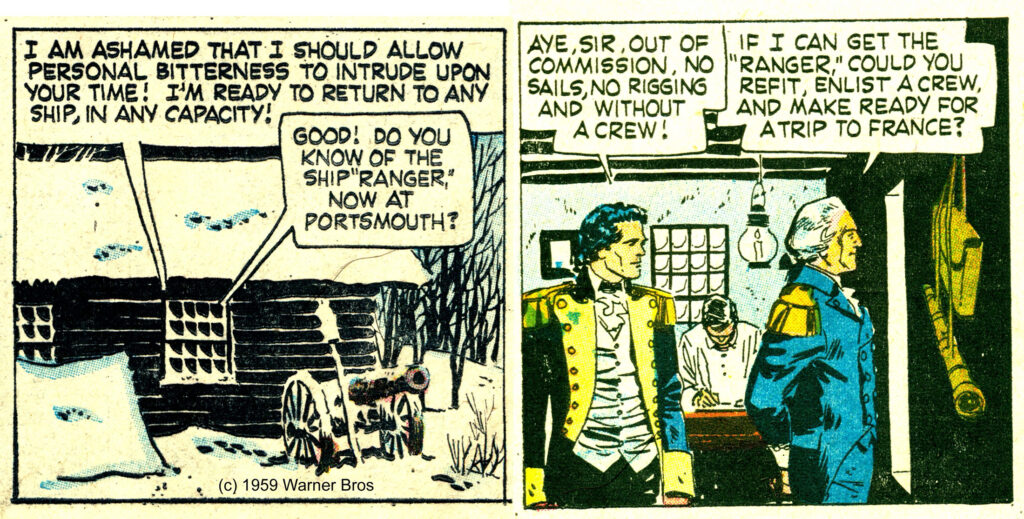
Jones’ story was embellished in early dime novels, historical fiction, and comic books. Never married, Jones is depicted as a ladies man and lover. And some of that is true. “Little Jones.” as he was called, dressed in fine clothes that he had tailored to fit his five-foot-six-inch frame. Of low birth, the son of a gardener, he educated himself, wrote poetry, created a fake family crest, and put on polite airs. Prone to jealousy and fits of frustration, Jones fought so fiercely in battle that his enemies questioned his sanity.
The selling of JPJ
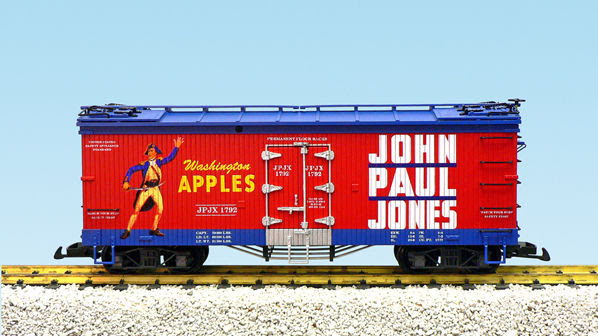
Because he died young and left no heirs, the life of John Paul Jones has become a blank canvas, copyright-free, for anyone who wished to exploit his name. British mothers once frightened their children into bed with threats that the pirate Jones would carve them up. Although he did not smoke tobacco or drink alcohol, Paul Jones brand cigarette, cigar, and whiskey ads were prominently displayed in the 19th and 20th centuries. A tobacco tin with his picture is worth $700 in today’s antique market. My collection includes a catalog of Paul Jones “middie” sailor blouses for women, labels for John Paul Jones brand oranges, apples and potatoes. I have a Jones doll and a Jones mechanical coin bank that fires pennies from a cannon. He has appeared on milk bottles, on Sugar Smacks cereal, as a Halloween costume, in plays, musicals and comic operettas.
With the exception of his many letters, there are fewer than a dozen surviving artifacts that can be directly traced to the real John Paul Jones. He died penniless in a slum apartment in Paris. His body, if it is indeed his body, was buried naked without artifacts or markings in a lead coffin lined with straw and preserved in alcohol. A couple of authenticated buttons have been found, an armor breastplate, a sword and one or two pistols. That’s all. Everything else, like the legend of Jones, is manufactured.
The most collectible item was John Paul Jones himself. President Theodore “Teddy” Roosevelt paid for the plan to bring Jones’ remains to America. Roosevelt orchestrated the campaign to rebury “The Father of the American Navy” in an ornate marble sarcophagus fashioned after the tomb of Napoleon. And it was Roosevelt who, speaking in front of the flag-draped coffin of Jones, challenged Americans to break out of their isolationism. In the spirit of Captain Jones, Roosevelt said, America should build a Great White Fleet and spread its influence around the globe.
Jones has since become an enduring symbol of the US Navy, especially when the nation is at war or goes “in harm’s way”. The first “recruitment” poster was written by Jones while he was at Portsmouth, and ever since, battleships have been named in his honor. The fact that Jones did not actually write much of the honor code attributed to him is forgotten. The fact that he was largely a freelance soldier of fortune is underplayed. The fact that he was passed by for promotion, unpaid for his efforts, and ignored by Americans until long after his death gets lost in translation.
Wrapped in the flag
The stuff for sale on eBay tells another tale. Hundreds of bits of “Jonesiana” indicate a maritime hero loved by a grateful and admiring nation. If he was not loved in person, at least he was loved in spirit. Inevitably, John Paul Jones appears in his red, gold, and blue uniform – a uniform he personally designed. Inevitably, there is a flag nearby. By a twist of fate, Jones was commissioned to captain the RANGER on the same day that the Continental Congress announced the design of the first American flag.
Jones raised one of the earliest American flags on the ship PROVIDENCE. He carried the colors into battle on the RANGER. But flag experts (they are called “vexologists”) will tell you that, in at least half of the historical images ever made, Jones is holding the wrong flag. He appears with the famous “Don’t Tread on Me” snake flag, with the British-styled “Grand Union” flag, with the unique “Serapis” flag that includes blue stripes, as well as the famous 13-star version. A collector could spend a lifetime sorting through these images and still never understand the man behind them.
Truth is, these artifacts teach us more about America, then about John Paul Jones himself. Or, more accurately, they teach us what America wants to be. John Paul Jones stands for one nation, under God, with liberty and justice for all. The real Jones, by contrast, was a man without religion who was employed by a loose confederation of independent states. After fighting for American democracy and liberty, Jones then worked for the French monarchy under Louis XVI and was then employed by the Russian dictator Catherine the Great. More than anything, Jones fought for fame – and won.
The real Jones was a complex man fighting in a complex world. Like America, he represents many different things to many people. But the collectible John Paul Jones, like the imaginary America, is without malice or vice, fighting only for the truth and seeking freedom for all.
© 2008 by J. Dennis Robinson. All rights reserved.
 Going Crazy in Portsmouth