

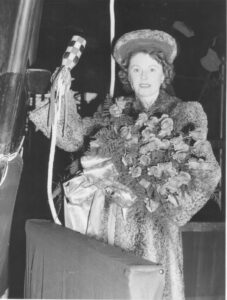
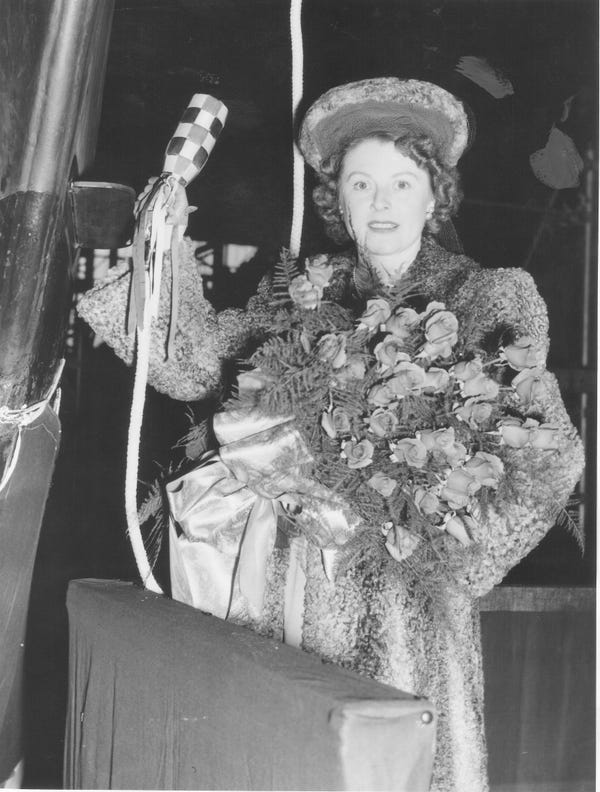
There’s a lot to unpack in this seemingly straightforward photo of a woman about to smack a bottle against a submarine. The first question that comes to mind is: What the heck is she wearing? That fuzzy coat must have been the height of winter fashion in November 1942.
And who is the woman clutching a champagne bottle in one hand and a couple dozen roses in the other? According to the yellowed caption glued to the back of this World War II photograph, we are looking at Mrs. L.S. Parks. Her husband, Lewis S. Parks, was staff commander of the U.S. Navy’s Atlantic Fleet. The year before, on the day the Japanese bombed Pearl Harbor, Cmndr. Parks had been the skipper of the USS Pompano, cruising off the coast of Oahu. Although his boat was strafed by Japanese planes, the Pomano survived. Parks would go on to earn three Navy Crosses in the war and moved up to the rank of rear admiral.
His wife, featured in this photo, didn’t even get her first name in print. But I looked her up. She was Zelda Leech Parks. At her death in 1997, this newspaper listed her as born in Philadelphia, but “formerly of Portsmouth.” According to the Herald, she was living in Honolulu with her daughter Zelda Louise when the Japanese attack came. Mrs. Parks “accompanied her husband on assignments” that took them to Hawaii, Panama, the Philippines, Europe, Japan, and apparently to Portsmouth, NH.
Moving very big boats from dry land to the water has been a very big deal in these parts since the launch of HMS Falkland in 1690. It is a complex feat of engineering, stressful for the ship, and risky for the builders. Launchings have always been a public spectacle and a source of pride in shipbuilding cities like Portsmouth. The launch of the frigate Raleigh, built here in just 60 days at the beginning of the American Revolution, inspired this local account:
“On Tuesday the 21st [May 1776] the Continental Frigate of thirty-two guns, built at this place … was launched amidst the acclamation of many thousand spectators. She is esteemed by all those who are judges that have seen her, to be one of the compleatest ships ever built in America … this noble fabrick was completely to her anchors in the main channel in less than six minutes from the time she run, without the least hurt; and what is truly remarkable, not a single person met with the least accident in launching, tho’ near five hundred men were employed in and about her when run off.”
Why break a bottle against the bow? The ceremony dating at least to ancient Greece and Rome may have been a plea to the gods to protect the crew on their dangerous journey. The christening by liquid, perhaps river or seawater, became a sort of baptism just before the vessel met its watery home.
In the U.S. Navy, the tradition came to include a female “sponsor” wielding a bottle of wine or champagne, often bound in ribbons. She was accompanied by a “maid of honor.” Go figure. Each ship received its official name at the moment of christening. And woe betide the crew if the bottle failed to break on impact.
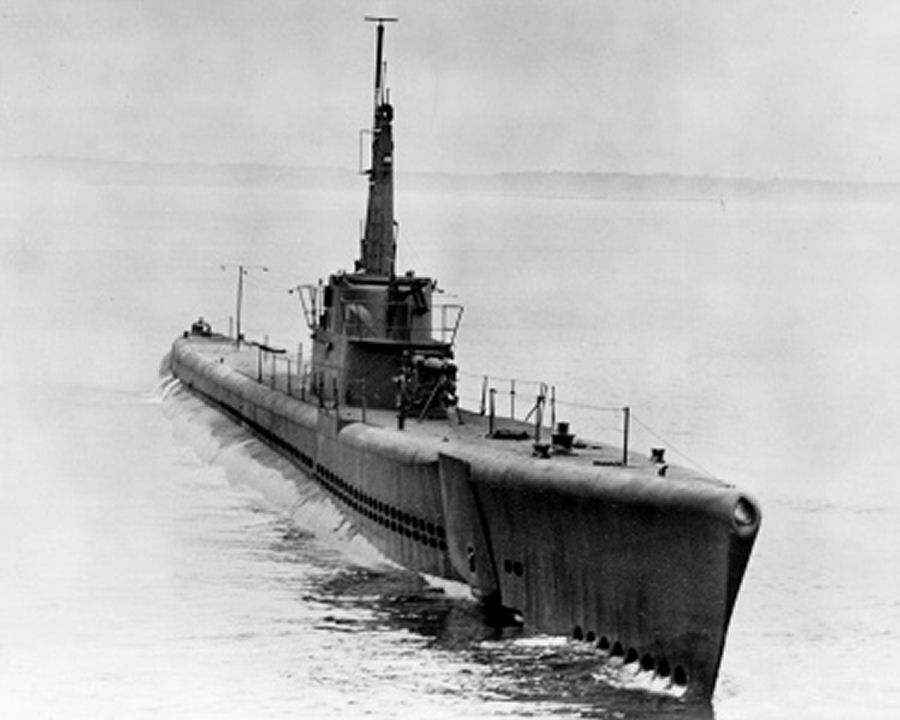
In this vintage ACME company photo, which had to pass through U.S. Navy censors during the war, Mrs. Parks was about to christen the Portsmouth-built USS Billfish (SS 286). The name, according to Navy records, refers to “any fish of many species (such as the sauty, gar, spearfish, and sailfish) which have long, narrow jaws that resemble a bird’s bill.”
Billfish is credited with sinking three Japanese cargo ships in World War II. It was decommissioned in 1968, placed in Fleet Reserve, and sold for scrap in 1971. The war was an historic era for Portsmouth Naval Shipyard. From an average of two submarines built per year in the 1930s, from July 1940 to July 1945, the Kittery yard built a record-breaking 79 submarines. USS Billfish was the eleventh boat launched in 1942. In 1944, four submarines were launched in a single day, requiring a lot of champagne.
Copyright J. Dennis Robinson, all rights reserved.
 Indigenous History is American History