

Note: This is the first of a two-part series on the life and work of Portsmouth-born author and artist Celia Laighton Thaxter.
Why does Celia Laighton Thaxter’s fame persist, even thrive in the 21st century? While many Victorian American poets and artists have long faded from public view, her writing is still published and analyzed, her life studied and dramatized, and her artwork collected and exhibited.
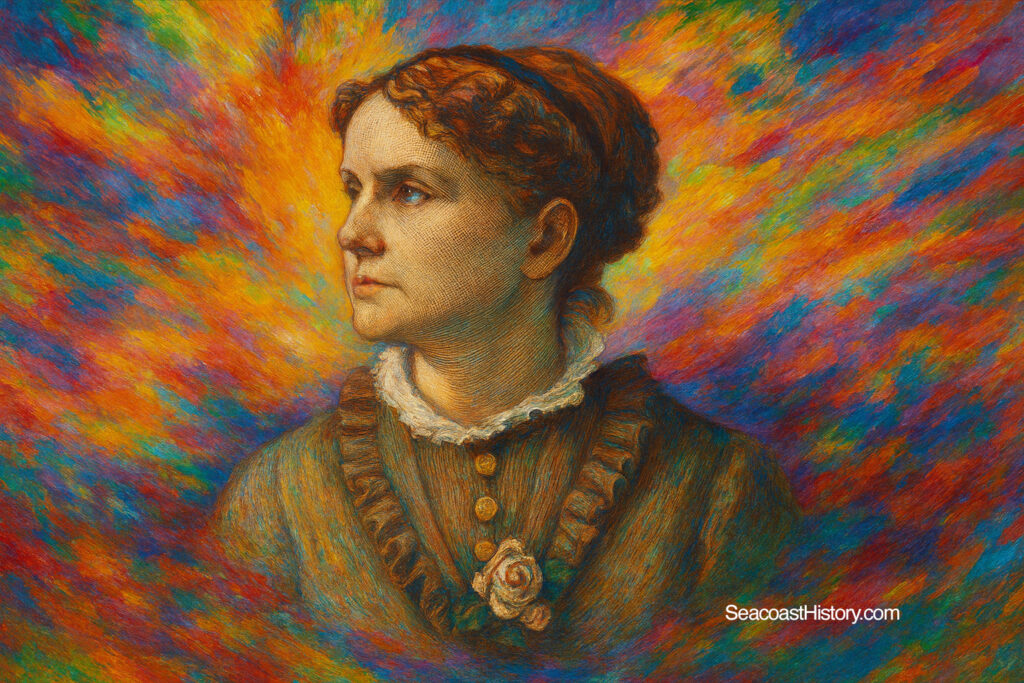
Ever since her death in 1892, Celia Thaxter has maintained a modest but avid following. One dedicated group annually revives her historic island garden on Appledore, the largest of the nine Isles of Shoals. There has been talk of reconstructing her cottage on the island. She appears as a character in a number of novels, inspires theatrical productions, stars in a coloring book, biographies, websites, and even a woman’s artistic retreat in Texas. Celia’s kaleidoscopic appeal derives from the interplay of the colorful overlapping roles she played.
She was a gifted child, reluctant wife and mother, a poet, caregiver, hostess, journalist, businesswoman, artist, sister, naturalist, and celebrity. Placed end-to-end, these roles form a chronological account of Thaxter’s life. Taken individually, each is a tinted glass through which we glimpse a colorful facet of Celia Thaxter’s complex character.
New admirers may “discover” her, for instance, through an anthologized poem, an early postcard of an old hotel, a bit of decorated china, a ferry ride to the Shoals or a painting by Childe Hassam. Once discovered, one aspect of Celia Thaxter’s life leads quickly to another. The colors return and repeat, overlap and inform one another in rich cycles of time and tide.
For newcomers, Celia Thaxter is a quick study. Her poetry and prose fill only a few thin volumes and her exceptional writing can be consumed in a week of dedicated study. Despite her national appeal as a romantic poet in the second half of the 19th century, today Thaxter’s fans hail largely from the three New England states visible in one panoramic glance from the Isles of Shoals — Maine, New Hampshire and Massachusetts. Each state stakes its claim on her, and rightfully. But she remains forever linked to the tiny, barren islands where she lived at least half her days and where she is buried.
Beyond her own writing, we have a volume of Celia’s published letters, a host of archived photographs in the Star Island collection, two biographies, a scattering of critical essays, and samples of her decorative art. It is, in fact, this small cache of “Thaxteriana” that often lures new followers to her fan club after their first visit to the Isles of Shoals. And, as with the Shoals, those who “discover” Celia Thaxter often come back, again and again. Each visit increases our sense of connection to the dead poet society.
THE CHILD
Born in downtown Portsmouth, New Hampshire in 1836, “the island poet” today personifies the isolated rocky Isles of Shoals just ten miles out from the state’s only major harbor. Four years later, her father, Thomas Laighton, accepted the post of Shoals lighthouse keeper, pulling his wife, Eliza, and daughter Celia from the bustle of the Port City to the harsh isolation of White Island.
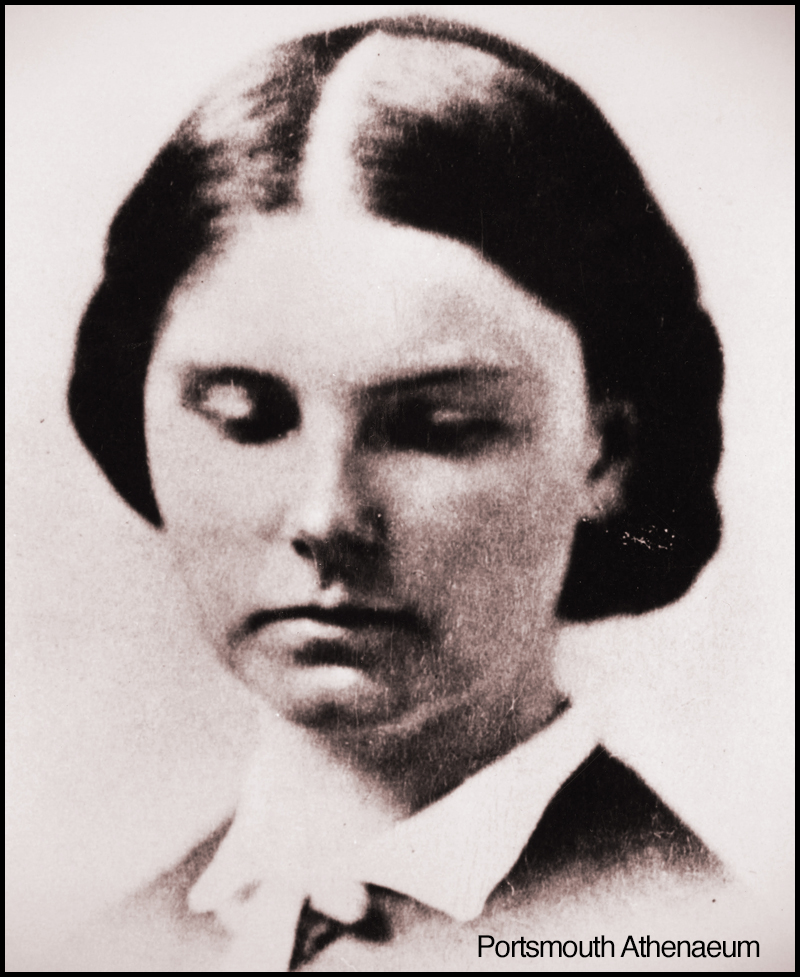
Even today, the island is stark and barely accessible by boat, yet Thaxter seems to have cherished her time growing up there with baby brothers Oscar and Cedric. In her poetry and prose, Thaxter paints vivid romantic images of her time as the lighthouse keeper’s daughter. Bleak, frigid, claustrophobic winters are transformed into innocent years of familial happiness on what must be among the most rugged weather-torn clusters of rocks in the Granite State.
Thaxter offers a captivating tale of her childhood in the endlessly popular prose work Among the Isles of Shoals (1873). The late Portsmouth author Anne Molloy recast the story into the book Celia’s Lighthouse. First published in 1949, this novel remains the ideal introduction to the Thaxter legend for readers young and old.
Passing White Island today aboard the ferry named for her father, summer visitors often hear Celia Thaxter’s story for the first time, narrated from the ship’s loudspeaker. During summers in the early 1840s, the Laightons lived on nearby Smuttynose Island, which they purchased from the Haley family. They managed the dilapidated Mid-Ocean House hotel there. Early guests included writers John Greenleaf Whittier and Richard Henry Dana. By 1847, the family had settled permanently at Hogg, largest of the isles, which they renamed Appledore and on which they built their large tourist hotel. Nathaniel Hawthorne, an early visitor to the new hotel with his friend Franklin Pierce, was captivated by a wild and pretty maiden, whose parents ran the Appledore Hotel.
THE WIFE
Celia Laighton’s innocence ended abruptly in 1851 when, at 16, she married her 27-year old former tutor, Levi Lincoln Thaxter.A guest at the Mid-Ocean House on Smuttynose, Thaxter had been her father’s business partner. In return, a marriage was arranged. Homeschooled, except for a brief semester at Mt. Washington Female Seminary in Boston, the young wife owed her view of the outside world to her husband and mentor. That worldview tarnished quickly as the couple divided their time between the Isles and various borrowed homes in Massachusetts. Nine months later, Karl, who suffered from birth defects, was born at the Isles. Sons John and Roland followed in quick succession.
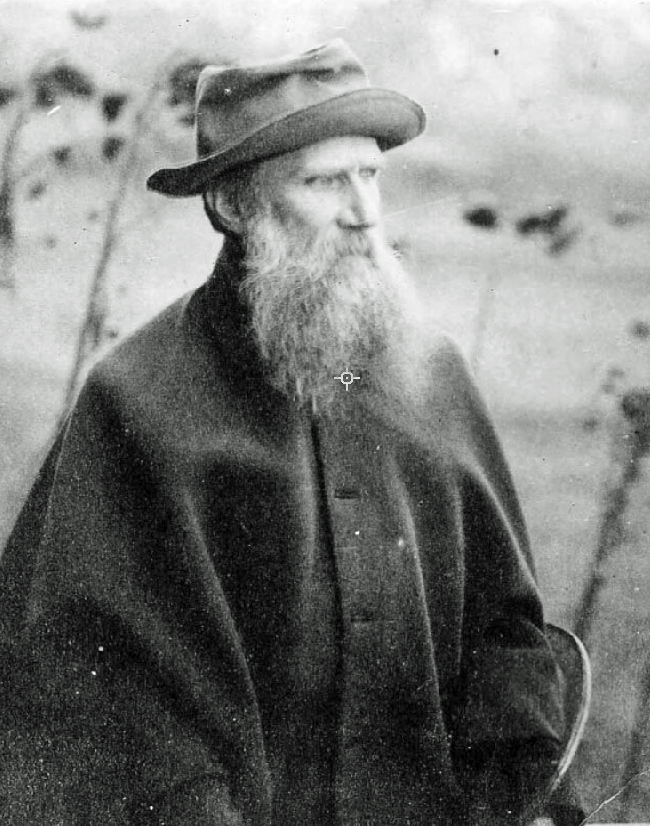
It has become fashionable recently to fault Levi Thaxter for the slow dissolution of the marriage. Born to privilege and drawn to philosophy and the arts, he drifted among jobs, never finding his true calling, except perhaps as a powerful reader of Browning’s poetry. Fearful of the sea after a near-disastrous boating trip, Levi disconnected himself early from the Shoals — even as Celia was becoming the island muse. He was often ill, appeared jealous of his young wife’s evolving fame. He refused, Celia told a friend, to allow her to hire a housemaid even with her own earnings.
But in defense of Levi Thaxter, despite his demons, he persevered. Although they never divorced, the couple’s repeated separations make their fractured household seem almost modern. During part of the bloody Civil War, Levi Thaxter stayed in their Newtonville, MA home with all three children, while his wife was on the Shoals. Traveling South to Florida and as far as Jamaica to ease his rheumatism, Levi often took John and Roland, with the aid of a housekeeper. The family would reunite, then go their separate ways. In 1880, with their children grown, the couple purchased the 186-acre former Champernowne Hotel property in Kittery. Though closer in proximity, their emotional separation was complete. They never lived together again. Levi died four years later and is buried at Kittery Point with his sons, while his wife lies in the thin earth of the Shoals with her family.
THE MOTHER
In photographs, Celia never smiles. In one familiar image, she stares vaguely at the camera, seemingly oblivious of her young son. She seems to have often overlooked her children in real life as well. She was often distant from them, except for Karl, whose mild retardation and fits of temper were more than husband Levi could handle. Except for short periods with his father and at a special school, Karl remained in his mother’s care until her death.

Her own unique and isolated childhood left Celia Thaxter with an active imagination and a sense of wonder that is at the heart of her writing for children. Although she was a frequent contributor to such popular periodicals as “Young Folks”, Celia’s letters to her own sons are more instructive than playful. The combined work of running the hotel, caring for her parents, keeping up her own household, writing, and entertaining visitors — all seem to have left little time for parenting. The younger boys lived more in their father’s domain, accompanying Levi on hunting trips to the South.
John grew partial to farming, and Roland graduated from Harvard to become a doctor. In her final years, the Island poet blossomed as a grandmother. She lavished her affections on Roland’s children when they visited the Shoals. As the juvenile book industry flourished, Celia Thaxter became, in essence, a kindly grandmother to thousands. Children across the nation read her short prose works, adored her colorfully illustrated books at bedtime, and recited her poems in school.
THE POET
The publication of “Land-locked” in the Atlantic Monthly in 1861 kicked off Celia Thaxter’s poetic career. The 27-line poem eloquently expressed her longing for the Shoals as she struggled to be a dutiful Massachusetts housewife. She wrote for love and for the money that was so necessary to a household where her husband Levi, depending on his wealthy parents, was frequently unemployed. Like many of her Victorian colleagues, a good deal of Thaxter’s poetry is just too forced and sentimental for the modern ear. In her early days, she wrote, she confessed, “between the pots and the kettles.” And yet, some of her work, especially her prose, simply sparkles.
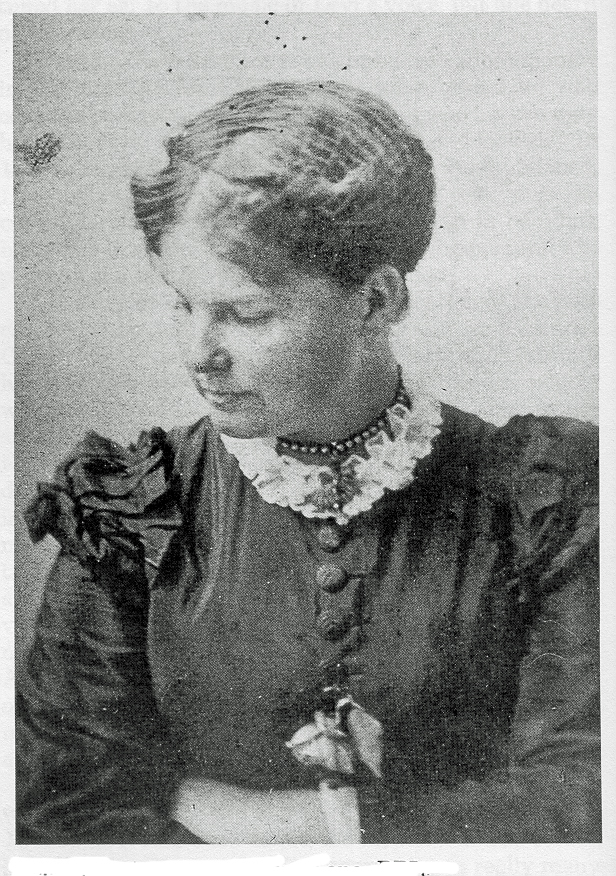
Most of her best work centers on the Shoals and the sea. Her musings on the graves of 14 sailors shipwrecked on Smuttynose Island, for example, telegraphs her empathy for the unknown mates of those lost men. She was less effective when imagining foreign lands or giant icebergs. But when Celia wrote about what she knew well, like a tiny sandpiper skittering along the shore, she had no peer.
Only a few scholars have treated Thaxter’s work seriously. Jane Vallier’s study, Poet on Demand, has remained the primary analysis for three decades. While Thaxter’s writing never reached the consistent power of her friend Sarah Orne Jewett from nearby South Berwick. Celia’s verse continues to be quoted and anthologized. But her poetry is merely the bait that lures us into her complex and colorful character.
TO BE CONTINUED
Copyright J. Dennis Robinson, all rights reserved. A version of this essay first appeared in the the book “One Woman’s Work: The Visual Art of Celia Laighton Thaxter (2001) edited by Sharon Palva Stephan.
 Aboard a Fishing Smack to Portsmouth in 1911
Leave a Reply