

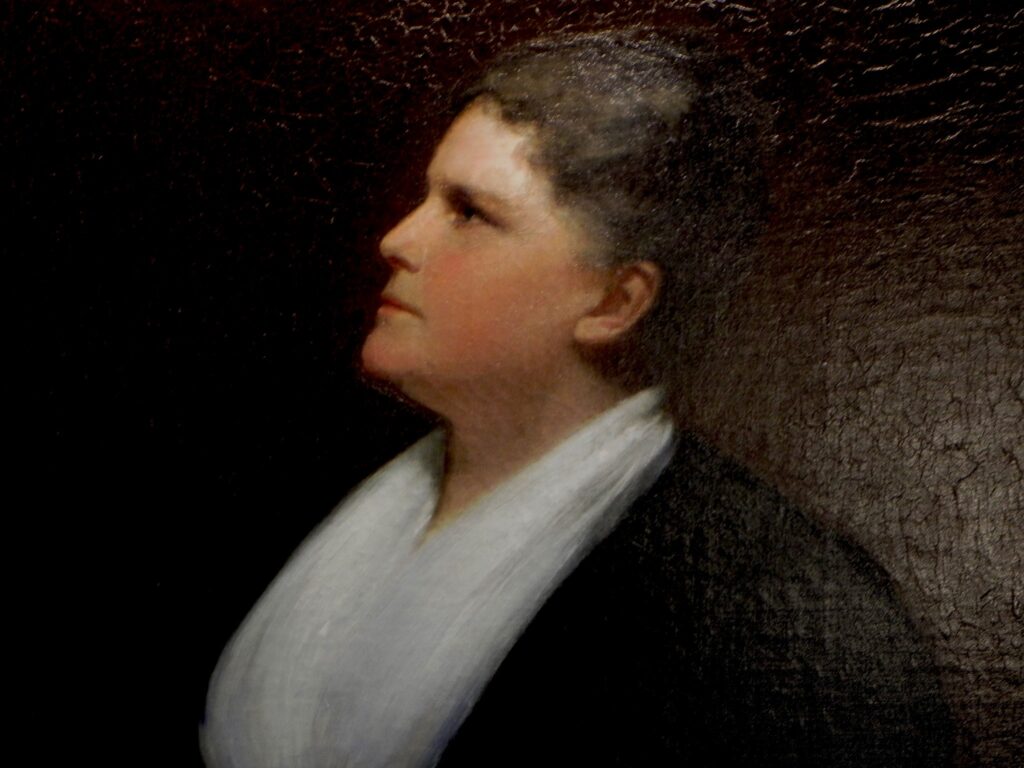
-Celia Laighton Thaxter was no saint. The famed 19th-century poet of the Isles of Shoals harbored many of the racial, social and cultural prejudices of her day. She often mistook rumors, gossip, and legends as facts in her writing. In her later years, hoping to communicate with her long-dead parents, Celia fell prey to a “spiritual medium,” who was exposed as a fake.
But there is no questioning her many acts of kindness. Born in Portsmouth in 1835 and home-schooled on the Shoals by her father Thomas Laighton and her tutor (and later husband) Levi Thaxter, Celia evolved into a compassionate, creative and resilient figure. Her poetry and children’s stories made her one of the most-read American women writers of the Victorian era. Her delicate painting on cups, plates, and vases are highly collectible today. Her artistic summer salon drew writers, musicians, and painters to her family’s bustling resort on Appledore Island.
It was Celia Thaxter who nursed her ailing parents Eliza and Thomas Laighton. She kept her first son Karl, born with emotional problems, at her side throughout her life. It was Celia who nursed Maren Hontvet, the surviving victim of the 1873 murders on neighboring Smuttynose island, salving Maren’s slashed and bloody feet with arnica as she recounted her horrific escape from killer Louis Wagner.
VIctorian fashioin
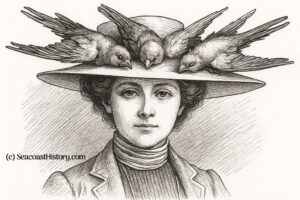
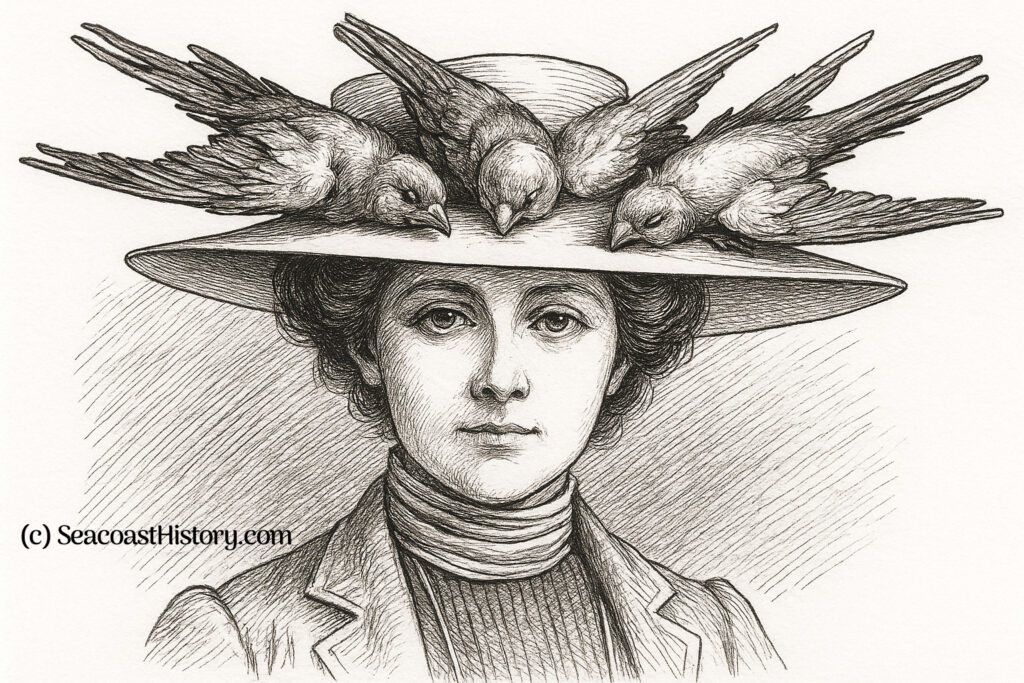
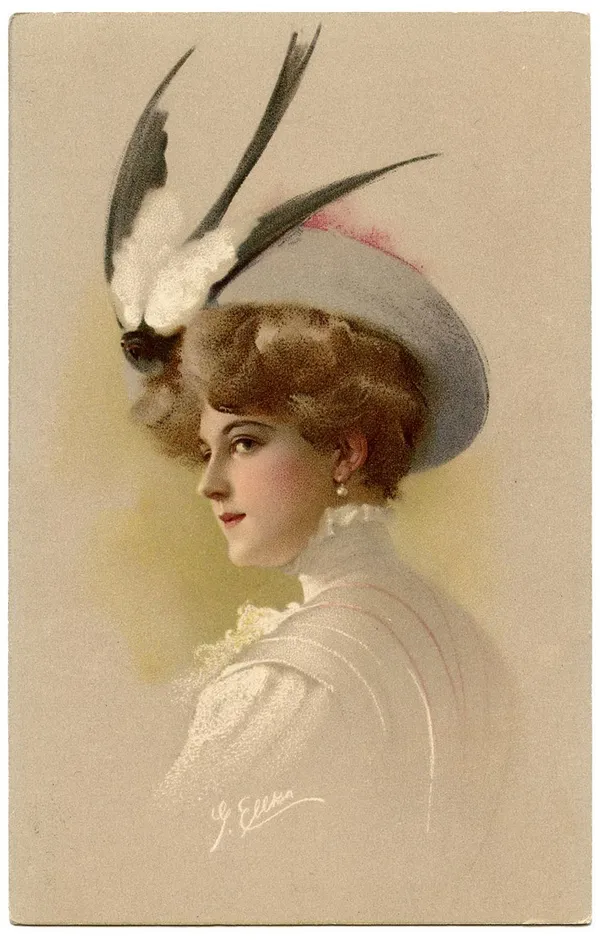
It became fashionable in Victorian times to wear the plumage and even the dead bodies of colorful birds attached to women’s hats. Celia abhorred this practice and fought to end this fashion statement. In 1887, she boldly penned an article decrying the practice. “Women’s Heartlessness” was among the first heartfelt environmental statements on the topic published in America.
Assuming that the trend would quickly fade, Celia was shocked to learn that women of privilege and social status were the worst offenders. When she argued the point, one cultivated and accomplished woman replied, “I think there is a great deal of sentiment wasted on the birds. There are so many of them, they will never be missed any more than mosquitoes. I shall put birds on my new bonnet.”
The famous writer pressed further, but the woman could see no reason to be concerned about preserving birds. “It was merely a waste of breath,” Celia concluded after their encounter, “and she went her way, a charnel-house of beaks and claws and bones and feathers and glass eyes upon her fatuous head.”
Heartless women
Not one in 50 women, the author wrote, showed any interest in the topic. “Why don’t you try to save the little fishes in the sea?” she was told by a snide lady wearing a “hideous” hat decorated with “dozens of warblers’ wings.”
“When these are worn out,” a few women reluctantly agreed, “I am willing to promise not to buy any more.” But birds never wear out, Celia lamented.
There were occasional victories. Now and then, Celia wrote, a sensible woman with good taste and a moral conscience would remove the colorful feathers and taxidermied bird corpses from her hat. “Heaven bless every woman who dares turn her back on Fashion and go about thus beautifully adorned!” the author exclaimed.
Raised as an independent “wild child” from the age of four on an isolated island kingdom, Celia Thaxter had no use for fashion. In “Women’s Heartlessness” she came close to railing against fashion itself. Why is it, she wonders, that “women must follow one another like a flock of sheep over a wall, and forget reason, forget the human heart, forget everything but the empty pride of being ‘in the fashion.’”
Waxing poetic, Celia called out to all colorful birds, advising them to wear a black coat like the carnivorous crow. But no, she says. Even blackbirds “are worn” for women’s vanity… Better that all birds fly to the Arctic and hide from the guns of men. Either that or ‘your dead body may disfigure some woman’s head and call all eyes to gaze at her!”
Environmental pioneer
“Oh, the birds!,” Celia wrote to her friend Feroline Fox in 1893. “I do believe few people enjoy them as you and I do.” The song sparrows and whitethroats were following her around her garden “like chickens” that summer, she wrote, and the hummingbirds and martins were landing on her head.
Illustrator John James Audubon (1785-1851) had long since printed his 435 colorful life-sized paintings in “Birds of America” and died by the time chapters of the Audubon Society began. Activist and naturalist George Bird Grinnell (his real name) and Boston socialite Harriet Hemenway are credited with forming the nonprofit organization to honor Audubon’s name and work.
In a letter to friend Feroline, Celia explained that she did not want to head up a league of the society, but preferred to fight on in her own way. “I cannot express to you my distress at the destruction of the birds. You know how I love them. Every other poem I have written has some bird for its subject, and I look at the ghastly horror of women’s headgear with absolute suffering.”
Celia Thaxter did join a Massachusetts chapter of the Audubon Society and served as secretary of a summer group at Appledore Island. Her article appeared in the society magazine in 1887. By that year an estimated 5 million birds were being slaughtered annually for use in the millinery business. Celia campaigned against the practice until her death in 1894, but the fashion continued well into the 20th century. It faded following the Migratory Bird Treaty Act of 1918.
Today, much of the Isles of Shoals has become a sanctuary for birds. Appledore Island, long the site of the Laighton family’s hotel, is now home to the Shoals Marine Laboratory, a renowned summer research institute for marine biology managed by Cornell University and the University of New Hampshire. Shoals Marine Lab students, like Celia Thaxter, find the region to be the ultimate classroom for the study of natural science amid a rocky and poetic landscape.
Author’s note: Many thanks to Peninah Neimark, editor of the Environmental Debate (2011), who suggested this article.
Copyright 2018 by J. Dennis Robinson, all rights reserved.
BONUS:
WOMEN’S HEARTLESSNESS
By Celia Laighton Thaxter, 1886
When the Audubon Society was first organized, it seemed a comparatively simple thing to awaken in the minds of all bird-wearing women a sense of what their “decoration” involved. We flattered ourselves that the tender and compassionate heart of woman would at once respond to the appeal for mercy, but after many months of effort we are obliged to acknowledge ourselves mistaken in our estimate of that universal compassion, that tender heart in which we believed. Not among the ignorant and uncultivated so much as the educated and enlightened do we find the indifference and hardness that baffles and perplexes us. Not always, heaven be praised! But too often,–I think I may say in two-thirds of the cases to which we appeal. One lady said to me, “I think there is a great deal of sentiment wasted on the birds. There are so many of them, they will never be missed any more than mosquitoes. I shall put birds on my new bonnet.” This was a fond and devoted mother, a cultivated and accomplished woman. It seemed a desperate case, indeed, but still I strove with it. “Why do you give yourself so much trouble?” she asked. “They will soon go out of fashion, and there will be an end of it.” That may be,” I replied, “but fashion next year may order them back again, and how many women will have human feeling enough to refuse to wear them? It was merely waste of breath, however, and she went her way, a charnel-house of beaks and claws and bones and feathers and glass eyes upon her fatuous head.
Another, mockingly, says, “Why don’t you try to save the little fishes in the sea?” and continues to walk the world with dozens of warblers’ wings making her headgear hideous. Not one in fifty is found willing to remove at once the birds from her head, even if, languidly, she does acquiesce in the assertion that it is a cruel sin against nature to destroy them. “When these are worn out I am willing to promise not to buy any more,” is what we hear, and we are thankful, indeed, for even so much grace; but alas! birds never “wear out.” And as their wearer does not carry a placard stating their history, that they were bought last year, or perhaps given to her, and she does not intend to buy any more, her economy goes on setting the bad example, or it may be her indolence is to blame, one is as fatal as the other. Occasionally, but too rarely, we meet with a fine spirit, the fire of whose generous impulse consumes at once all selfish considerations, who recognizes the importance of her own responsibility, and whose action is swift as her thought to pluck our the murderous sign, and go forth free of its dishonor. And how refreshing is the sight of the birdless bonnet! The face beneath, no matter how plain it may be, seems to possess a gentle charm. She might have had birds, this woman, for they are cheap and plentiful enough, heaven knows! But she has them not, therefore she must wear within things infinitely precious,–namely, good sense, good taste, good feeling. Heaven bless every woman who dares turn her back on Fashion and go about thus beautifully adorned!
In one of the most widely circulated newspapers the fashionable news from Paris begins: “Birds are worn more than ever.” Birds “are worn!” Pitiful phrase! Sentence of deadly significance! “Birds are worn,”—as if that were final, as if all women must follow one another like a flock of sheep over a wall, and forget reason, forget the human hear with, forget everything but the empty pride of being “in the fashion.” Ah me, my fire-flecked oriole, watching your airy cradle from the friendly swinging elm bough, go get yourself and inky coat. Your beauty makes you but a target for the accursed gun that shatters your lovely life, quenches your delicious voice, destroys your love, your bliss, your dutiful cares, your whole beautiful being, that your dead body may disfigure some woman’s head and call all eyes to gaze at her! But no,–that will not save you. Blackbirds are not safe, they “are worn.” Carrion crows “are worn,” unsavory scavengers though they be. No matter on what they may have fed,–they “are worn.” Soar, swift sea-swallow,–I would it could be millions of miles away from the haunts of men; to the uttermost parts of the earth and the ocean carry your grace, your slender loveliness of shape, your matchless delicacy of tint and tone of color, soft, wondrous like gray cloud and silvery snow,–fly! dear and beautiful creature; seek the centre of the storm, the heart of the Arctic cold, the winter blast, they are not so unkind as—woman’s vanity. Do I not see you every day, your mocking semblance writhing as if in agony round female heads,–still and stark, sharp wings and tail pointing in stiff distress to heaven, your dried and ghastly head and beak dragged down to point to the face below, as if saying, “She did it.” The albatross of the Ancient Mariner is not more dreadful. . . .
I would the birds could all emigrate to some friendlier planet peopled by a nobler race than ours, where they might live their sweet lives un molested, and be treated with the respect, the consideration, and the grateful love which are their due. For we have almost forfeited our right to the blessing of their presence.
But still we venture to hope for a better future, still the Audubon and other societies work with heart and soul, to protect and save them, and we trust yet to see the day when women, one and all, will look upon the wearing of birds in its proper light,–namely, as a sign of heartlessness and a mark of ignominy and reproach.
SOURCE: Celia Thaxter, Woman’s Heartlessness (Boston 1886; reprinted for the Audubon Society of the State of New York, 1899), in National Audubon Society records, 1883-1991, Manuscript and Archives Division, Humanities and Social Library of the New York Public Library, Section C (Box C32, New York State Audubon Society folder).
 The Forgotten Founders of the Wentworth Hotel