


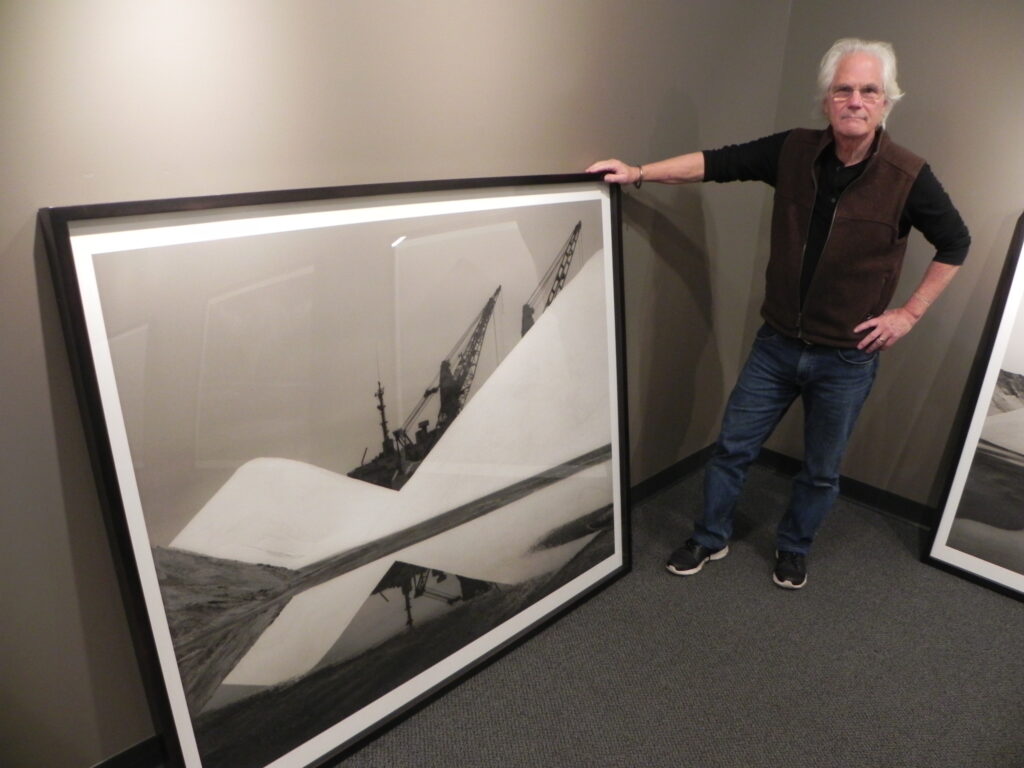
As gallery exhibitions go, this one was monumental. It’s not just the huge photographs taken by Carl Austin Hyatt. Some of Carl Austin Hyatt’s powerful black and white landscape photographs measured four-by-four feet. And it’s not simply that they depict actual mountains, which they do. Hyatt’s subjects range from the looming white salt piles of Portsmouth to the towering mountains of Peru. They speak of things so truthful that they often defy words.

“As a child, I always felt that Nature was conscious, alive!,” Hyatt said in a recent documentary about his work. “Of course, in our Western culture, we’re taught that it’s basically inert inorganic stuff. There’s nobody home. But Nature is not stuff. It’s alive, it’s conscious, it’s aware.”
Over 40 of Hyatt’s images were on display at the Portsmouth Historical Society in 2019, but their memory lingers. The popular exhibition was appropriately titled “From Portsmouth to Peru: In Search of Anima Mundi.” If your high school Latin has faded, “anima mundi” refers to the essential connection between all living things on Earth. It is the “soul of the world.”
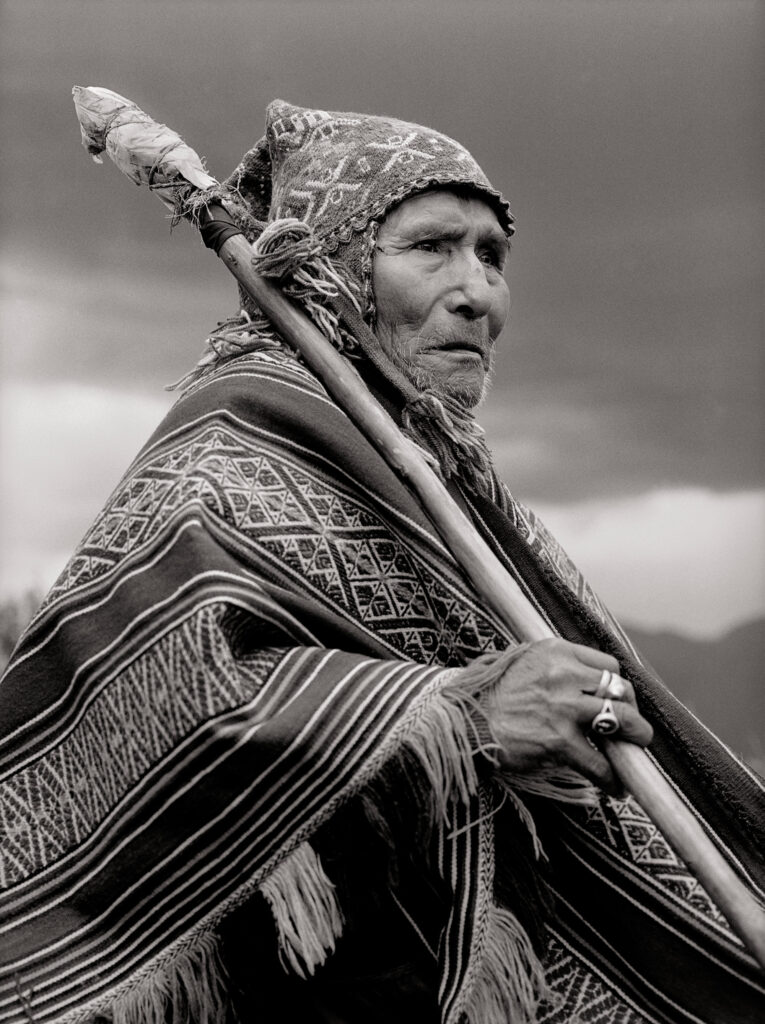
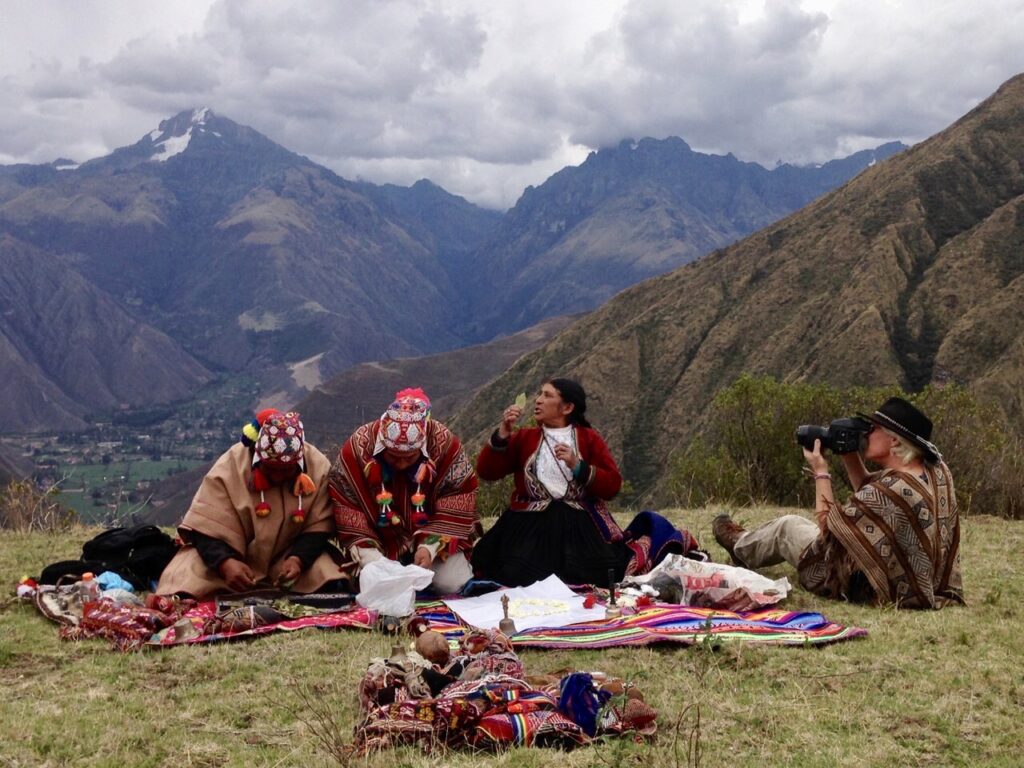
A native of Connecticut, Hyatt arrived in Portsmouth in the mid-1980s, setting up his studio among other artists in the old Button Factory in the West End. As a fine artist, his search for the meaning of life eventually brought him to the indigenous shamans of Peru. These are people, Hyatt discovered, who continue to believe that the Earth is conscious and alive. He has returned to the Andes for the last 20 years and photographs of these spiritual healers are included in the new exhibition.
“I never expected to fall so profoundly in love with the people and the land,” Hyatt says of his visits to Peru. He sees their ancient message as especially timely. “The indigenous people of the world know how the climate works. And we are disconnected from Nature. We don’t know how it works. We just want to use it.”
“When you decide that Nature is dead,” Hyatt continues, “then you are profoundly alone in the universe. And for the human psyche, that’s a tragedy.”
“I moved here because of the rocky coastline,” he explained. His portraits, many including the rocky shore, are produced in three ways: digital, silver, and platinum. The massive images are digital prints or pigment ink on watercolor paper. The traditional silver prints created in his darkroom run to 16 by 20 inches.
The artist moves down a sunlit hall and picks up an 11-by-14 inch seascape created using the costly and complex platinum system. Invented in 1873 this is a contact printing process in which the chemicals are brushed onto paper. This creates a more painterly image that is prized as fine art by art lovers, galleries, and museums.
“I aim very high,” Hyatt said of his work that hangs in private collections across the United States, Europe and South America. It can be seen at The Boston Museum of Fine Arts, the Smithsonian Museum in Washington, D.C., and the Currier Museum in Manchester.
In the brief history of fine art photography, Hyatt’s work falls into the aesthetic of famous names like Ansel Adams, Edward Weston and Paul Strand. But much has changed since digital photography arrived “like a tsunami” about a decade ago, Hyatt saod, both altering and expanding the fine art world.
Hyatt’s exhibition flowed around all four walls of the Balcony Gallery and into the more intimate and modern Special Events Gallery next door, where some of his most monumental images are being installed. During this interview, a photograph of the highlands of Peru was being installed. It was less a framed picture than a picture window into a distant world.
An equally large print of the Portsmouth salt pile was positioned nearby. The two mountains appeared to be in silent conversation. Critics of Hyatt’s work often struggle to explain what his pictures are saying. They use words like “visceral, profound, ethereal, cosmic and enlightened.” But what the two mountains are saying to each other is where words fall short.
What is “anima mundi?” One could say Hyatt sees landscapes in the craggy face of a Peruvian shaman and in the curled muscular form of a nude model. But he also hears mountains talk and watches the rocky New England coastline dance.
Copyright J. Dennis Robinson, Photos courtesy of the photographer.
 A Few Words from Dorothy Vaughan