


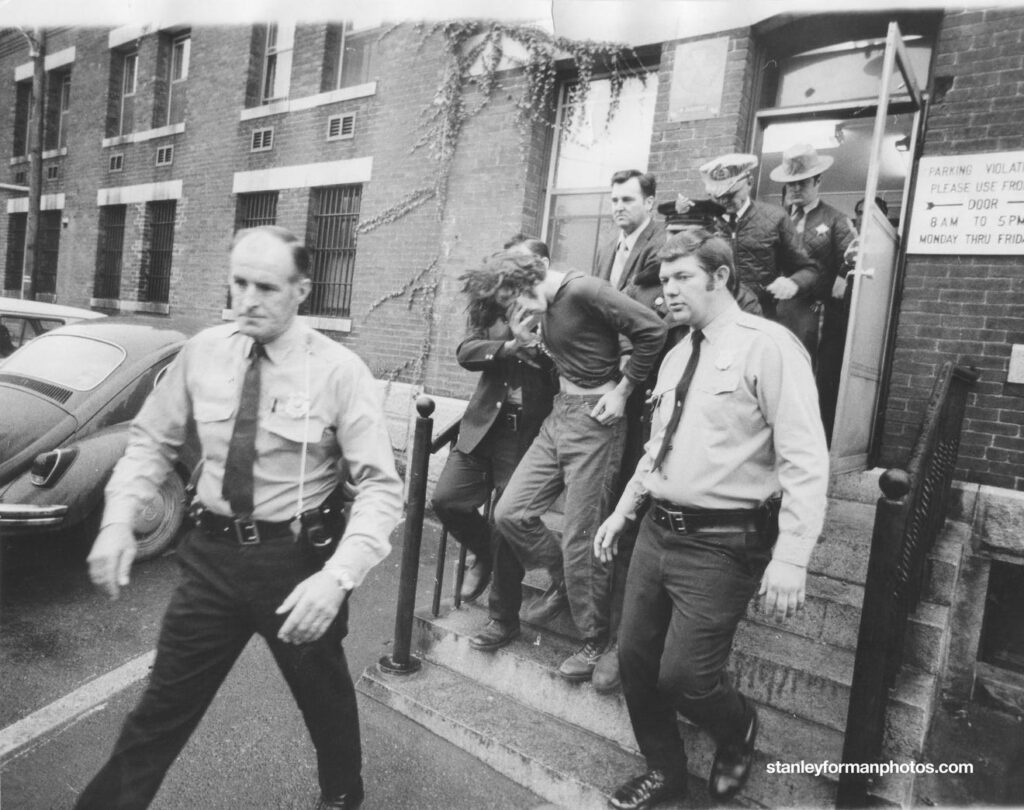
It looked, at first, like a dramatic newspaper photo of just another day of crime prevention in Portsmouth. The black and white photograph shows a young man in chains being escorted from the former Portsmouth Courthouse on Penhallow Street by half a dozen law enforcement officers. The suspect holds one shackled hand over his face to avoid the press camera.
That was November 2, 1971. Peter Yuhas, 17, was being extradited to Boston. Yuhas and his friend Arnold King were suspected of shooting John Labanara, 26, on Newbury Street two weeks earlier. Labanara, who had just passed the state bar exam, worked for Boston Mayor Kevin White’s re-election campaign. King, now 67, admitted shooting Labanara as he sat in his Volkswagen on Newbury Street. King, who is African American was sentenced to life in prison, but was released in 2020 pending a new trial based on issues of racial bias.
Peter Yuhas’ brief life was filled with tragedy. His father, Charles, was among the 33 men who survived the sinking of the USS Squalus submarine in 1939. Twenty-six men died, but Yuhas was among those rescued from the sub 240 feet underwater by the “Momsen lung” diving bell invented by Charles Momsen.
But Peter’s father and his mother Rose both died in 1965 when he was only 12. Raised by relatives, according to one account, he grew restless and resentful. In early November 1971, he was hanging out with his friend King, who had been released from a prison term for robbery only two days earlier. The two Portsmouth teens, under the influence of drugs, took a late night ride to Boston with a female friend, the mother of three. They returned to Portsmouth after the murder and were tracked there by Boston police.
Peter Yuhas pled guilty to second-degree murder, but did not live long enough to serve his sentence as King’s accomplice. The day after his trial he was diagnosed with leukemia. In August of the following year, Yuhas reportedly climbed out a window of the Boston City Hospital and caught a night bus to Portsmouth. “I just wanted to go home to die,” he said when re-arrested. He died on Sept. 4, 1972 and is buried in Calvary Cemetery.
The dramatic image of Yuhas’ extradition from Portsmouth appeared in Boston’s Record American Sunday Advertiser. Whoever typed the details on the back of the photo got the date wrong and misspelled the name of both the murder suspect and the photographer. The picture was taken by Stanley Forman who would go on to win three Pulitzer Prizes for photography.
No stranger to tragedy, Forman shared in a team Pulitzer for coverage of the “Blizzard of 1978.” His winning 1976 photograph depicts a White desegregation protester attacking a Black lawyer with the spear-end of an American flag. And on July 12, 1975, Forman was covering a Boston fire on Marlborough Street. His camera was focused on a 19-year old woman and her two-year old goddaughter standing on a fire escape as a rescue ladder approached. Suddenly the fire escape collapsed. Forman’s horrific images show the two victims frozen in mid-air as they fell to the pavement. The child survived and the photograph inspired fire escape safety legislation across the nation.
Text copyright J. Dennis Robinson
 Portsmouth Naval Shipyard Closing “Irrevocable” in 1964