


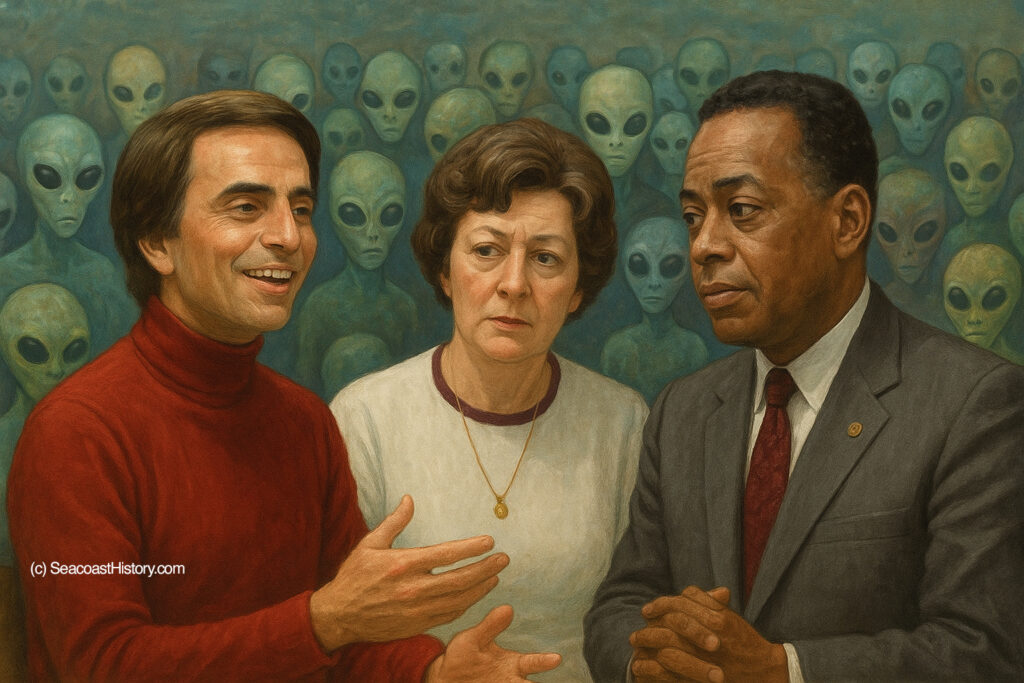
Following the release of John G. Fuller’s best-selling paranormal book “Interrupted Journey” (1966), Betty and Barney Hill left their Portsmouth, NH home for a whirlwind media tour. Appearing on television shows, at book signings, and in lectures to explain the couple’s alleged abduction by extraterrestrials was especially stressful for a media-shy Barney Hill. In 1967, the Hills and Fuller braved a live discussion with six serious-minded critics. The prestigious panel included Harvard professor Carl Sagan and Dr. Leon Jaroff, science editor for TIME magazine. The hour-long radio show entitled “Captured by a UFO” aired on CBS affiliate WNEW. Following an eerie orchestral introduction, host David Schumberg spoke up.
“We’re gathered together tonight to hear an extraordinary story,” he began, “one of the most fascinating stories in the history of man. Whether it is true or false is something you will judge.”
A former teacher, Schumberg had been a war correspondent in France before he was recruited to CBS by the legendary Edward R. Murrow soon after World War II. “Witty and versatile,” according to the New York Times, Schumberg was a balding chain-smoker with a face fit for radio. A friend once described him as “a mustache that slanted down and eyebrows that slanted upward.”
At the time of his interview with the Hills, Schumberg was working on a biography of French President Charles de Gaulle, whom he had interviewed often. He was also writing a book about the escalating Vietnam War. Confronting a mixed-race couple who had reportedly been aboard a flying saucer was not his standard radio fare.
Schumberg allowed Betty and Barney to tell their story in great detail for a full 20 minutes while the distinguished panel of scientists sat silently. The host’s tone was unwaveringly serious and respectful. Wrapping up the first half of the show, he asked the Hills bluntly, what they thought had happened to them on September 19, 1961.
“Ask Betty first,” Barney insisted.
“I believe we were really captured,” Betty said confidently.
Forever cautious, Barney had been dubious from the start about Betty’s claim that they had seen a UFO while driving through the White Mountains of New Hampshire six years earlier. He had reluctantly accepted the possibility of their abduction by aliens after undergoing hypnosis sessions with Dr. Benjamin Simon, a noted Boston psychotherapist. Simon, who did not accept the couple’s abduction theory, had diagnosed Barney’s nervous condition as “racial paranoia,” a detail Fuller had played down in his book about the Hills.
“I can’t say, for definite, as to what definitely happened,” Barney hedged, “but apparently, if the hypnosis, which we were led to believe would be the method for opening up the amnesia, if these were not the facts, then what are the facts?”
Carl Sagan was first among the panelists to weigh in. The smooth-talking, dark-haired, son of Russian immigrants, Sagan was then in his mid-thirties. He was working at the Smithsonian Astrophysical Observatory and as a professor at Harvard. His Pulitzer Prize, all but one of his 20 popular books, and most of his hundreds of published articles were still unwritten at this early date. Sagan’s world renowned television series “Cosmos” with its catchphrase “billions and billions” of stars was yet to come.
Sagan’s first question was more like a lecture on the slow process of evolution by natural selection. Scientists would assume, he said, that beings who had evolved on a distant planet in a very different environment over eons would look very different from humans from earth, he explained. And yet, Sagan noted, the Hills had been taken aboard a “supposed extraterrestrial vehicle” by humanoid beings with heads, hands, two eyes, nose, arms, legs, and feet. They were wearing clothes, according to the Hills’ hypnosis tapes, even hats. The mathematical possibility of such a coincidence was beyond calculation, Sagan said. There was an “intrinsic implausibility” about the whole story.
“The thing that strikes me most,” an unidentified panel member interjected, “was the fact that, not only did these creatures breathe the Earth’s atmosphere with no difficulty, but you were able to breathe the spacecraft’s atmosphere with no difficulty.”
“Is that a question?” Barney asked defensively.
Time science editor Leon Jaroff, then drilled in on the shiny circular spots seen on the Hills’ car. Jaroff would write at least 40 cover stories for Time, including memorable issues on test-tube babies and the demise of the dinosaurs. He went on to become managing editor of the slick, monthly, science-oriented magazine Discover.
Jaroff was concerned that Betty’s compass tests on their car, the only “tangible evidence” the Hills could come up with, was uncorroborated. Barney agreed, and as he had in other interviews, said he had not found his wife’s theory to be important evidence and did not participate in it.
“Are those spots still there, and if not, what happened to them?” This question came from Edward Edelson of the World Journal Tribune. With his tweed sport coat, distinguished high brow, and large glasses, Edelson looked more like a professor than a journalist. When the Tribune folded that same year, he went on to write and edit articles on science, medicine, and technology for the New York Daily News.
“The spots gradually wore away over the winter months,“ Betty explained, sounding annoyed at this line of inquiry. “And we don’t have the car now.”
When asked if they had any other actual evidence of their close encounter, Barney Hill mentioned that the tips of his shoes had been badly scuffed up, possibly from when the aliens had half-carried him up the ramp and into the flying saucer. Dr. Leon Jaroff politely noted that this, again, was anecdotal, not scientific evidence.
“It’s my word,” Barney admitted. “There’s no proof to it.”
Barney’s scuffed shoes, the TIME magazine editor pointed out with wry humor “could have happened in any earthly experience.”
“That’s correct,” Barney agreed.
Following a quick discussion of the beeping sounds the Hills reported hearing while driving in the White Mountains, Prof. Sagan shifted the topic to Betty’s “needle incident.” The probing of her navel, Sagan said, implying she had dreamed it up, sounded “particularly Freudian.” Fuller jumped in to suggest that the subject of the probe “should not be discussed publicly.”
Betty, however, wanted to insert one more point. She had since learned, she said, that needles were used in hospitals to collect blood samples from the navels of infants. Host David Schumberg, seemingly unwilling to make the leap from alien abduction to post-natal childcare, asked a follow-up. “Didn’t Betty say the aliens plunged a large needle into her navel?”
“It was a long needle,” Betty corrected, not large. “I can’t say as if it was plunged in. But they started to insert it, and I had pain.”
“But there was no blood or physical evidence of puncture?” he pressed.
“I wasn’t aware of this until 1964,” she replied, referring to the taped hypnosis session, deflecting Schumberg’s query.
“Well, whenever it happened, if it did happen,” the host continued, his tone now doubtful, “you didn’t detect any wound on your body?”
“No,” Betty replied quietly, as if wounded by the comment.
Schumberg paused for a commercial message. When it was over, he gave a succinct summary of an interview he had previously done with psychiatrist Dr. Benjamin Simon, whose hypnosis tapes were the heart and soul of Fuller’s book. According to Simon’s testimony, the Hills were not perpetrating a fraud. Nor, Simon believed, was this a likely case of Folie à Deux, in which two people had gone crazy at the same time from a shared delusion. However, the idea that the Hills had actually seen and gone aboard a flying saucer, Dr. Simon had told Schumberg was “a very remote possibility.”
Simon’s working hypothesis, according to Schumberg’s notes, was that “there was very strong evidence of dream content” in the hypnosis tapes. While Betty and Barney had certainly told the truth under hypnosis, Simon noted, it was their own personal truth, which did not necessarily match reality. The Hills, or at least Betty Hill, had demonstrated “a very strong stimulus toward believing the existence of the flying saucer” from the moment of the first sighting. They had seen a UFO, Simon agreed; there was something in the sky they could not fathom. The dream hypothesis, Simon told Schumberg, was the most likely explanation.
John Fuller then admitted that his research with Dr. Simon for “The Interrupted Journey” had been “a long hard pull.” Without Simon’s tapes there would have been no book. Dr. Simon could not confirm that the Hills had been abducted by aliens, in Fuller’s view, “because it is not documented anywhere in scientific history.”
“This is the main reason,” Fuller continued vigorously, “why I think it is most important that the scientific fraternity turn toward the masses of the other cases which are appearing right now.”
This was too much for Sagan, who interrupted Fuller. “There is no doubt that there are a fair, small, fraction of these sightings that remain unknown,” Sagan said. “That is very different from saying that the only possible explanation of these unknowns is that they’re space vehicles from another planet.”
And here, in microcosm, was the divide that continues to this day. While Betty Hill would spend the coming decades developing a working explanation for her imagined encounter, Sagan was willing to let the unknown remain unknown. “The mere fact that we don’t know, means just that,” Sagan said. “It doesn’t mean that extraterrestrial visitation is the only explanation.”
“I’d just like to point out,” Edward Edelson interjected, “that if these are visitors from another planet, they’re going about this in a very illogical, let‘s say unearthly way … They have gone to very great expense to come long distances, and yet, somehow, they don’t want to open contact with us. They seem to delight in deserted places and hard maneuvers.”
Ten years later, in a newspaper review of the newly released film “Close Encounters of the Third Kind,” Edelson did not mince words. “Fun is fun, but science is science,” he wrote. “And the consensus in science is that UFOs aren’t messengers from the devil or from another planet. They’re just funny lights in the sky. Period.”
“Dr. Sagan does not believe in UFOs,” Betty wrote incorrectly to UFO investigator Walter Webb following their appearance on the show, “but we met him in Boston one night and he wants to visit us in Portsmouth to discuss UFOs, and our experience, so we invited him to visit any time.”
For Betty, who would go on to “document” hundreds, even thousands, of UFOs in the decades following Barney’s death in 1969, the lights she saw in the night sky were controlled by aliens. UFOs, for her, became inseparable from extraterrestrials. For Sagan, they were not. After their first close encounter in 1967, the believer and the scientist would clash again and again through the media. But Dr. Sagan would never show up at the Hill house in Portsmouth, New Hampshire.
Copyright 2021 by J. Dennis Robinson, all rights reserved.
 Fascinated by Harriet Livermore