

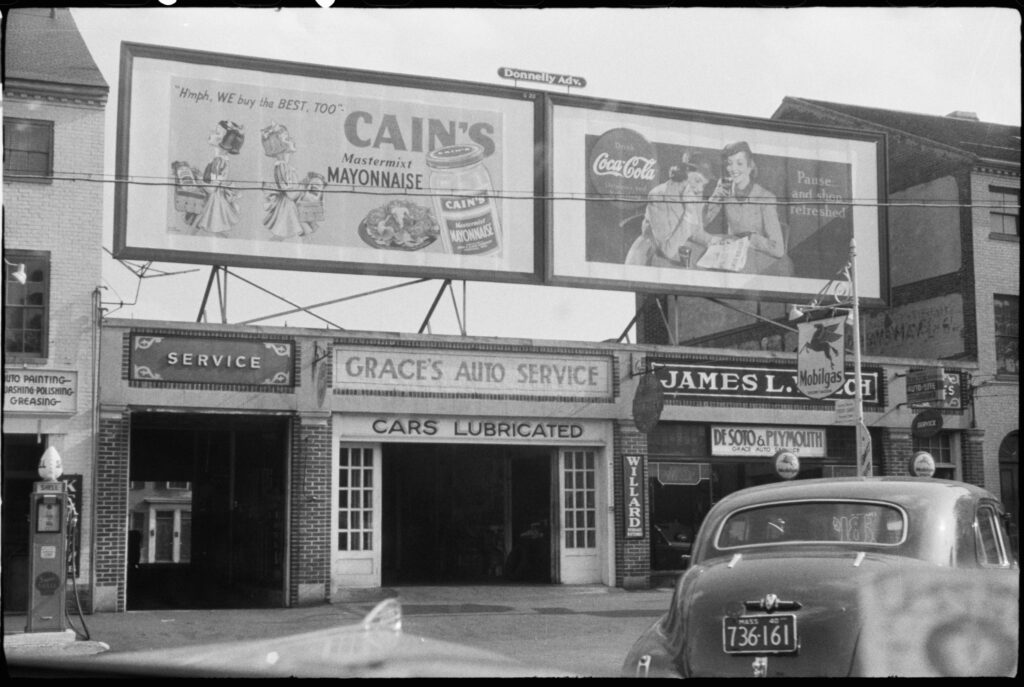
Newcomers who gravitate to our attractive downtown may not realize just how gentrified and squeaky clean Portsmouth has become in recent years. Here, in evidence, is a shot of 68 State Street. The rebuilt address is just up the street from Prescott Park that was once dominated by rotting wharves, looming water tanks, and industrial coal pockets.
A closer look at this photo shows three thriving businesses. Grace’s Auto Service on the left was what one local writer jokingly called a “lubricatorium.” Founded in 1919 by Harold and Ronald Grace, the family business boasted a second location in Kittery. Around 1940, when this picture was taken, Grace’s Auto specialized in Plymouths and DeSotos, “the great American family car.” A large newspaper ad offered the “bigger & wider” 100-horsepower Desoto Coupe for $845 and the Sedan for $905.
Next door, to the right, was J.L. Welch, another family business launched in 1919. Both Grace and Welch were loyal Portsmouth Herald advertisers. Throughout World War II Grace and Welch were among a group of Portsmouth companies that sponsored full page ads encouraging readers to keep buying US War Bonds.
James R. Welch was operating a radio and electrical supply shop on Bow Street in the 1920s. A Herald ad from 1928 showed J.R. Welch offering the hottest new technology. Their “Revolutionary Atwater Kent Radio” was as big as a breadbox and could run on AC house current rather than gigantic batteries. The radio was on sale for $88 plus $37 for the speaker, each in its own cabinet.
Son John Welch took over the business in 1947. The company relocated to Court Street, but was required to move from the “Strawbery Banke colonial restoration area” in 1964, and settled on Hanover Street. Welch specialized in ignition, tune-up, and carburetor work.
Hovering above the two garages are massive billboards. The one on the left depicts two housewives who both prefer Cain’s “Mastermixt” mayonnaise. On the right, two fashionable women are drinking Cokes as they “pause refreshed” before continuing their shopping.
Both billboards were owned by the Donnelly Advertising Company of Boston. Founded in 1850, Donnelly had been part of the “Poster War” of 1898 in which competing companies pasted over one another’s billboards, sometimes leading to fistfights. The company boomed in the 20th century with the addition of neon and electric signs, including the famous SHELL sign on the Boston skyline.
The company experienced a financial boom in the 1930s. One newspaper cartoon showed company president Edward C. Donnelly Jr., standing on a ladder and plastering signs on the face of the moon. In the 1960s public opinion turned toward beautifying the nation’s cities and roads and getting rid of billboards. Donnelly Advertising fought back with billboards showing a long-haired Bob Dylan-style young man.The huge signs read: “Beautify America–Get a Haircut.”
Copyright J. Dennis Robinson, photo from the LIbrary of Congress
 A Big Bridge and a Little Girl in 1923