


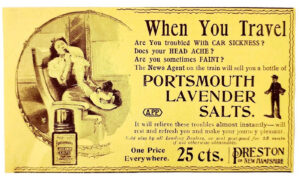
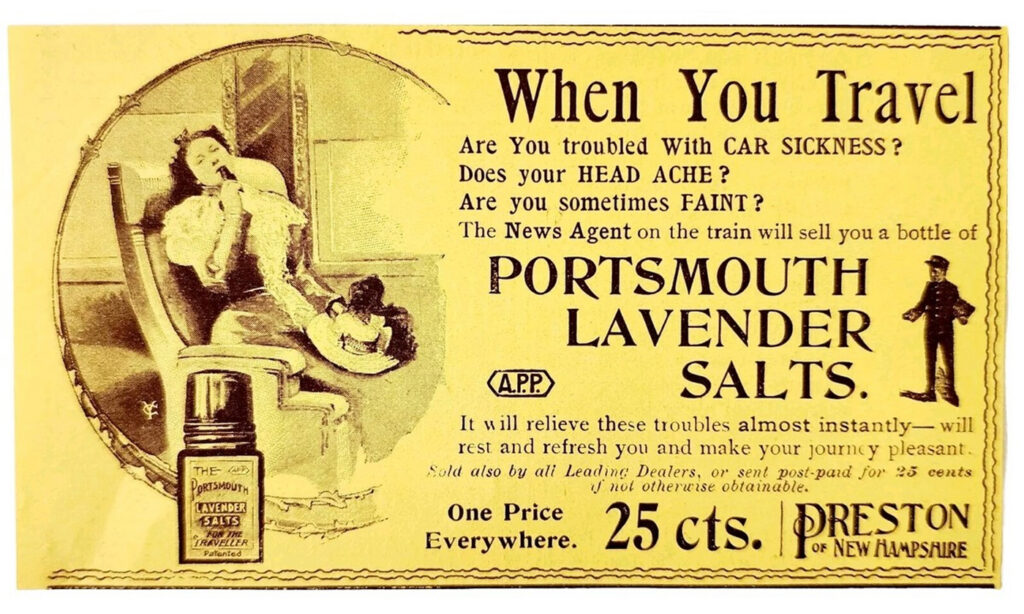
Our Victorian ancestors fainted a lot. To keep in fashion, women wore tight corsets that restricted breathing. The resulting dizzy spells were known as “the vapours.” A little swooning, now and then, was considered attractively feminine in a male-dominated culture.
To ward off a spell, women often carried a decorative bottle of smelling salts known as “vinaigrettes.” A sniff of the powerful mixture helped stimulate breathing. Shoppers preferred “lavender salts,” the lavender scent helped mask the sharp smell of ammonium carbonate. Portsmouth Lavender Salts from the Preston company was among the most popular brands. Lavender was also a popular scent for furniture polish, laundry fresheners, and sachets scattered in bureau drawers.
READ ABOUT: June Leaves, a newspaper for women
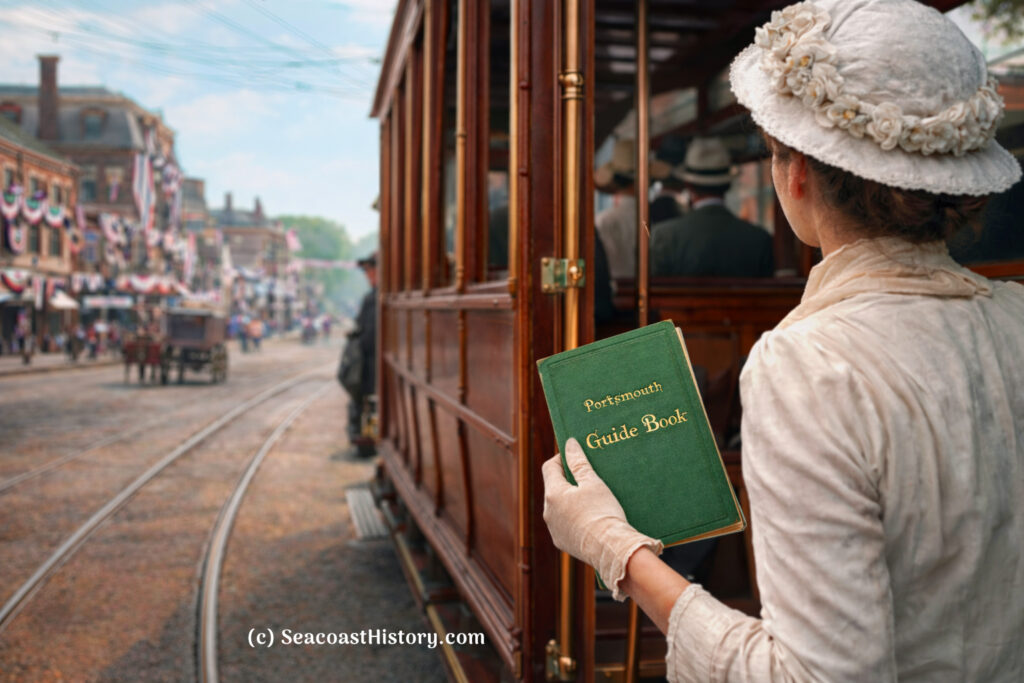
An Exeter reader of this column kindly sent a fragile clothbound copy of The Portsmouth Guide Book, by Sarah Haven Foster (1827-1900). Sarah’s name does not appear in the original 1876 edition. Although the city’s first portable walking tour was designed specifically for women, it was considered unseemly, at the time, for the author to reveal that she was female.
The booklet was reprinted in 1896 and again in 1902, two years after Sarah’s death, with her name finally attributed. The back few pages include advertisements, in the first edition, for everything from cakes to carpets, for stereoscopic “view cards,” and for Miss Morgan’s School for Young Ladies. Sarah’s early ads reflect her audience with offers for seacoast hotels, hats, umbrellas, horse-drawn taxis, “teeth brushes,” traveling bags, and wooden trunks.
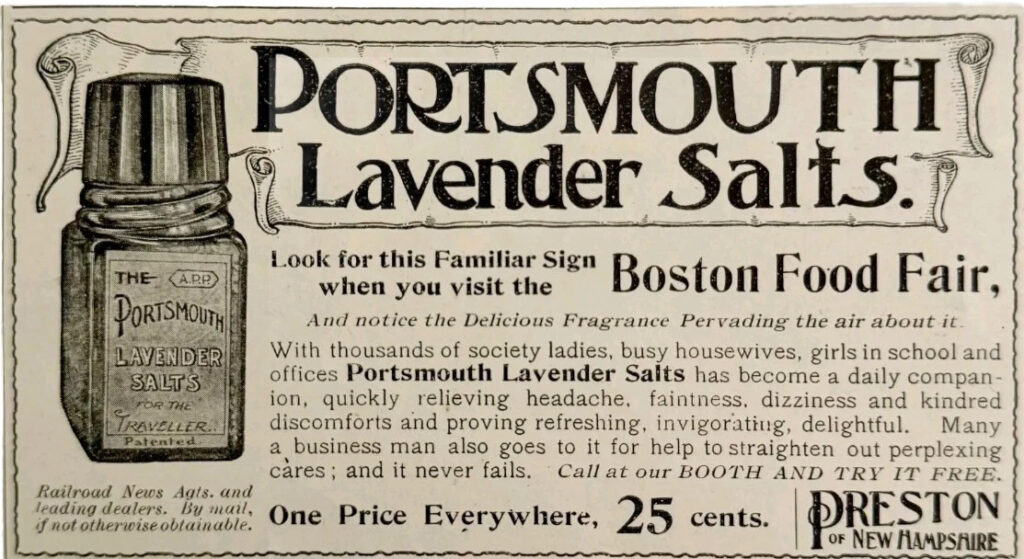
The 1902 edition includes this illustrated ad for Portsmouth Lavender Salts–for the traveller, available at Preston’s Pharmacy in Market Square. Bottled essence of sweet-smelling lavender was a hugely successful product for fainting spells, headaches, and motion sickness, among other complaints.
Long after his death in 1879, a series of Portsmouth projects created by physician William Rantoul Preston, were still selling briskly in town and through a mail order business. Consumers were invited to visit the company’s laboratory on Bow Street, near St. John’s Church. Another early ad for Preston’s “Portsmouth Specialties” lists the doctor’s famous “1886 Tooth Powder,” Rivermouth Sachets (a reference to books by Thomas Bailey Aldrich), plus Portsmouth-branded powders, cold cream, and cologne. Preston’s line of toilet accessories, the ad reads, were “prepared from formulas adopted after the most careful study and experiment, and they are designed to please the most critical people.”
© J. Dennis Robinson
 How Portsmouth Attracted Tall Ships in the 80s