


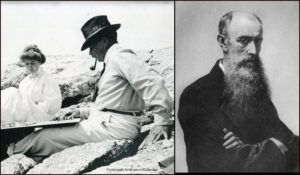
If a vote were taken today for the most famous artist to summer at the Isles of Shoals, Frederick Childe Hassam (1859-1935) would win hands down. “America’s finest Impressionist painter” began visiting Appledore Island in 1886. He returned for almost 30 summers and produced over 300 paintings of the Shoals. His colorful work continues to major exhibitions, books, and art prints.
It was poet Celia Thaxter who invited Hassam to join her creative summer salon. She also commissioned him to provide the illustrations for her best-known book, An Island Garden, published just after her death in 1894. It was Celia who convinced the up-and-coming artist to drop his first name and stick with Childe Hassam.
A native of Dorchester, MA, the naturally talented young Hassam trained as commercial engraver, moved to freelance black-and-white illustrations, before turning to watercolor and oils. After a tour of Europe he was influenced in the 1880s by artist William Morris Hunt who brought atmosphere and light to his landscapes by painting in nature. Hassam had a long and lucrative career, producing thousands of works. Although his impressionistic style fell out of favor, it has enjoyed a rebirth since the 1960s.
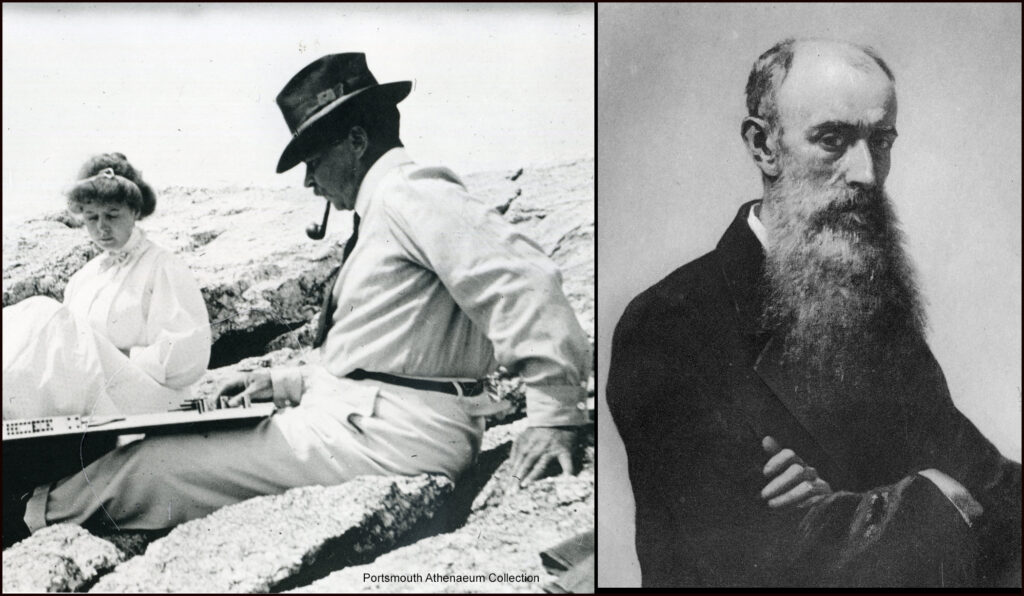
William Morris Hunt (1824-1879) was born in Brattleboro, Vermont. He and Celia’s husband Levi Thaxter, were both from prominent families and were college chums at Harvard. (And they grew to look hauntingly similar.) Trained in Italy and France, Hunt became an acclaimed Boston portrait painter and was a close friend of the Thaxters.
In July of 1879, Hunt arrived at the Isles of Shoals for a long visit with the Thaxters. On September 8, at age 55, the famous artist was discovered drowned in a tiny pond near the center of Appledore Island. Hunt had gone out for a morning walk alone, and when he did not return, a search party fanned out across the small island.
“I found him,” Celia Thaxter wrote to a close friend. “It was reserved for me, who loved him truly, that bitterness.”
Hunt’s glittering watch chain swung back and forth as his tall thin body was carried up the rocky path and placed on the piazza of the hotel where he had been sitting, watching the birds and listening to music all summer.
“We took him in,” Celia wrote, “put in blankets, rubbed and rubbed. It was mockery. He had been dead for hours.” Originally reported as a suicide, the cause of death was later amended to accidental drowning, but the debate over his mysterious death continues.
Copyright by J. Dennis Robinson, all rights reserved.
 Atlantic Heights Created for Garden Tours in 1918