

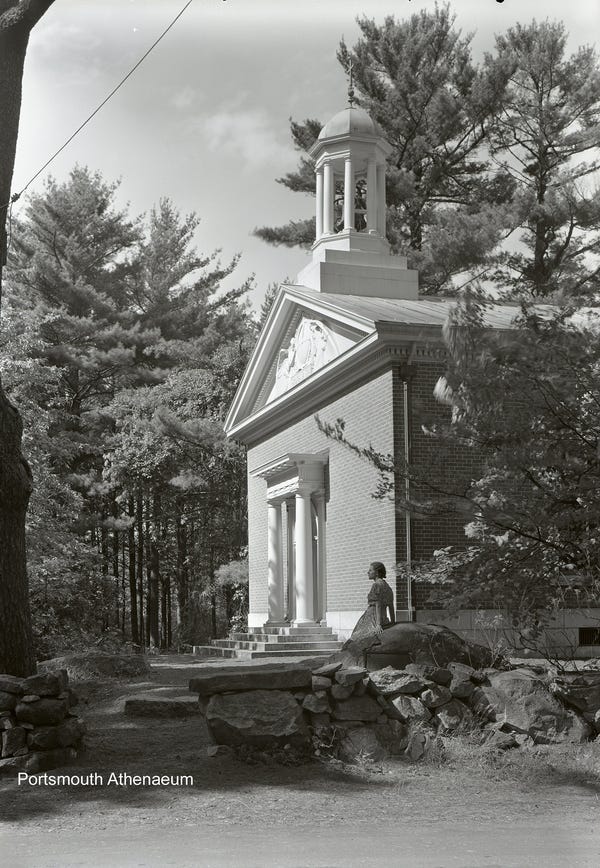
I’m showing my age, but this perfect little chapel among the pines always reminds me of the song “The Three Bells” (1959) by The Browns. It was one of the first 45 rpm records I bought with my own money. (You can listen to the song on YouTube.) I mentioned the Little Harbor Chapel earlier this week in a feature about millionaire Arthur Astor Carey. He built the chapel on his Creek Farm property down Little Harbor Road in Portsmouth. Carey’s historic 1888 cottage is in danger of immediate demolition by the Society for the Protection of NH Forests, which owns the property. The chapel, however, is now operated by a separate nonprofit group and in no danger of destruction.
Arthur A. Carey was descended from the nation’s first multi-millionaire, John Jacob Astor. Arthur, however, seems to have been a kind, gentle and artistic fellow who suffered from nervous tension and possibly a touch of upper-class guilt. He was drawn to the religious writings of Emanuel Swedenborg (1688-1772) that were a mash-up of science, philosophy, mysticism and the Christian New Testament.
Little Harbor Chapel was created as a space in the woods for non-denominational worship for summer visitors. It was designed to look like a 1744-era chapel at Harvard, Carey’s alma mater, and opened in 1902 as the “Chapel of the New Jerusalem.” The chapel seats about 70. Today it is open for summer services and can be rented for weddings, baptisms, memorial services, concerts and cultural events.
You’ll find plenty of images of Little Harbor Chapel online, including colorized postcards dating from 1905, the year of the Treaty of Portsmouth. I selected this black and white image by the late Douglas J. Armsden (1918-2009) of Kittery Point for a reason. Doug was a fantastic photographer and I was lucky enough to work with him on my book about Strawbery Banke Museum when he was in his 90s.
The Portsmouth Athenaeum recently obtained some 30,000 Armsden images. Digitizing, organizing, and archiving these photographs is a huge job. A $1,500 grant from the Rosamond Thaxter Foundation will go to purchasing archival supplies to house these images. The new acquisition will nearly double the size of the Athenaeum’s photographic collection. I’ve seen a few of these photos and there are some real gems.
According to an article by James Smith in the Athenaeum newsletter, Douglas Armsden “captured the essence of the mid-20th-century Seacoast region of New England and beyond.” Armsden documented local companies, shot weddings, and captured historic houses, scenery and events for magazines including Down East and NH Profiles. He also documented his service in World War II. Could the woman in the photo be Alice Walker Decatur, who married Doug in 1948? Their union was mentioned in The New York Times, and they lived at Kittery Point.
The archival supplies for the collection are estimated to cost over $6,500 and the nonprofit Athenaeum is seeking donations. Checks may be made out to the Portsmouth Athenaeum with “Armsden” in the memo line, or donors can go online to the donation page.
Copyright J. Dennis Robinson, all rights reserved.
 How Old Was the Daily Times Building?