


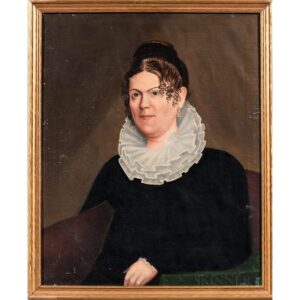
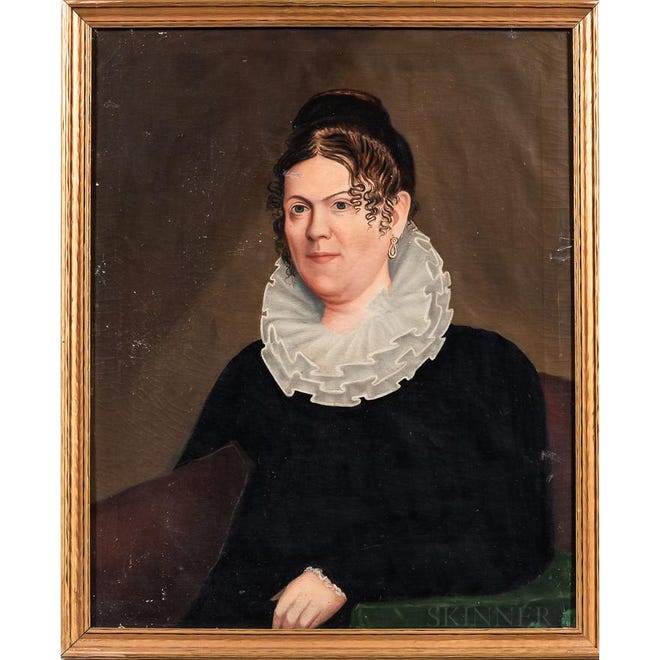
But today we’re headed across MIddle Street to the iconic mustard-colored John Paul Jones House Museum. Built in 1758, it has been home to the historical society since 1917. Inside the Colonial mansion, curator Gerry Ward is cataloguing an exciting new acquisition. The framed oil painting depicts a fresh-faced woman in a dark dress and an enormous triple-ruffled collar that harkens to the Elizabethan age. She gazes wide-eyed to her right, adorned only with a small earring. Delicate ringlets hang from her Regency-style hairdo.
“It’s our first Blunt,” Ward says proudly. “I’d love to have more.”
He’s talking about John Samuel Blunt (1798-1832), a hardworking and talented Portsmouth-born painter, best known for his maritime scenes, pastoral landscapes, and portraits. The son of a ship captain, young John was drawn to the sea, but also to making art. His grandfather piloted George Washington’s boat during that famous crossing of the Delaware River in 1776. A relative on his mother’s side designed the iconic grasshopper weathervane atop Boston’s Faneuil Hall.
Largely self-trained, John S. Blunt founded Portsmouth’s Pennimanic Society for the instruction of young artists. When commissions to paint ships and portraits ran dry, Blunt was available to hand-letter signs, and to paint ornamental “coffin plates,” glassware, leather fire buckets, mirrors, and household furniture.
In 1821 John married Esther Peake Colby of Newburyport, the mother of their six children. Making a living as an artist was especially tough during Portsmouth’s economic nadir. In 1825, he advertised a “Drawing and Painting School” in the Portsmouth Journal before moving to Boston in 1830. Struggling still, like so many young men of his era, Blunt decided to go West. After selling a cluster of paintings, he purchased some land in Texas. Tragically, he died of yellow fever aboard the ship Ohio while traveling home to Boston to collect his family.
Acquiring Sarah March
An 1821 ad in the New Hampshire Gazette shows Blunt was living on Daniel Street in Portsmouth when he completed this portrait – two centuries ago. Blunt’s record book, now in private hands, identifies the sitter as Sarah Huntress Drisco March (1780-1844). Sarah was married to Blunt’s landlord, a saddler and merchant named Nathaniel March, who paid the artist $12 for the portrait.
While much of Blunt’s work went unsigned, this one was unmistakably authentic when it appeared in an online auction last November. Thanks to art historian Deborah Child, the author of a groundbreaking study of John Blunt’s sketchbooks, the information on the back of the portrait matched the historical record.
“If not for the old label on the stretcher of this portrait,” Child says, “this canvas would probably have been lost to posterity. Instead Sarah’s portrait is coming back to the city where she was painted.”
Two historical society members donated funds and Gerry Ward attended the online auction. “I put in a modest bid and sat there nervously watching until it finished,” he says. Society members picked the portrait up in Marlborough, Massachusetts, and delivered it to the museum.
“It needs a little work,” Ward says of the new acquisition. “You can see a few white flecks of loss, but that’s not major.” Other images by the artist can be seen at Strawbery Banke Museum, at City Hall, and at the Portsmouth Athenaeum.
“As a painter, Blunt was ahead of his time and was much more than the provincial or naïve artist he has sometimes been called,” historian Child notes.
“There are a lot of Blunts out there in private collections, and we could really use an outstanding one,” Ward adds. It’s all part of the nonprofit society’s mission to “champion” the city’s arts, history, and culture through collecting, preserving, and exhibiting.
It’s a challenge, especially these days, Ward adds, for museums to remain dynamic, not static. Like many small museums, PHS has no cache of funds to draw on when acquiring new items. Most groups rely on the kindness of members, strangers, grants, and sponsors to build and exhibit their collections.
Two gentlemen from Milwaukee recently presented PHS with an excellent Federal period card table that they bought at a Florida auction. “It was a pleasant surprise to me when it arrived,” Ward says appreciatively. The donors have gifted other items to PHS in the past, including a pair of chairs attributed to local furniture maker Langley Boardman.
“There are many kind-hearted souls who like to see things going back to where they came from,” says Ward. “Having a dynamic collection is what makes a museum a museum.”
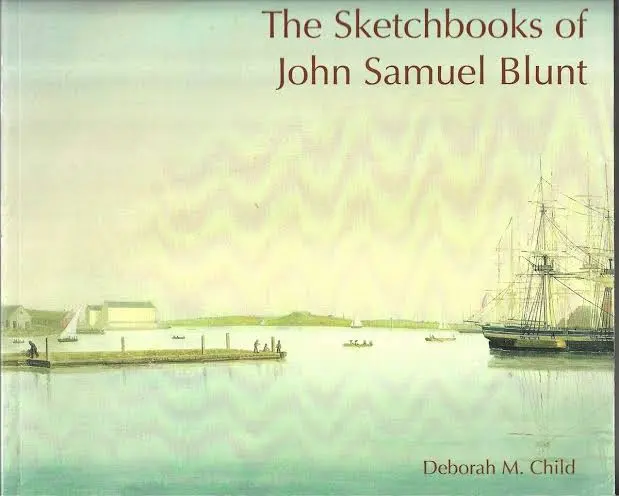
Copyright J. Dennis Robinson. For much more on Blunt see: “The Sketchbooks of John Samuel Blunt”, by Deborah M. Child (Portsmouth Athenaeum, 2007).
 Kickstarting the Portsmouth Cultural Renaissance