


TRYST (v) To mutually agree to meet at a certain place.
Two decades before the sinking of the “unsinkable” RMS Titanic, island poet Celia Thaxter wrote “A Tryst.” Published in her 1896 collection, the poem tells a hauntingly similar tale of a ship fated to collide with an iceberg. Thaxter wrote of “Brave men, sweet women, little children bright” who did not suspect the looming tragedy on a cloudless night.
From the atomic bomb to AI, each generation worries about the future. Celia’s poem reflected Victorian-era fears of modern mechanization. The Titanic disaster killed 1,522 passengers on April 14, 1912, but others survived. In ”Tryst,” all passengers and crew are lost. Celia imagined, not the world’s largest passenger ship, but a traditional sailing vessel. Her tragedy occurs midway through the journey, not towards the end of the journey as with the historic Titanic.
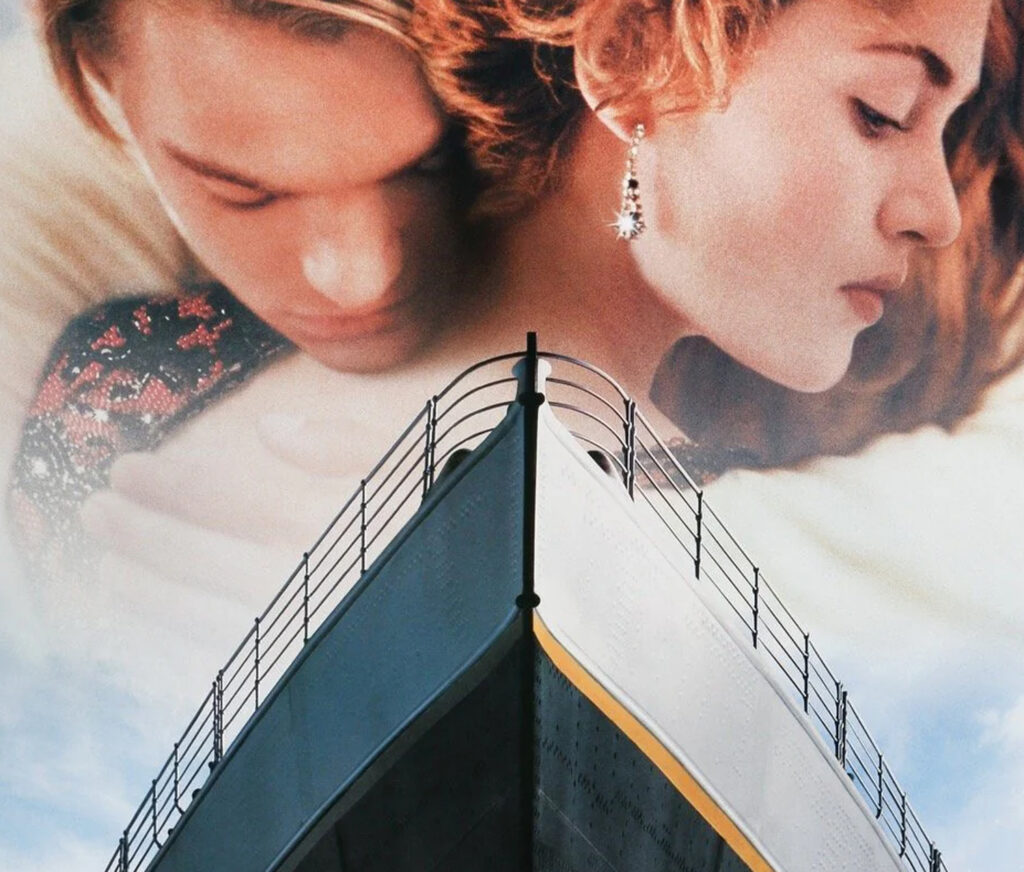
The most intriguing connection is between the poem and the 1997 blockbuster film by James Cameron. Both are about star-crossed lovers. In her book, Poet on Demand, Celia scholar Jane Vallier wrote:
“The image of the ship and iceberg as ill-fated lovers whose meeting is decreed by Fate is the kind of cosmic theme Thaxter found most attractive.” Modern audiences, too, were drawn to the tragic romance between characters played by actors Leonard DiCapria and Kate Winslet.
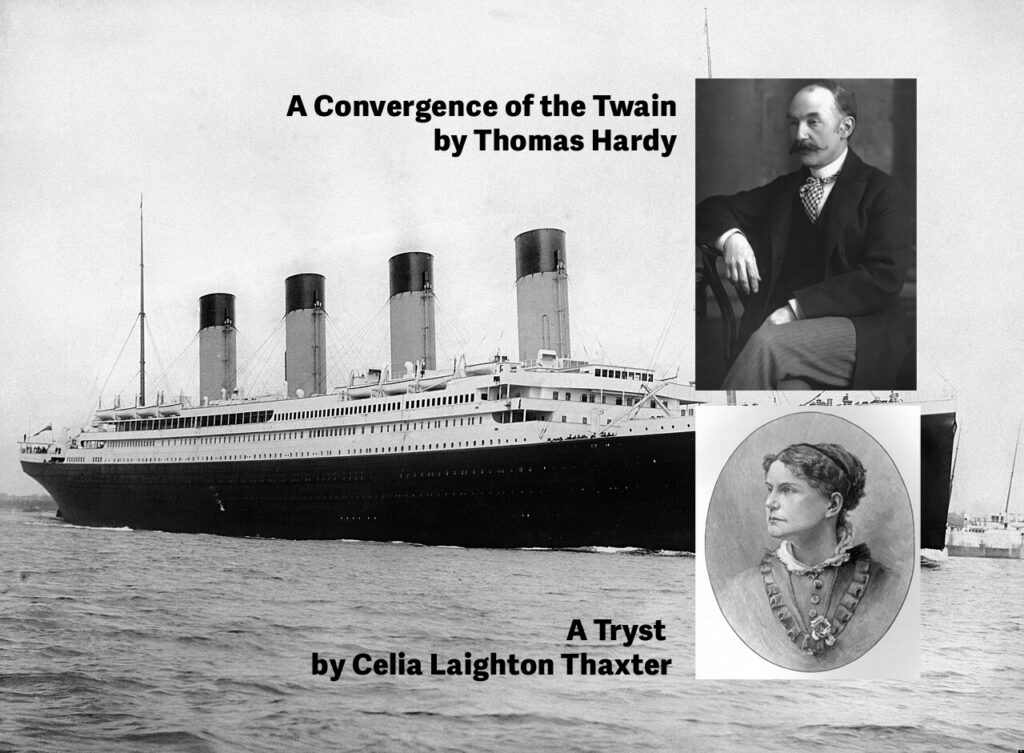
Celia Thaxter offered one of a series of foreboding connections that preceded the Titanic disaster. Hers and many others appear in a 1986 book edited by puzzlemaster Martin Gardner. The Wreck of the Titanic Foretold? was reprinted in 1998 in response to Titanic fever following the release of the Cameron film.
Among the most intriguing literary works cited is the short story “Wreck of the Titan” by Morgan Robertson, which is fully reprinted in Gardner’s book. The 1898 novella, published two years after Celia’s poem, warned of an iceberg collision with the “largest craft afloat and the greatest works of men.” Celia’s theme of a ship and an iceberg as fated lovers also appears in the poem “Convergence of the Twain” by Thomas Hardy. Did Hardy know Thexter’s poem? Unlikely, but the thought might make members of the scholarly Thomas Hardy Association lift their eyes to heaven. Hardy wrote his verse after reading about the tragedy. He recited it on May 14, 1914 to help raise funds for victims of the Titanic.
Setting aside the literary merits of “A Tryst,” there is plenty to compare with Hardy’s “Convergence.” Barely two decades separate the two poems, and Celia (1835-1896) was only five years older than Thomas Hardy (1840-1928). Although contemporaries, the two poets were as distant in their writing styles as sailing ships are to ocean liners. Yet in this one fateful topic, the two converged with history. For readers interested in a deeper look, both poems follow.
© 1999 by J. Dennis Robinson, revised 2026
A TRYST
By Celia Thaxter (1896)
From out the desolation of the North
An iceberg took it away,
From its detaining comrades breaking forth,
And traveling night and day.
At whose command? Who bade it sail the deep
With that resistless force?
Who made the dread appointment it must keep?
Who traced its awful course?
To the warm airs that stir in the sweet South,
A good ship spread her sails;
Stately she passed beyond the harbor’s mouth,
Chased by the favoring gales;
And on her ample decks a happy crowd
Bade the fair land good-by;
Clear shone the day, with not a single cloud
In all the peaceful sky.
Brave men, sweet women, little children bright
For all these she made room,
And with her freight of beauty and delight
She went to meet her doom.
Storms buffeted the iceberg, spray was swept
Across its loftiest height;
Guided alike by storm and calm, it kept
Its fatal path aright.
Then warmer waves gnawed at its crumbling base,
As if in piteous plea;
The ardent sun sent slow tears down its face
Soft flowing to the sea.
Dawn kissed it with her tender rose tints. Eve
Bathed it in violet,
The wistful color o’er it seemed to grieve
With a divine regret.
Whether Day clad its clefts in rainbows dim
And shadowy as a dream,
Or Night through lonely spaces saw it swim
White in the moonlight’s gleam,
Ever Death rode upon its solemn heights,
Ever his watch he kept;
Cold at its heart through changing days and nights
Its changeless purpose slept.
And where afar a smiling coast it passed,
Straightway the air grew chill;
Dwellers thereon perceived a bitter blast,
A vague report of ill.
Like some imperial creature, moving slow,
Meanwhile, with matchless grace,
The stately ship, unconscious of her foe,
Drew near the trysting place.
For still the prosperous breezes followed her,
And half the voyage was o’er;
In many a breast glad thoughts began to stir
Of lands that lay before.
And human hearts with longing love were dumb,
That soon should cease to beat,
Thrilled with the hope of meetings soon to come,
And lost in memories sweet.
Was not the weltering waste of water wide
Enough for both to sail?
What drew the two together o’er the tide,
Fair ship and iceberg pale?
There came a night with neither moon nor star,
Clouds draped the sky in black;
With fluttering canvas reefed at every spar,
And weird fire in her track,
The ship swept on; a wild wind gathering fast
Drove her at utmost speed.
Bravely she bent before the fitful blast
That shook her like a reed.
0 helmsman, turn thy wheel! Will no surmise
Cleave through the midnight drear?
No warning of the horrible surprise
Reach thine unconscious ear?
She rushed upon her ruin. Not a flash
Broke up the waiting dark;
Dully through wind and sea one awful crash
Sounded, with none to mark.
Scarcely her crew had time to clutch despair.
So swift the work was done:
Ere their pale lips could frame a speechless prayer,
They perished, every one!
The Convergence of the Twain
Lines on the loss of the “Titanic”
By Thomas Hardy (May 14, 1912)
I
In a solitude of the sea
Deep from human vanity,
And the Pride of Life that planned her, stilly couches she.
II
Steel chambers, late the pyres
Of her salamandrine fires,
Cold currents thrid, and turn to rhythmic tidal lyres.
III
Over the mirrors meant
To glass the opulent
The sea-worm crawls — grotesque, slimed, dumb, indifferent.
IV
Jewels in joy designed
To ravish the sensuous mind
Lie lightless, all their sparkles bleared and black and blind.
V
Dim moon-eyed fishes near
Gaze at the gilded gear
And query: “What does this vaingloriousness down here?”
VI
Well: while was fashioning
This creature of cleaving wing,
The Immanent Will that stirs and urges everything
VII
Prepared a sinister mate
For her — so gaily great —
A Shape of Ice, for the time far and dissociate.
VIII
And as the smart ship grew
In stature, grace, and hue
In shadowy silent distance grew the Iceberg too.
IX
Alien they seemed to be:
No mortal eye could see
The intimate welding of their later history,
X
Or sign that they were bent
By paths coincident
On being anon twin halves of one august event,
XI
Till the Spinner of the Years
Said “Now!” And each one hears,
And consummation comes, and jars two hemispheres.
 Ace Karlo, the Man who Built Portsmouth