



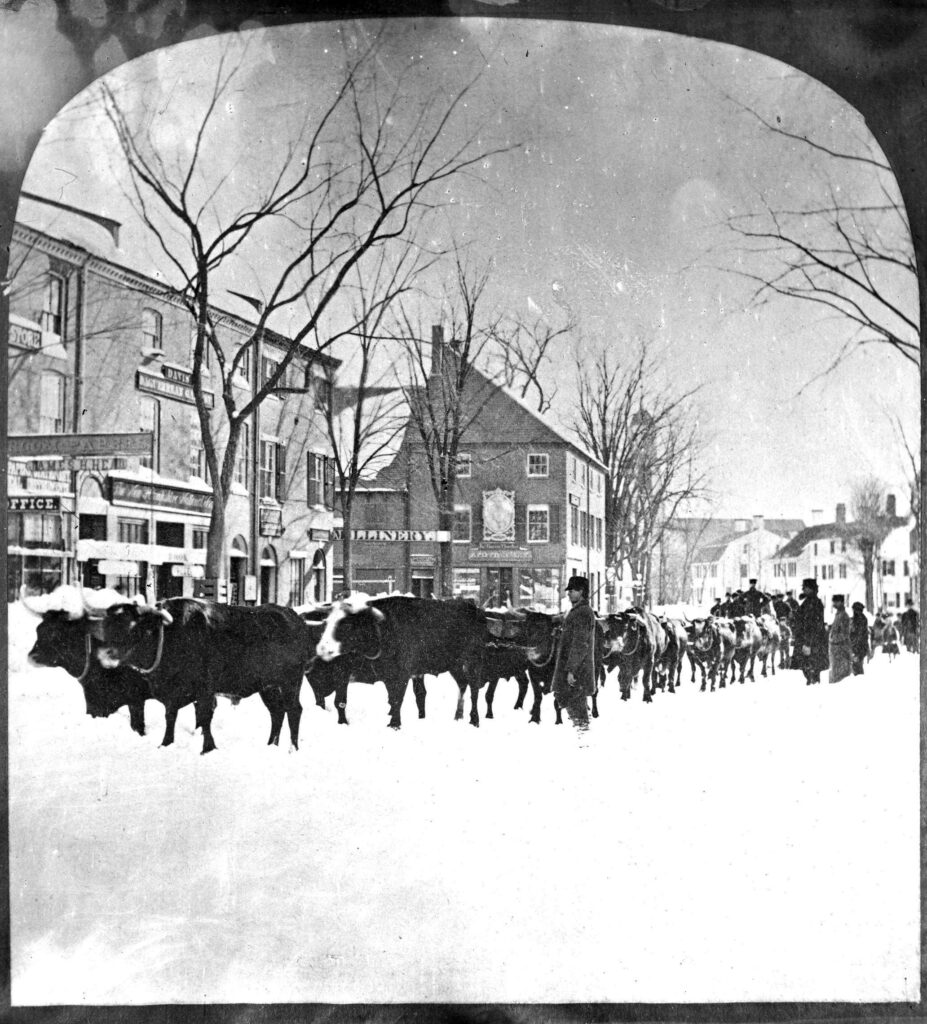
No photograph of a Portsmouth snowstorm better illustrates the change in technology since Victorian days. Teams of oxen once “rolled” the city streets to flatten the snow for sleighs. This photo from a stereoscopic slide shows Pleasant and State streets likely in 1867, just after the Civil War.
Business signs on the buildings indicate a milliner, an apothecary shop, a book and music store, a and a bank. This shot was taken next to the “Daguerrean Gallery” of the Davis Brothers who stpped outdoors to capture the moment. We have a cluster of Davis Bros. photos coming up in this column from their studios at 15 and 17 Pleasant Street.
Next door we can also see a sign for James H. Head, who wrote an entire book on the art of “tableaux vivants” or “living pictures.” Our library includes a rare copy of Head’s book “Home Pasttimes,” in which he instructs readers how to set up still images of historic and literary scenes using people, props, and lighting. (You can download a free copy of this book from the Internet on several websites.) This was the Victorian version of a live “freeze frame” image, either depicted onstage, on parade floats, or even in the home. Imagine recreating a painting like “Washington Crossing the Delaware” with friends and family. The curtain rises and the figures stand stock still. Then the curtain is lowered, and another scene is quickly assembled showing another image drawn from literature, history, or the Bible. Think of it as the world’s slowest slideshow in which the actors do not move a muscle. Oxen flattening, but not removing the snow. Still life scnes from the Bible. Our recent ancestors lived at a slower, gentler pace.
(c) J. Dennis Robinson
 Why Writers Starve