


You are sitting at the epicenter of New Hampshire history. To your left, as you face the stage, is the mighty Piscataqua River, among the fastest flowing waterways in the Continental United States. Indigenous people gathered here for at least 12,000 years. The Abenaki name, scholars suggest, means “where the swift river branches.”
Beginning in 1630 a ragtag collection of about 80 English adventurers, laborers, tradespeople, and indentured servants set up a communal “great house” right here. They were not seeking religious freedom, but for land and economic independence. When the settlers failed to find valuable minerals or to turn a profit within five years, their English investors shut down the company. Those abandoned settlers who remained learned to fish, to farm, joined the fur trade or felled the straight white pine trees that dominated the rocky landscape.
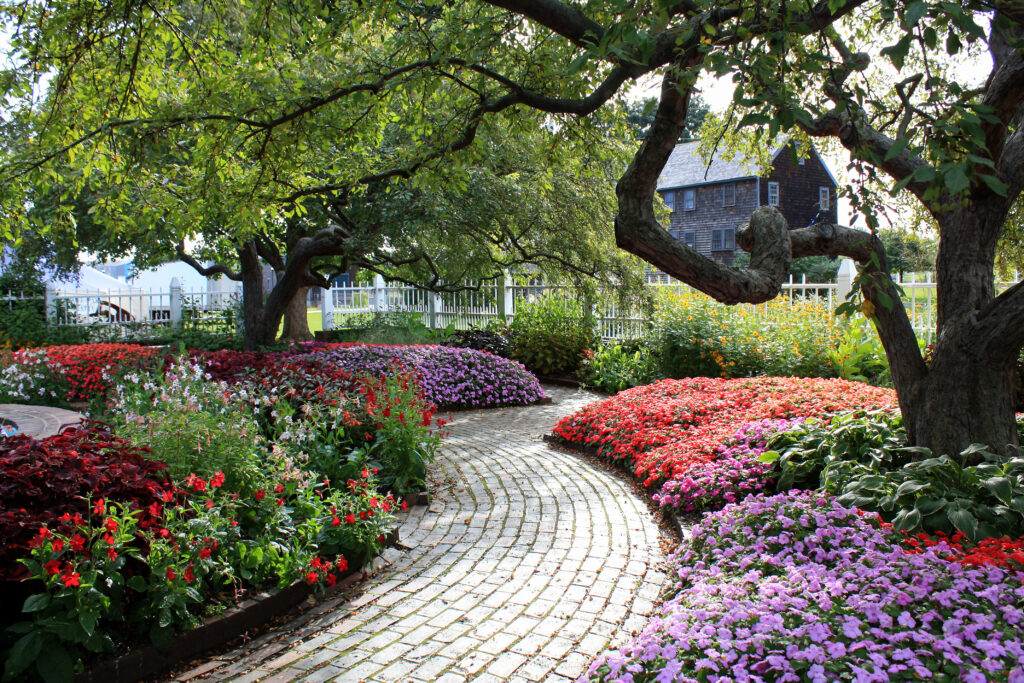
The flat garden area behind the Prescott Park stage was once a small tidal inlet flowing into the center of what is now Strawbery Banke Museum. That sheltered pond, now filled in, attracted the first settlers. But for the rest of the 1600s, the hub of Portsmouth (originally the colony of Strawberry Bank) was centered at the mouth of the river on Great Island, now the scenic village of New Castle. That changed in the 1700s as New Hampshire’s only seaport became a shipbuilding capital and a world trade center.
Building Portsmouth
A small group of wealthy merchant families built their mansions within walking distance of the massive wharves jutting into the river. This peaceful park was once the beating heart of the city as tall ships and flat-bottomed gundalows loaded and unloaded their valuable cargo. Cart paths leading inland became streets branching toward modern day Market Square and beyond.
The river, however, was still the main highway of this very important colonial port. Our last three British governors, all named Wentworth, lived nearby. Although initially under the control of Puritan-dominated Massachusetts, Portsmouth was always considered a town more inclined to feasting than to fasting. It was also, history teaches, a city of enslaved Africans who served as laborers and house servants in many of the surviving historic mansions.
The Liberty Pole across from the museum parking lot is evidence that revolution was in the air. In 1760, locals protested the Stamp Act, driving the tax collector out of town here. In 1774, excited by the arrival of Paul Revere, residents stormed the fort at New Castle and stole all the King’s gunpowder months before the battles of Lexinton and Concord. From this spot, in 1777, you could see naval hero John Paul Jones and his Piscataqua crewmen as they eased the sloop of war Ranger downriver. From Portsmouth, Jones began a 3,000 mile journey in a bold guerilla raid on the English coast. Here, President George Washington climbed into a boat to fish for cod during his four-day visit to Portsmouth in 1789. Then in 1800 the Portsmouth Naval Shipyard, still thriving today, was established across the swift river in Kittery, Maine.
Ebb tide era
Three fires devastated downtown Portsmouth in the early 1800s, flattening hundreds of wooden buildings like a bomb blast. Restrictions on shipping enacted by President Thomas Jefferson, followed by the War of 1812 against England, crippled Portsmouth’s maritime economy. Young residents seeking opportunity moved away. By the Civil War, the city’s dominant business was the Frank Jones Brewery in the west end of town. Trains replaced river traffic. Wharves rotted, and the waterfront faded.
Drawn to low rents along the river, residents of “Puddle Dock” established an ethnically diverse neighborhood here. A plant for the storage and loading of coal dominated what is now the upper end of the park. Water Street (now Marcy Street) was well known for a string of bordellos that catered to visiting sailors. Meanwhile, an efficient network of trains, trolleys, and ferries drew a wave of summer tourists from smog-filled cities to Victorian hotels at the nearby Isles of Shoals, New Castle, Rye, Hampton, and coastal Maine. Those visitors touring “The Old Town by the Sea,” however, were advised to steer clear of the dilapidated area we now call Prescott Park.
The Prescott sisters
The city was in “a state of siege” in August 1912, when four marines were found dead in the South End. Residents were angry. Reform was in the air. Following a political battle, the newly elected Portsmouth mayor ordered all bars and “houses of ill repute” closed. Then in 1932, a 79-year-old businessman named Charles E. Prescott, formerly of Portsmouth, died in an Erie, Pennsylvania hospital. In a scrawled deathbed declaration, Prescott gifted his entire fortune to the hospital.
His two sisters, however, fought back. Mary and Josie Prescott sent their lawyer to Pennsylvania. Charles M. Dale successfully broke the dubious will and returned to Portsmouth with $2,752,693–an enormous sum amid the Great Depression.
The Prescott sisters, both retired Portsmouth school teachers, had grown up in the neighborhood with their brother. Through lawyer Charles Dale, who later became governor of New Hampshire, the sisters gobbled up riverside real estate. Then they demolished all but three brick buildings along Water Street. The upper end of what is now our 10-acre Prescott Park opened in 1939, just a few months before the death of Mary Prescott, aged 84. Josie Prescott survived to age 91. Her last will and testament left Dale almost totally in charge of completing her dream park and set clear regulations for its use.

A place for us
With Prescott funds managed by a small team of city trustees, the park has grown larger and more vibrant with each passing decade. Four Tree Island, now a popular picnic area, was added. Gardens blossomed. Strawbery Banke Museum, a 10-acre historic house restoration, opened in 1965. A few art classes held under a tent at the park evolved, by 1975, into family-friendly summer musicals and concerts. Formed in 1974, the nonprofit Prescott Park Arts Festival has since entertained over 3.5 million people. Sitting here, visitors from around the globe have enjoyed over 10,000 shows. Each year this historic site fulfills the Prescott wish for a free and public park, accessible to us all.
J. Dennis Robinson is the author of a dozen nonfiction books and over 3,000 articles about local history, arts, and culture.
 Pat Paulsen for President in NH