

We learned a lot about “funny money” in our interview with newly minted Portsmouth author Kevin Lafond. In his 400-page book, New Hampshire Merchant Scrip (Peter E. Randall, Publisher), Lafond identifies hundreds of paper notes used to make change when coins were scarce in tough economic times.
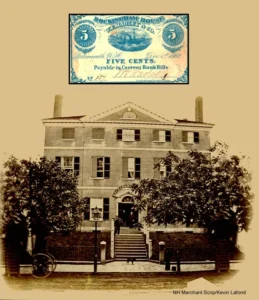
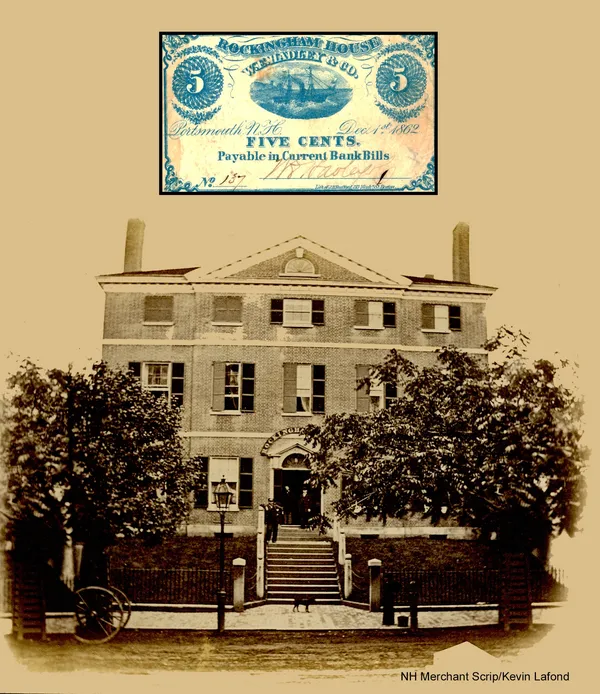
For 25 years, Lafond traveled extensively to record, not only the “scrip” notes, but the merchants who printed them. Here’s just one example of the paper notes. It wasn’t counterfeit because it didn’t pretend to be legal tender, and functioned more like an IOU from the vendor to the customer. This is note number 157 issued on Dec. 1, 1862, by J.M. Hadley & Company that operated the Rockingham House on State Street in Portsmouth. It was worth a nickel. But that nickel in 1862 would be worth more than a dollar today.
The Rockingham House was the former grand brick home of the controversial merchant and politician, Woodbury Langdon, brother of New Hampshire governor John Langdon. Built around 1785, it stood next door to what is now the John Paul Jones House Museum. Langdon’s mansion was converted into a hotel that opened on November 1, 1833. Portsmouth ale tycoon Frank Jones bought and rebuilt the Rockingham House in 1870.
The towering Rockingham we see today was rebuilt after a fire in 1884. The hotel served as Frank Jones’ base of operation for years. He reportedly hosted dignitaries, including presidents Franklin Pierce, James Polk, Theodore Roosevelt, Chester Arthur, and John F. Kennedy. It was converted into condominiums in 1973 and was added to the National Register of Historic Places in 1982.
According to Lafond’s book, William E. Hadley and his father, William S. Hadley, owned the Rockingham House from 1862 to 1870. A few months after this scrip note was issued, the Hadleys put a notice in the Portsmouth Morning Chronicle telling all “holders of our small checks” to cash in their notes quickly, “or they will not be redeemed.”
Copyright J. Dennis Robinson
 The Ratcatcher and the NH Lithographer
Leave a Reply