

If this writer is remembered for one thing, it will likely be half a lifetime of digging into the 1873 murders on Smuttynose at the Isles of Shoals. My goal in print, lecture, online and broadcast media has been to counter a conspiracy theory. Maren Hontvet did not murder Karen and Annette Christensen. The real killer, a 28-year-old Prussian fisherman, Louis Wagner, was quickly identified, captured, tried, and eventually hanged. Justice was done; end of story, at least until a popular novel turned the surviving victim into an ax-wielding psycho. That bothered me and launched an endless research journey.
There’s a movie called Weight of Water about the fictional version. The novel was a national bestseller and an Oprah favorite with an estimated worldwide sale of one to 1.5 million copies. The nonfiction version, according to my New York City publisher, has sold around 17,000 copies to date. There is no Hollywood movie about what really happened.
Writing nonfiction history is a slow process. I’ve invested a few thousand hours into researching and reporting the story. When you’re in this deep, the story never goes away, which brings us to today’s illustration.
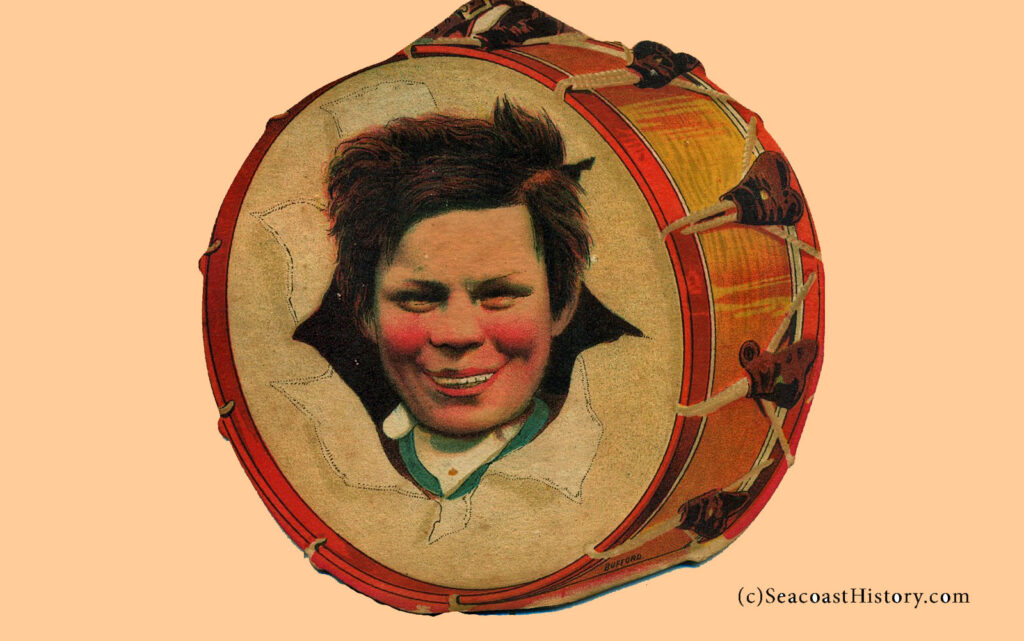
The eBay auction for this 19th-century JK Manning shoe store advertisement was listed as “Creepy Boy Ad.” There is something disturbing in the face of the slick-haired young man whose head is bursting through a large parade drum surrounded by shoes. He could be the Portsmouth ancestor of Mad Magazine mascot Alfred E. Neuman. Could it be store owner JK Manning himself, or his son? More likely, this is a stock image, the Victorian equivalent of clip art. It drew my attention, and I bought it. If you have any ideas about this creepy boy, give me a shout.
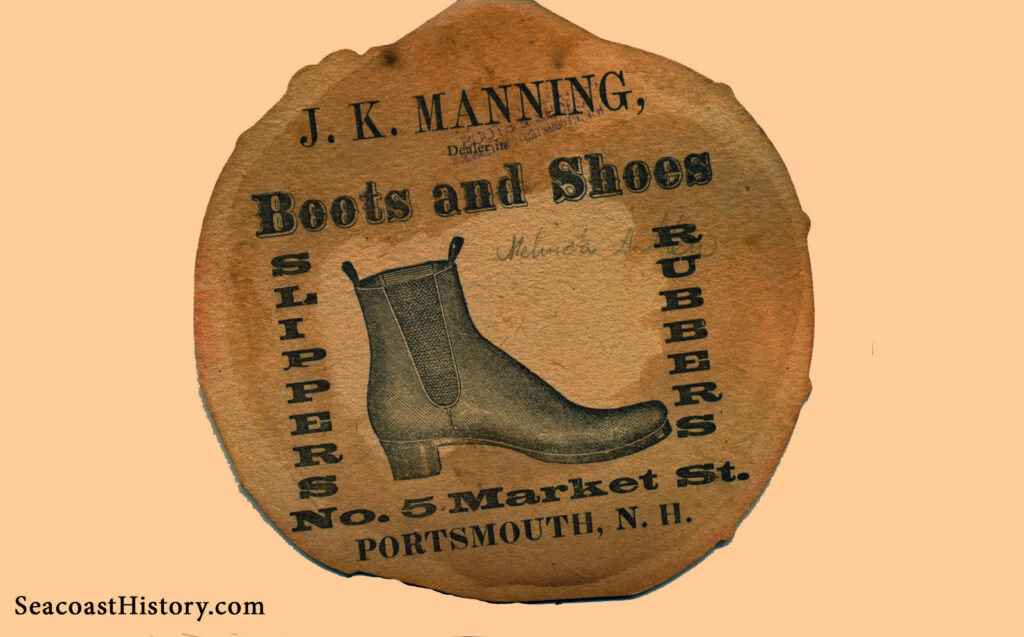
The advertisement on the back promotes shoes, boots, rubbers, and slippers by JK Manning at 5 Market Street in Portsmouth, NH. The hand-out was elaborately die-cut and printed on heavy paper stock. I’ll eventually turn this over to the Portsmouth Athenaeum, where countless thousands of seacoast documents and artifacts are professionally cataloged and stored.
There wasn’t much online about JK Manning. His shoe store was in the heart of Market Square. Street numbers have changed, so 5 Market Street back then may be 9 Market Street today. That’s been home to multiple shoe stores in the Pickering Block, built in the early 1800s after the last of three downtown fires.
According to a Victorian business guide, JK Manning carried “the largest in its line in the city.” The shop “has enjoyed a liberal and substantial patronage” due to superior quality of goods, full selection, low prices, and location. Nothing new here, just boilerplate marketing familiar to all shoppers.
The home of “seasonable and fashionable” footwear,” the shop was run by “polite assistants and a proprietor in attending to the wants of his many customers. Another report says Mr. Manning was a resident of Newmarket, NH, noted for its shoe factories on the Lamprey River.
And then it hit me. Among the damning circumstantial evidence in the Wagner murder trial were the bloody size 11 boot prints found in the snow on March 6, 1873. After killing Karen and Anethe, Wagner had spent hours searching Smuttynose Island for Maren Hontvet, who had escaped into the darkness with her dog Ringe. Eventually, as dawn approached, the murderer rowed back to the mainland. He stashed his stolen boat in New Castle and walked back to the city’s South End.
Witness after witness identified Wagner en route. During the trial, as I reported in Mystery on the Isles of Shoals, Wagner was seen wearing “a white hat and a bluish frock that was simply buttoned around his neck, with the sleeves unused and hanging. He had on a fisherman’s jumper, a pair of blue overhauls, and large rubber boots. He also wore a black and red scarf around his neck.”
Arriving exhausted at his boarding house in Portsmouth’s South End, Wagner was covered in blood, wild-eyed, and windburned. He immediately hopped on a train to Boston where, dumping his fishing outfit and boots, he bought second-hand clothes with the funds stolen from the Hontvet House on Smuttynose. His bloody clothes–he claimed it was fish blood–were recovered by police and presented as evidence at his trial in Alfred, Maine, that summer. From the book:

“Wagner stayed cool even under intense cross-examination on Monday. With no dramatic confession likely, the prosecution chose to pick away at Wagner’s alibi, forcing him to add details that they hoped would stretch his explanation to the point of absurdity. He had purchased his extra-large rubber boots last winter on Market Street in Portsmouth, Wagner testified, where there were ‘a couple hundred there the same size.’ Attorney George Yeaton, incredulous, asked Wagner if there were really hundreds of size-11 boots in a little Portsmouth shop. Didn’t he mean ‘a couple hundred different sizes?’ ‘No, sir,’ Wagner confirmed, ‘there were about ten hundred [boots] there, different sizes, a couple hundred from the same size.’
There it is, directly from the trial transcript! Wagner must have purchased his boots from JK Manning’s store. It isn’t an earth-shaking revelation, but it was a new detail to me. Wagner’s effort to imply that “10 hundred” pairs of boots in his size were for sale did not impress the all-male jury. He was convicted and executed, but never confessed. In fact, it was Wagner who spread the rumor that Maren Hontvet, the woman he had failed to kill, was the murderer. Maren’s testimony in court, however, nailed his coffin shut.
One detail still nagged at me. According to my source, an early history of New Hampshire businesses, JK Manning opened his shop around 1878, five years before the murders. Was there an earlier boot shop on Market Street? Perhaps. Or had the catalog reprinted information from an earlier edition? Was the listing simply in error?
The Victorian guide lists hundreds of New Hampshire businesses in dozens of towns in an era before telephone books. It includes a promotional history of each town. According to the guide, the City of Portsmouth was founded by English colonists Ferdinano Gorges and John Mason in 1862 at a place called Odiorne’s Point in a town called New Castle. Oops. The editor got the names right, but listed the wrong town and missed the date by almost 250 years. And that’s just the first paragraph. So, until some scholar says otherwise, I propose that Louis Wagner bought his bloody boots from JK Manning’s store. Perhaps he was drawn in by this creepy advertisement. The truth, they say, is stranger than fiction.
© 2026 by J. Dennis Robinson, all rights reserved.
 Waging Peace in the 1905 Treaty of Portsmouth