


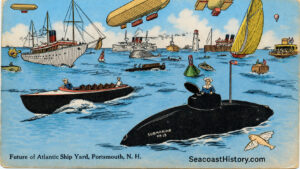
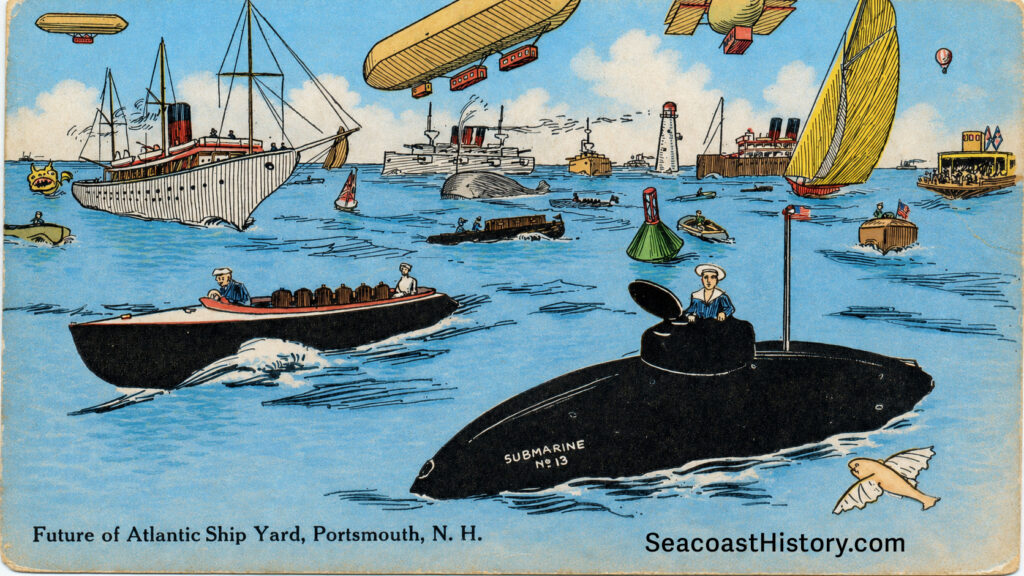
When Ben Frisbee gazed into his crystal ball in 1895, he saw his rural hometown of Kittery, Maine, radically altered by progress. By 1955, Frisbee predicted, the wetlands would be dredged into lakes. Steel wharves would accommodate massive cruise ships. Gerrish Island would be ringed with wide-tarred roads lit by bright electric bulbs.
A huge, illuminated, metal tower would replace Whaleback Light and Fort McClary had become a bustling business center. Ben Frisbee envisioned future Kittery as a mechanized, heavily populated, industrial city – and he welcomed the change.
I’d never heard of Benjamin Randall Frisbee until a reader handed me a copy of The Island and Harbor Echo. The Echo was an annual publication created by the alumni of Kittery public schools. The group gathered for a number of years in November to reminisce, sing, feast, and listen to poems and speeches. As the official Class Prophet, Frisbee predicted that Kittery would finally become a profitable and important New England city in the upcoming 20th century.
In a speech to his fellow alumni in 1895, transcribed in the Echo, Frisbee imagined a visitor arriving from Liverpool to Kittery Harbor aboard a high-speed steamer 60 years into the future. The transatlantic voyage from England would take only four days, Frisbee guessed. The prophet opened his essay with the image of an ocean liner gliding past the Isles of Shoals and the Navy Yard toward the modern wharves at Kittery Point. Frisbee wrote:
“Wood Island soon comes into view, on which is a steel fortress covering the entire island. A bridge of solid masonry, steel-clad, connects the fortress with the earthworks on Gerrish Island. On top of this bridge is a covered archway built of steel, bombproof, where troops can be taken from one fort to the other without exposure in time of battle.” Frisbee was living in the era of the Spanish-American War.
Misfortune-telling
Futurists are doomed to fashion their opinions from the past they know. In 1918, Portsmouth mayor FW Hartford predicted that Portsmouth was about to double in population to become New Hampshire’s new industrial capital. But when World War I ended the following year, so did the brief boom in the local economy, followed by a crushing Depression.
Ben Frisbee’s vision of steel forts guarding the Piscataqua River made sense in his day when wars were fought on land and sea, not from the air. Science fiction writer H.G. Wells would propose aerial warfare in his 1907 novel, aptly titled War in the Air. But for Frisbee, in 1895, the idea of nuclear bombs dropped from the sky was unimaginable.
Future generations may not value what we prize today. While Frisbee waxed poetic about the rich history and natural beauty of Kittery, like Portsmouth’s Mayor Hartford, he desperately wanted to see his city grow. He predicted 64-foot-wide macadamized roads on Gerrish Island, heavily trafficked by equestrians, people in electric cars, and riders on electric bicycles.
As in his own time, Frisbee’s future seacoast was populated by large tourist hotels. Kittery’s own newspaper would appear six times each day with a circulation of 533,140 readers. Shoe factories and iron wharves line the waterfront, and the railroad runs along scenic Chauncey Creek. By the mid-twentieth century, the densely populated Kittery Point would separate to form a suburb known as Piscataqua.
“Pepperrell’s Cove has been dredged to a depth of twenty feet at low water,” Frisbee proposed, “its ledges blown out and removed.”
The city of York will expand to 40,000 residents by 1955, Frisbee added. New Castle will become a thriving freight depot. Portsmouth will return to the business of shipbuilding, and become the biggest city in the Granite State. New England would annex Canada in 1920, Frisbee promised, creating new states named Columbia, Ontario, Manitoba, Quebec, and Arcadia.
SEEL with apologies to Kittery
Copyright © J. Dennis Robinson, all rights reserved. Thanks to Richard Candee for this topic.
 Pease Tanker Crashes on Highway in 1964