


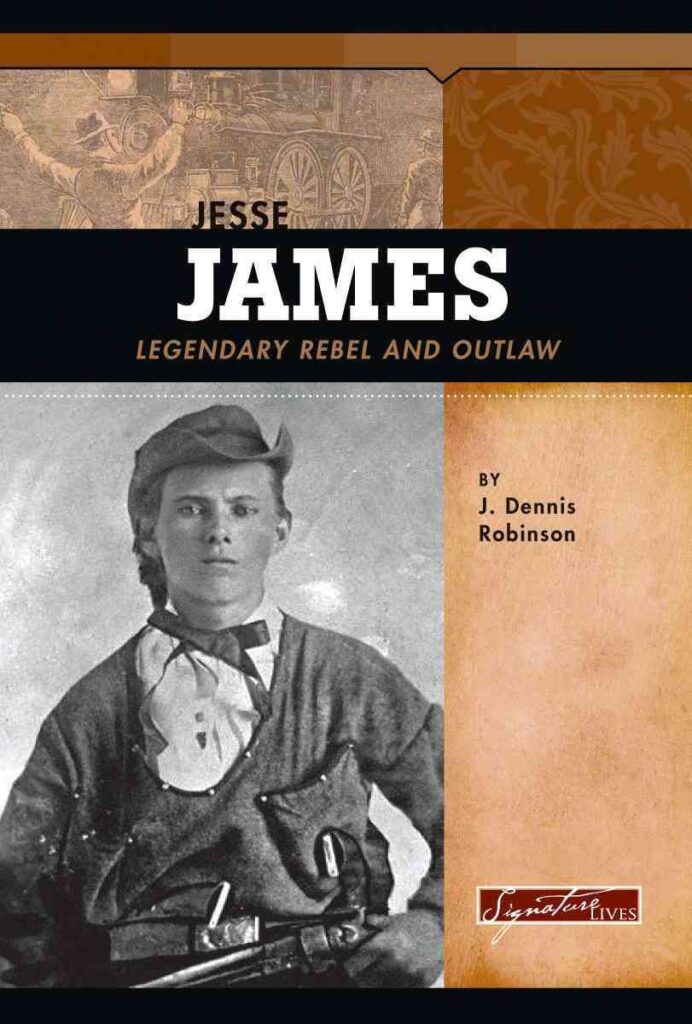
NOTE: Among my early book projects was a biography of outlaw JesseJames for young readers. James was a bad man, not the Robin Hood of the West as often depicted. I wrote this essay while researching the book.—JDR
Like so many men before me, I am on the trail of the murderous Jesse James. He rides like the devil just over the horizon, forever out of range. A killer and a thief in real life, the historical Jesse James was assassinated on April 3, 1882, by Robert Ford, one of his own gang members.
At his death, after a crime spree that lasted nearly 20 years, James was famous, his image pumped up by fictional dime novels and book-length biographies based on wildly inaccurate newspaper accounts. By shooting James in the back, when he was unarmed and in his own home with his wife and two children, Bob Ford pushed the outlaw from notoriety to martyrdom.
Film has spread the James myth around the globe. Lovable cowboy Roy Rogers once played James on the silver screen. So did Rob Lowe, Robert Duvall, Colin Farrell, Kris Kristofferson, Tyrone Power, and other luminaries. Brad Pitt starred as the Missouri outlaw in The Assassination of Jesse James by the Coward Robert Ford.
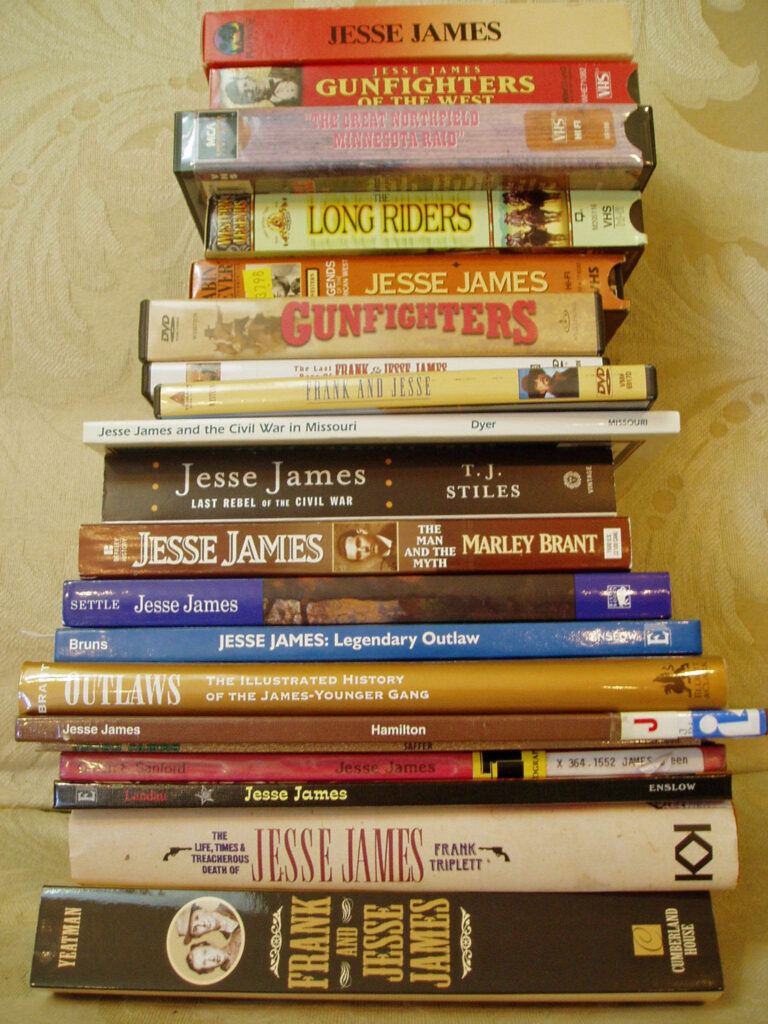
To date, I have watched 35 out of an estimated 55 Jesse James films. I am chasing this movie character the way detective Alan Pinkerton pursued the real Jesse James. And like Pinkerton, I am doomed to fail. Jesse James is dead and much of the truth died with him. The Hollywood Jesse James, meanwhile, cannot be captured or killed because he represents our national madness. He is the righteous American killer. He is an anti-hero, both victim and victor, the misunderstood psycho, the hit man with the heart of gold. Check your streaming TV listings. How many shows depict weapons, crime lords, bank robbers, evil-doers, dark forces, serial killers, drug runners, war, or plain old violent themes?
I joined this outlaw posse quite by accident when I was asked to write a short biography of Jesse James for a publisher of books for young readers. What red-blooded male could turn such an assignment down? I was shocked during my research to see how many earlier books were sympathetic to James, a man who killed more people than Charles Manson’s followers.
At the Centralia Massacre in 1864, guerrilla forces marched 20 unarmed Union soldiers off a train, forced them to strip, and shot all but one at close range. “Bloody” Bill Anderson, more gang leader than soldier, considered the teenage Jesse James among his most deadly raiders. Historians often give Jesse and brother Frank a pass for their role as guerrilla “bushwackers” in the Civil War. They were violent men in violent times, we’re told. But they carried on the “Lost Cause” of the Confederacy long after the war. The James Brothers only robbed and killed Yankees, the legend goes. They contributed their stolen loot to Southern causes..
But the facts say otherwise. The “Robin Hood” image is pure myth, penned by newsman John Newman Edwards, a fan of Southern insurgent leader William Quantrill. Edwards single-handedly turned a serial killer into a polite and handsome highwayman. Hollywood did the rest.
Jesse James was the son of a Baptist preacher, many biographers point out, but fail to mention that his father trafficked in enslaved black children and died when Jesse was barely old enough to remember him. Jesse had a restless spirit. His brother Frank quoted Shakespeare. Both men married and raised children. These details are offered as if they excuse all crimes.
As an American anti-hero, the legendary Jesse James and his gang became fodder for stage melodramas and then films. Although Thomas Edison’s silent classic The Great Train Robbery (1903) isn’t about the James gang, it might as well have been. The James-Younger Gang has long been credited with the first American train robbery. Two silent films featuring the James Boys appeared in 1908 and 1911. Then in a macabre twist, the outlaw’s real son played his father in the 1921 silent movie Jesse James Under the Black Flag. The bizarre screenplay begins when a millionaire crashes his plane on the estate of Jesse James Jr. and learns, through his son, that the famous criminal was actually a good guy. The film was a box office flop and left Jesse Jr. bankrupt and depressed.
Every American boy wants to play Jesse James, the man who could not be captured. So apparently, does every American man. Other actors portraying Jesse James include James Keach, James Coburn, Clement Moore (aka TV’s Lone Ranger), Robert Wagner, and Wendell Corey (twice). I’ve seen them all. Farrell in American Outlaws (2001) is, hands down, the worst of the lot, depicting James as a cross between Superman and one of the Dukes of Hazard. Coburn and Duvall characterized James as just short of a psychopath. Audie Murphy, the most decorated American combat soldier in World War II, played James early in his film career in 1950 and again in his final film, A Time for Dying (1969), right before his own death. Henry Fonda played Frank James in two films in 1939 and 1940 that were presented as the true story of the outlaw brothers. The only thing accurate about these films, according to a descendant of the outlaw, was that Jesse wore a hat and rode a horse.
Not even Bill Hickok, Billy the Kid, or Wyatt Earp can match the number of films based on the James legend. His name is synonymous with outlawry. But too often the historic James is mistaken for the fictional James who, though clearly a bad guy, exhibited empathy for the poor and downtrodden.
Unable to capture James, the state of Missouri considered offering him amnesty simply to end his crime spree. Bob Ford solved the problem by shooting James in the back. America, however, has granted the fictional Jesse James a full pardon and a handsome royalty.
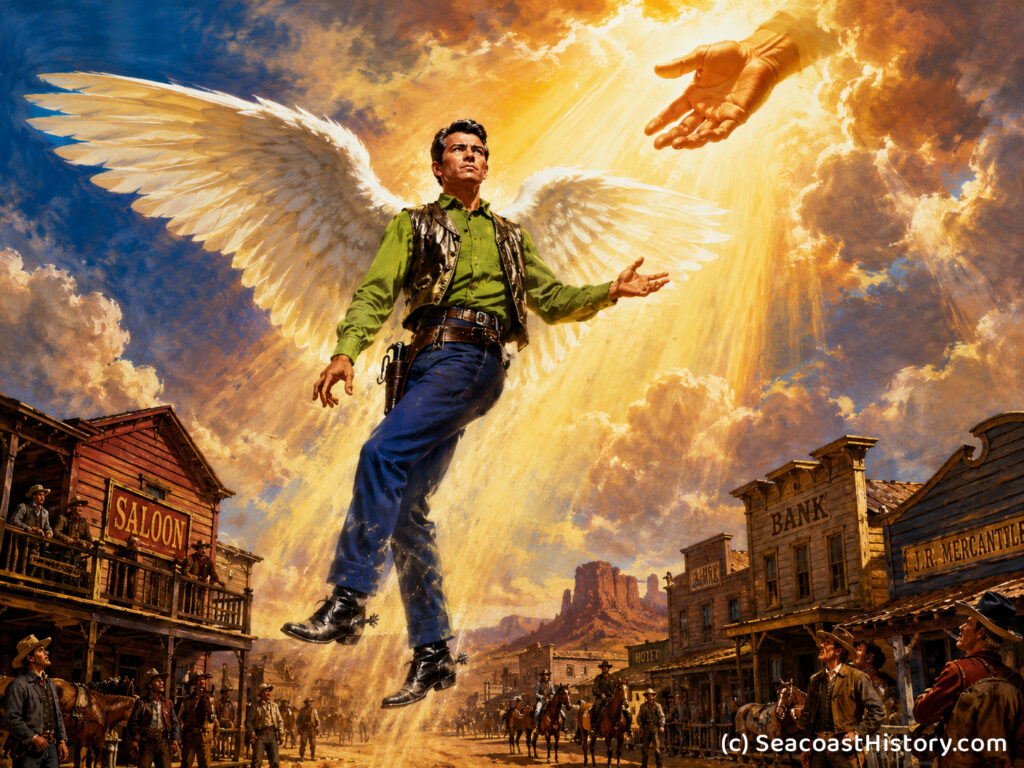
In the film Purgatory (1999), God gives a reincarnated James a shot at getting into heaven if he can suppress his violent ways for 10 years. Jesse appears in an episode of Little House on the Prairie, and in comedy-westerns with Bob Hope and the Three Stooges. In the trash classic Jesse James Versus Frankenstein’s Daughter (1966), a kind-hearted Jesse saves a Mexican village from the deadly scalpel of a well-endowed vivisectionist. Indeed, there is an entire subgenre of B-westerns where James meets a femme fatale. And yes, I have seen Renegade Girl (1946), Jesse James’s Women (1954), and The Woman They Almost Lynched (1953).
There are a few movies that come dangerously close to the truth. The True Story of Jesse James (1957), however, is not one of them. Among the best of the genre, Ride with the Devil (1999) is not about James at all. Instead, the film probes the psyche of a fictional Missouri bushwhacker caught between warring neighbors on the bloody border states during the Civil War. The hero is caught between warring worlds.
For a tidbit of reality, I recommend The Great Missouri Raid (1951), The Long Riders (1980), and The Last Days of Frank and Jesse James (1986). Even though singers Kris Kristofferson and Johnny Cash were 20 years too old to play Jesse and Frank, this made-for-TV movie struggled to get the history right. When, in the rim, an admirer asks Frank which of the stories about his adventures are true, he replies, “I wouldn’t believe very much that’s been written about us from any source.” That goes for the movies, too.
Ultimately, we learn more about ourselves and our culture from these films than about Jesse James. Given the choice between fact and fiction, Americans prefer the latter; Rambo inevitably outguns reality. Despite the body count, the American with the gun, especially if he’s handsome like Brad Pitt and has suffered an injustice, becomes a righteous weapon. If he can also dodge a hail of bullets, leap horses through windows, and jump onto moving trains– all the better. The rules do not apply to him. His victims are faceless. His story is everlasting.
© 2006 J. Dennis Robinson, All rights reserved.
 Who Lies Under NH’s Tallest Tombstone?