


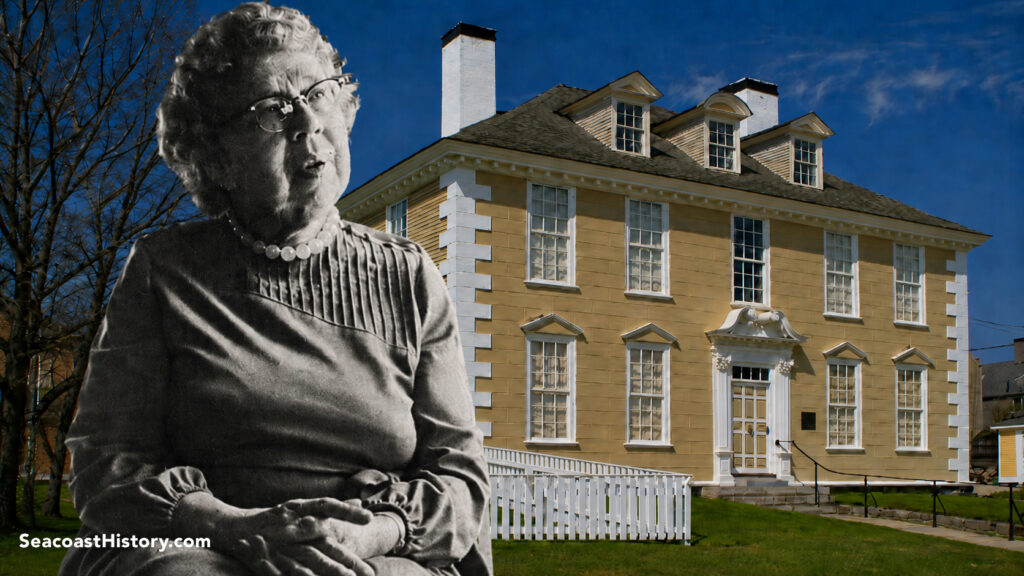
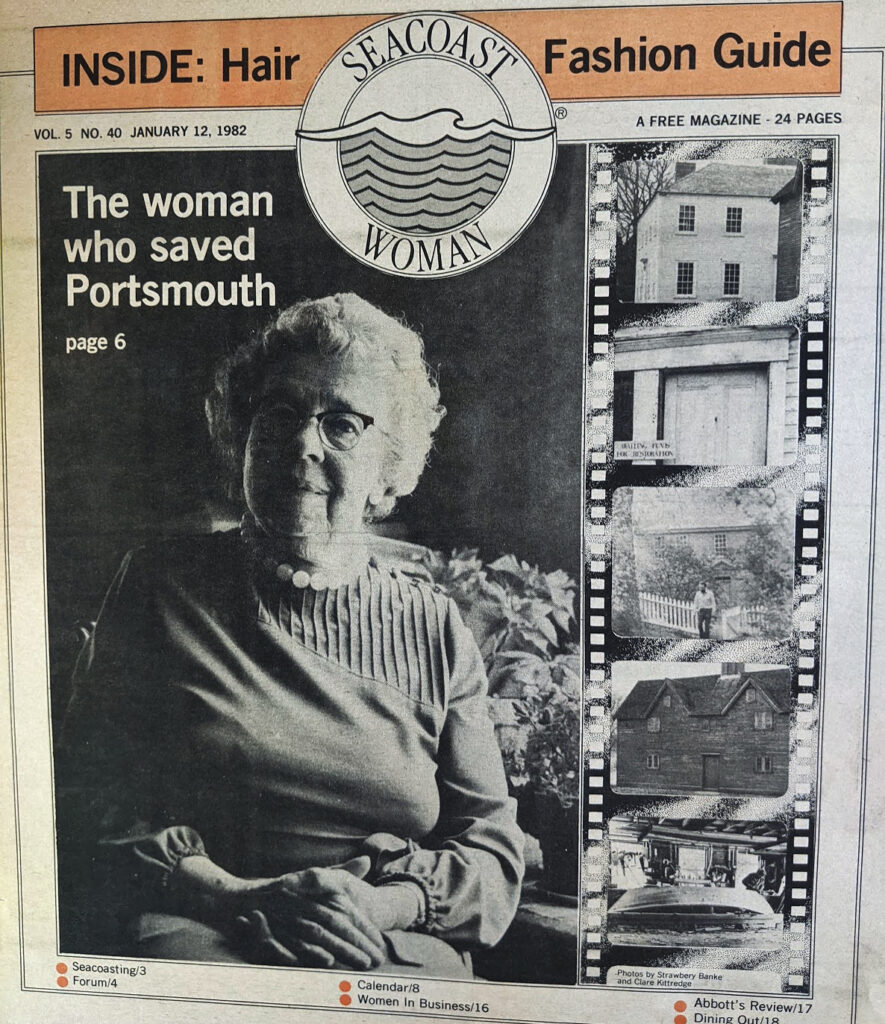
NOTE: I’ve been criticized as “too harsh” on the legacy of historian Dothy Vaughan (1904-2004) for her Colonial Revival approach to preserving Portsmouth history. This classic 1982 profile from Seacoast Woman, a free local newspaper from the 1980s, offers a more upbeat point of view by a veteran local journalist. – JDR
SEE: Who Started Strawbery Banke
To Dorothy Vaughan, the women’s movement is nothing new.
“Since 1623, the women of this area didn’t have much to go on except that they wanted a new world, adventure, freedom: women’s lib began 300 years ago,” she says firmly.
“Take Mary Brewster, scalped and left for dead in Portsmouth in 1696.
She survived, gave birth to four children and lived until she was 81, with a silver plate in her head and a wig. She was a brave woman.
“Or take Rachel Isaacs, one of the first Jews here, who came to Port-smouth from Prussia in the 1790s and survived on her own after the death of her husband. Liberation—she had it!”
Perhaps best known for her pioneering work to save the Puddle Dock area of Portsmouth, now called
Strawbery Banke, from the bulldozers, Dorothy Vaughan would rather be thought of as a historian.
She came to Portsmouth in 1917 as a 12-year-old and began her career as a Portsmouthophile by giving walking tours for the Chamber of Commerce.
“In 1921, I walked people around every inch of this city until my legs were ready to fall off,” she recalled in 1980. She spent over 20 years as leader of Troop 2, “the biggest Girl Scout Troop in town,” she says proudly, adding that she often bumps into ex-Girl Scouts on the sidewalk.
She also collaborated over the years with historical novelists who wrote stories set in Portsmouth. She helped writer Lois Lenski research Ocean Born Mary, the true story of an Irish girl in the early 1700s who was saved on the high seas by a pirate as she sailed to Portsmouth.
In the ’30s, Vaughan had a long collaboration with Kenneth Roberts, author of the novel, Northwest Passage. In the ’50s, she worked with author Thomas Raddal on The Governor’s Lady, the story of Frances Wentworth, an important lady of Portsmouth in the 1790s.
Vaughan has assembled a large collection of illustrations of Portsmouth women and often gives talks about them “because,” she explains, “a lot of them have done a lot.’
Everything in Vaughan’s life revolves in some way around the city of Portsmouth.
“One of my prime objects in life is to see that the flavor of Portsmouth is kept,” she says. “Portsmouth is not like St. Louis, San Francisco, Boston, or Newburyport. It has its own flavor, as distinct as strawberry is from chocolate and vanilla.”
She has seen this special character threatened at times.
READ: Lost Interview with Dorothy Vaughan
“Portsmouth was a beautiful town before World War II,” she reminisces, “but by the ’50s people had started tearing down the old houses to replace them with bowling alleys and parking lots, and there wasn’t much anyone could do. We didn’t have any teeth in the law, then.”
As a result of a now-famous talk she gave to a group of Rotarians in 1957, the urban renaissance of Portsmouth began.
“I warned them that if we didn’t do something, we’d soon be Main Street, USA-just beer joints, honkey tonks, and bowling alleys.”
That same evening, a historical commission was formed and the situation assessed.
“Some of the houses were in such bad shape that the government was ready to simply raze them all. We had to fight for the trees, because the urban renewal people said it was their custom to level everything. I told them that without trees, it would look like Arizona flatland.”
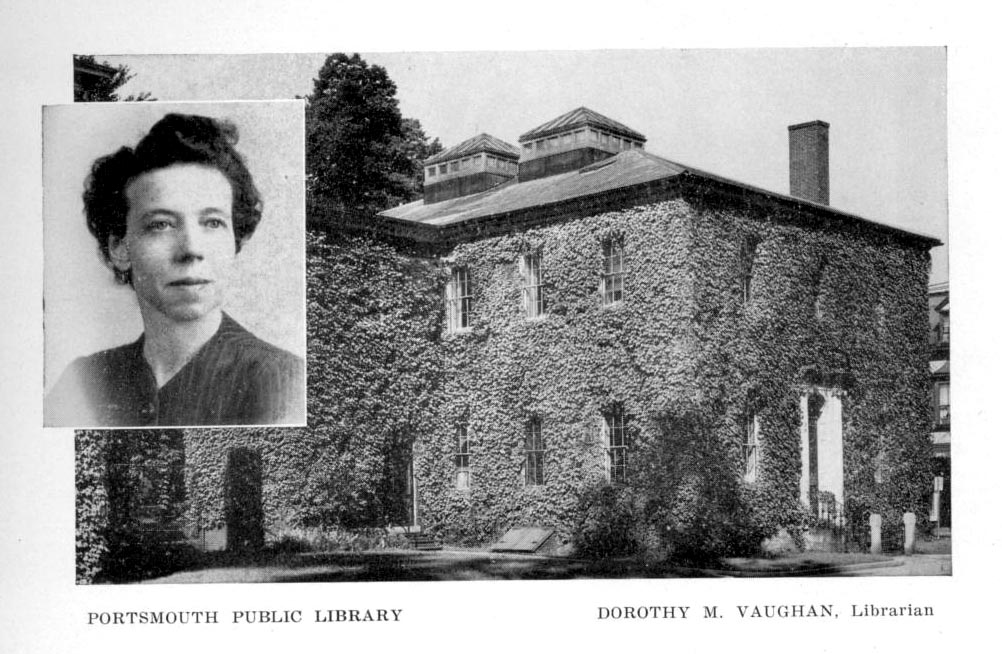
To raise money, and arouse an interest in historical preservation, Vaughan gave some 150 talks to everyone from women’s clubs to squirming third graders. Her position as librarian at the Portsmouth Public Library for 54 years helped her speak.
“I learned to have a good memory in the library,” she says. “You need it to remember names and dates and things, and practice helps.”
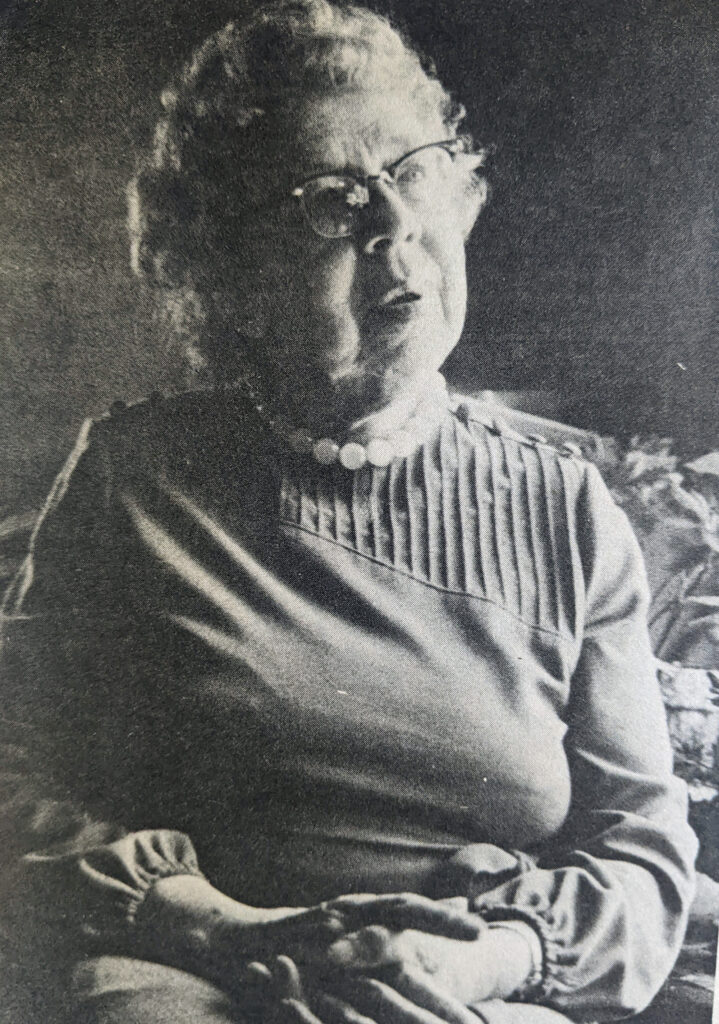
Vaughan doesn’t like to take sole credit, “get the blame,” as she puts it, for the Strawbery Banke project.
“Although I was the one to throw the ball to the Rotary Club back then, I was only one of 30 or 40 people involved.” Now, at 77, she is the last survivor of this founding group.
It was a good start, perhaps, but Vaughan’s vision doesn’t begin and end with Strawbery Banke. “My main interest is in historic preservation, of the whole of Portsmouth- and Strawbery Banke isn’t the only thing in town!”
The Strawbery Banke project was a pilot project for U.S. Government Urban Renewal, the first time, she points out, federal funds were used for historic preservation.
“But it was only the spark,” Vaughan insists, “and from that, a lot of other things have come to pass: people are fixing their fences, mending their gates, refurbishing their gardens. The whole South End’s blooming!”
As proof, she points to South Street past the Blue Fin, to the North End past Sweaterville, to the revival of Bow and Ceres streets on the waterfront, and to the “Preservationists’ ” restoration of “The Hill.”
Throughout the years, Vaughan’s public-spirited work has not gone unrecognized. The recipient of countless titles and awards, she is mentioned in the first edition of Who’s Who of American Women. In 1966, she was given an honorary doctorate by the University of New Hampshire.
“I guess it’s called working up the ranks,” she jokes. “Some people work four years for a diploma, others 40.”
Another time, Lady Bird Johnson invited her to a “Women Doers’ Luncheon” at the White House. “I went as the New Hampshire gal,”
Vaughan recalls. “I took her a little strawberry pin.”
About the present crisis surrounding the crumbling Foyes building in Market Square, she comments, “This will no doubt come before the Historical Commission and no mat-ter what happens to the building, if we’re on the ball, it’s going to look the same when they’re done.
“Otherwise,” she explains, “Market Square would look like a person with his front teeth missing.”
SEE: Love letters of Dorothy Vaughan
She says a lot of things had to happen for things to “start moving,” but she thinks Portsmouth is on the right track now. “It’s really not an industrial city,” she points out, “it’s more of a historical, residential, cultural city.”
A lot remains on Vaughan’s agenda. Foremost is to educate people.
“If people knew their houses were important, perhaps they wouldn’t hurt them,” she says wistfully.
If anyone has what it takes to convince them, it’s Dorothy Vaughan. She smiles, and a fighting light comes into her eye.
“I gave a talk one stormy night,” she recalls, “and afterwards a man from the legislature came up to me. He said that if I were selling the Brooklyn Bridge, he’d buy.” She chuckles. “The work I do is important to me I think I was meant to do it.”
(c) Clare Kittredge, 1982, all rights reserved. Reprinted from Seacoast Woman by permission of the author.
 Cinema Cowboy Tom Mix at Fort Constitution