
How’s this for a brilliant summer job? You and I go around to every hotel from York, Maine and throughout the New Hampshire Seacoast. We copy the names of every guest registered at every hotel, including where each visitor comes from. Then we publish the entire list as a weekly newspaper and sell copies.
What about the hotel guest’s right to privacy, you ask? Hey, isn’t it our right to know who is staying in our Seacoast.
Believe it or not, that newspaper did exist. “The Sea Shore,” as it was known, hit the newsstands each Saturday in the summer of 1886. Copies sold for a nickel. The eight-page weekly publication listed visitors staying in York, Kittery, Portsmouth, Rye and on the Isles of Shoals.
The Sea Shore
The owners of The Sea Shore knew they were walking a fine line between idle gossip and news. “The invasion of private circles is no part of its mission,” editor Edward Tilton wrote in the Aug. 7, 1886, edition. The newspaper was no “Paul Pry,” he noted, referring to a British play about a notorious eavesdropper. Its purpose, instead, was to promote the many new summer resorts in the region.
The eight-page weekly registry listed guests staying at the Marshall House, Donnell House and the Sea Cottage in York Beach: the Farragut Hotel, Prospect House and Ocean House in Rye; The Pepperrell House and Hotel Pocahontas in Kittery Point and more. Only a rare visitor is mentioned at the Oceanic Hotel on Star Island or the Wentworth and Rockingham hotels in Portsmouth. The famous Appledore Hotel at the Isles of Shoals, known for its superstar summer artists and intellectuals, is conspicuously missing.
The venture appears to have been a flop. So far only a single, fragile, torn copy of the sixth issue from the summer of 1886 is known. Beyond the registry of names, that copy includes part of a fictional story titled “Lara,” a dribble of society gossip, a cluster of hastily designed ads for local shops and services, and a report about another hotel under construction.
Behind the scenes
Seacoast publications come and go. The Portsmouth Journal, edited by Charles Brewster, for example, survived for decades and is still an important source of historical information. Rockingham Magazine, however, sank after a single issue, while Hampshire Life never got off the drawing board.
The quick demise of The Sea Shore was likely its business plan. In 1886, newspaper mogul F.W. Hartford issued his daily Penny Post newspaper, crammed with incidental details about people and places. Hartford would eventually buy up all six local papers and replace them with the Portsmouth Herald. The penny daily and other local newspapers would have been stiff competition for a tiny weekly that sold for a nickel.
Even by the surviving sixth issue it is clear reader response to The Sea Shore was minimal. As editor Tilton admits, between the lines in his opening remarks, tapping into a transient readership was no easy task. Whether guests cared who else was visiting the region seems unlikely, and the non-participation of the biggest hotels in the region may have been the kiss of death.
And the content was, to be honest, boring and badly written. That may be because editor Edwin A. Tilton (1834-1904) appears to have been a musician, not a journalist. Born in Roxbury, Massachusetts, Tilton was a New Hampshire soldier during the Civil War. He was assigned to the N.H. Invalid Corps that found military jobs for disabled and wounded servicemen. Active in the Masons and in veteran’s affairs after the war, Tilton was primarily a music teacher and organist at St. John’s Church.
Curiously, when he was writing about his favorite topic, Tilton’s prose was smooth and sonorous. In 1892 he penned an essay in The Organ, a Boston publication, about the historic “Brattle organ” still in use at St. John’s Episcopal on Chapel Street. “One of the most distressing things in the world is an old organ,” Tilton wrote. “Its only rival is a poor new one.” Now fully restored, Portsmouth’s famous pipe organ came from England before 1708. It served at Harvard College and in Newburyport, Massachusetts, before being installed at Portsmouth in 1836.
The Sea Shore publisher John D. Randall (1851-1920) may also have been the wrong man for the job. A city native, Randall learned the printing trade at the Portsmouth Chronicle. He went on to establish his own print shop at 5 Congress St. But Randall is best known today for his term as a fireman and chief of “the Sagamore Engine Boys.” His name appeared often in the Portsmouth Herald at the turn of the 20th century – as toastmaster at public events or escorting his wife in the grand march at the annual Fireman’s Ball. His 1920 obituary claims Randall was “one of the best known firemen in the state.”
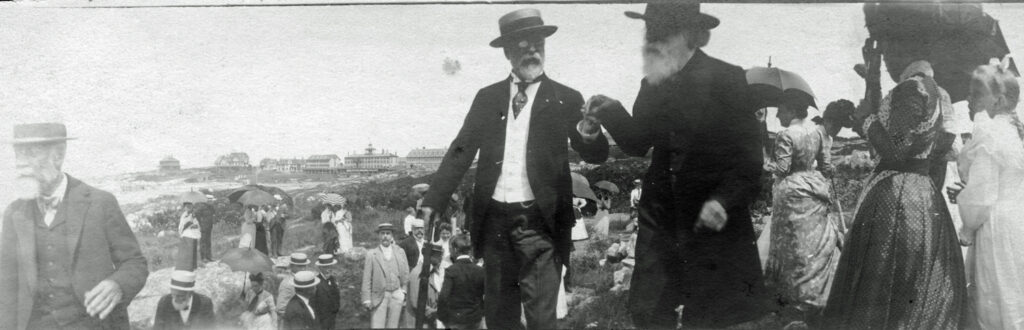
Who was here?
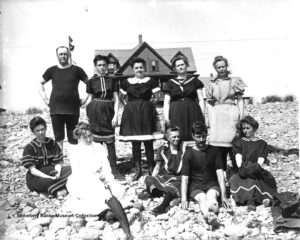
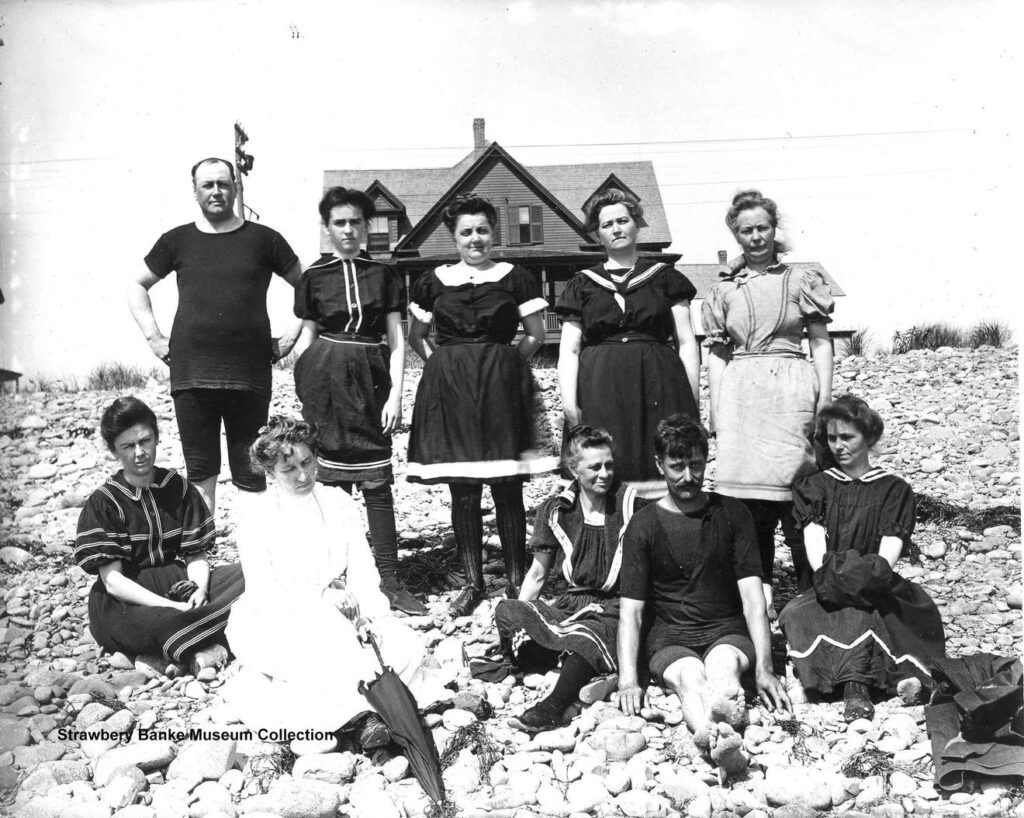
In the late 1800s, we should note, visitors often stayed in hotels like the Appledore and the Wentworth for weeks, even months. It wasn’t uncommon for a successful business owner from a city like St. Louis or Boston to accompany his family, including servants, to a major hotel and set them up for the summer. The patriarch would then go back to the hot, gritty city, returning occasionally to rusticate among the cool and healthy air of the New Hampshire seacoast, lakes or mountains.
More copies of The Sea Shore, if they turn up, may provide interesting clues to genealogists tracking their family history. Our single issue also offers a snapshot of the number and variety of hotels and boarding houses that were open during this era. And it serves as a reminder that luring summer visitors to the region has long been critical to the local economy.
But most interesting, to this reader at least, is the distance visitors traveled to enjoy the coastline and culture of the region. A significant number of seacoast guests, back in the day, were Seacoast residents, especially from nearby Dover and Newburyport. As expected, the region drew a solid percentage of visitors from Boston and other industrial Massachusetts cities. Many of the male guests were identified as doctors and judges, here to enjoy the healthy air.
It’s also important to remember an active network of trains, trolleys and ferries made public travel easier and certainly more accessible than today. A quick scan of the August 1886 “registry” shows many visitors from Philadelphia, Cleveland, Washington, D.C., Buffalo, Hartford, Utica, New York City, St. Louis and Montreal. Times change.
Today those American “come-from-aways” are being replaced by a growing number of visitors from Australia, Japan, India, China, the United Kingdom, and a host of European nations, all come to visit the seacoast region with their privacy largely intact.
DEAD LOCAL PUBLICATIONS: A Quick List

Below is my updated and certainly incomplete list of paper (not digital) newspapers and periodicals that have lived and died in the Portsmouth region. A few were only distributed here, but all included news about the area. It’s frightening to realize I personally contributed to at least 17 of these defunct publications in my own brief life. I’m sure there are many more out there to be discovered. They include:
Accent Magazine, Atlantic News, The Beacon, Business Digest, Clue Magazine, Hampshire Life, The Herald of Gospel Liberty, June Leaves, Rockingham Magazine, New Hampshire Gazette (the 1756 original), New Hampshire Profiles, New Hampshire Spy, New Hampshire Times, Oracle of the Day, The Penny Post, Penumbra, Piscataqua Weekly, Portsmouth Chronicle, Portsmouth Journal, Portsmouth Gazette, Portsmouth Magazine, Portsmouth Mercury, Portsmouth Press, Portsmouth Times, Publick Occurrences, Re:Ports, Rockingham Gazette, Seacoast Life, The Sea Shore, Shoreliner, States and Union, Sweet Potato, Troubadour, The Wire and Women for Women Weekly.
Copyright 2019 by J. Dennis Robinson, all rights reserved.
 NH Merchants Once Minted Their Own Money