


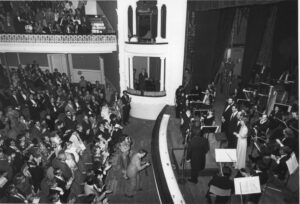
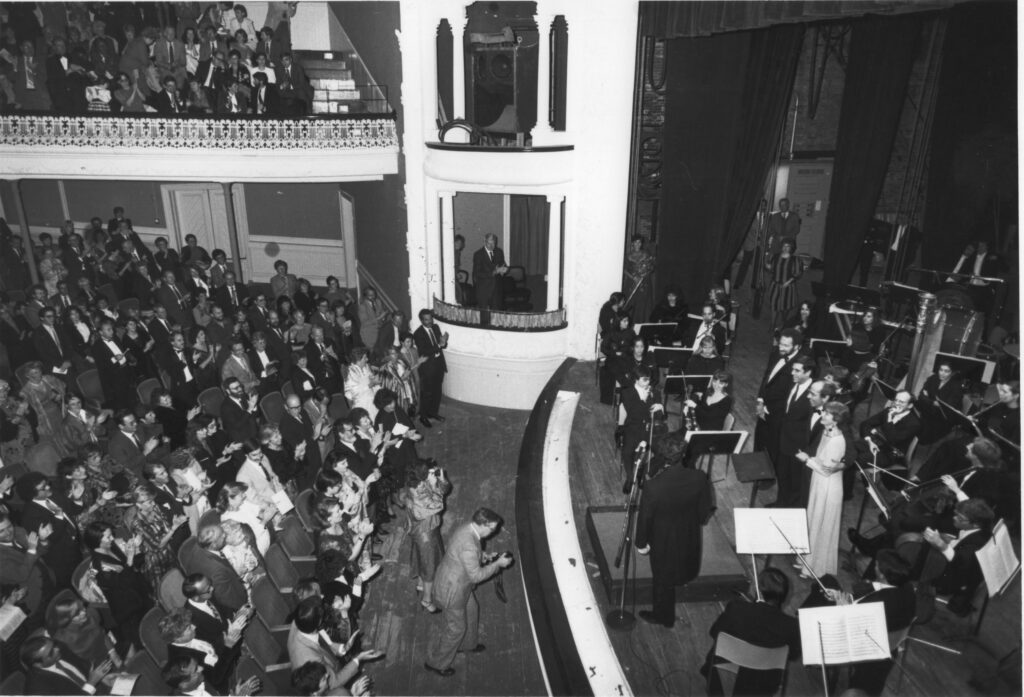
The roller coaster ride lasted three stomach-churning years. It began on June 28, 1985, when a group called the Portsmouth Civic Opera House, Inc., bought the last historic theater in downtown Portsmouth. The buyers listed on the deed were Lewis Shaw, Gretchen and Jerry Weiss and Sennon Nimetz.
Culture-lovers held their breath. Would the new owners restore the battered leaky Civic Theater, formerly the 1878 Music Hall? Or would they repurpose it into housing units, a restaurant, or office space as they had done with other old Portsmouth buildings?
“Our purpose is to produce popular entertainment at a profit,” Jerry Weiss announced to the media. Staging big acts, the new owners explained, was the key to making their considerable investment in renovating the theater worthwhile. Blues guitarist B.B. King, singers Joan Baez and Tony Bennett, and jazz musician Dave Brubeck were being considered for the premiere season. Culture-lovers across the seacoast exhaled in relief. But the turbulent ride had just begun.
High hopes
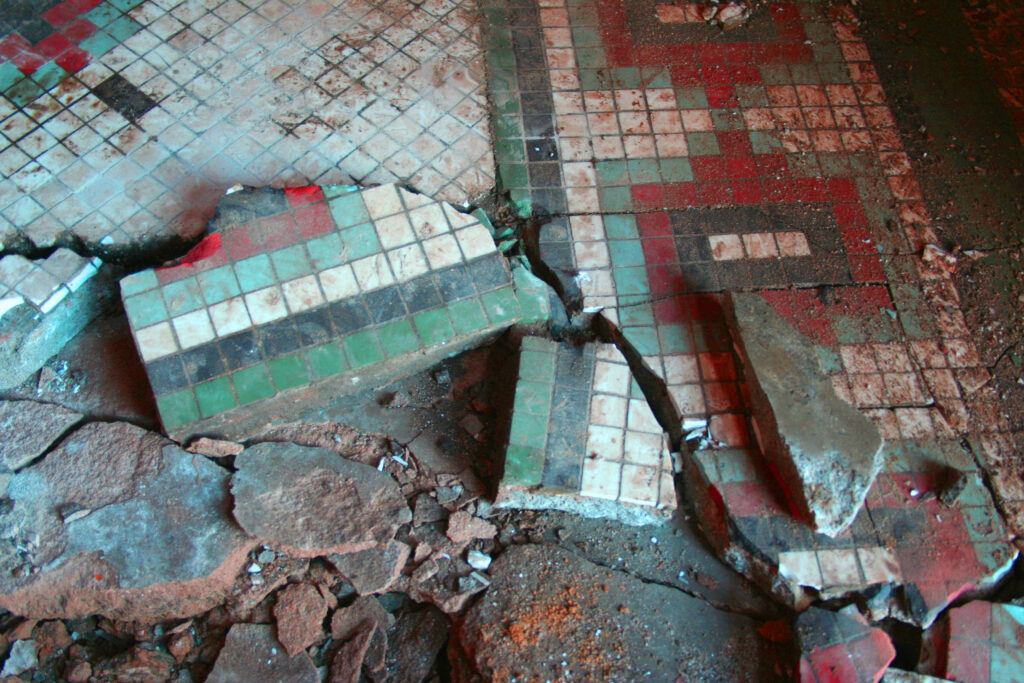
One month after signing the purchase and sales agreement on The Music Hall, Lewis Shaw sat with this reporter amid 900 empty orange chairs in the yawning dimly-lit space. Down in the lobby a solo workman was peeling gunky strips of linoleum off the floor to reveal a tiled surface not seen since World War II. A behemoth old Westinghouse air conditioner unit squatted in a corner, ready to be trucked away and replaced.

“Don’t worry, we’re going to paint the seats,” Shaw told this reporter. “They won’t be orange any more. The big job now is painting the ceiling.”
Long curls of peeling paint quivered 50 feet overhead as four distant fans rotated slowly. The original crystal chandelier that once hung in the center of the ceiling was gone, sold off to an unknown buyer at an unknown time. It had been replaced by a black plastic trash can lid studded with tiny lights. This newspaper reporter scanned the gilded face staring three stories down from the center of the proscenium arch that framed the stage.
“That’s Janus,” the new owner explained. “He’s the god of auspicious beginnings.”
Too much, too soon
Long story short, the bold, earnest, and costly experiment failed. A joyous black-tie opening night in October was followed by a single star-studded season of live entertainment. But in August 1986 the undercapitalized owners of Portsmouth Civic Opera House filed for bankruptcy. Their herculean effort left the building greatly improved. But it also left the impression that the obstacles to running a successful downtown theater were insurmountable. The only profitable future for the building, the owners told city officials, was converting it to condominiums.
Pressure mounted as a Massachusetts company, Stanhope Development Inc., expressed interest in taking on the condo project, estimated at $3 million, plus $950,000 to purchase the shuttered Music Hall from its owners.
“This building is really no longer a theater,” Stanhope’s attorney said during a public hearing. “It’s had its chance, and it just didn’t work.”
Portsmouth city officials balked at the proposal to build 29 residential units (later reduced to 21) in the old playhouse. When the Zoning Board of Adjustment unanimously turned down Stanhope’s request for a variance to build condos, the owners filed a lawsuit against the city in Rockingham Superior Court to overturn the decision.
‘We made a Frankenstein’
Sparked by the latest failure-to-launch, a grassroots group dedicated to saving the old theater was gathering steam. More than 3,000 people signed a protest petition circulated by “Don’t Let the Hall Fall,” the volunteer team led by Betsey Galligan, a soft-spoken mother of two and a former Civic Theater usher. “Culture, Not Condos” was their slogan.
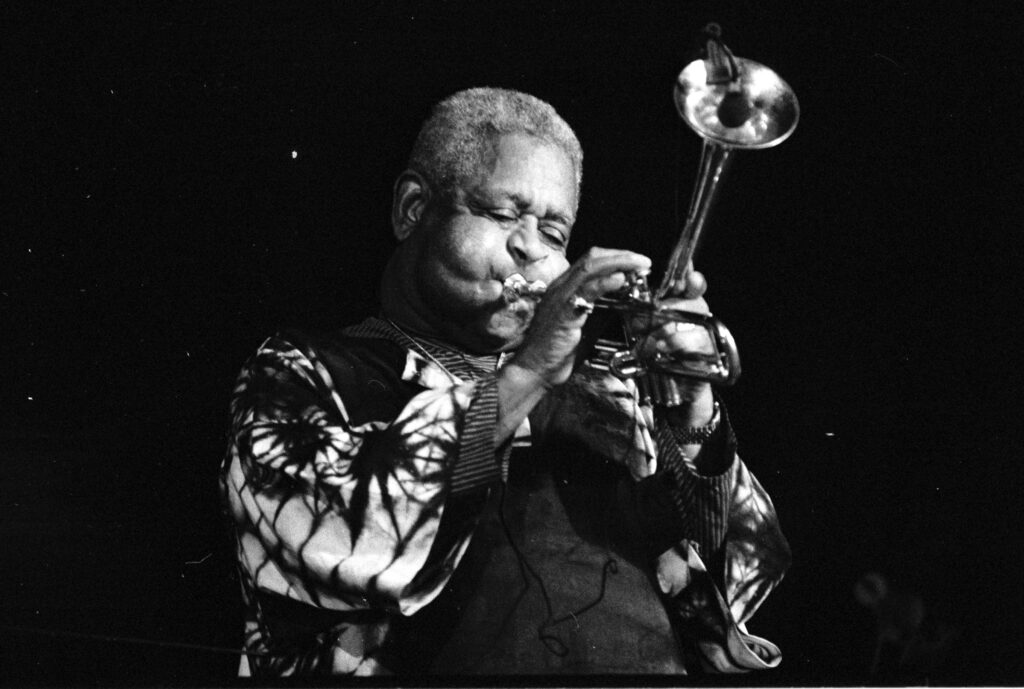
As the September date of the bank foreclosure (or sale to Stanhope) loomed, the activists incorporated as a New Hampshire nonprofit under the name “Friends of The Music Hall.” Properly run with community and corporate support, director Galligan claimed, the old theater could still become an economic boon to the city. There was a clamor of public outrage against the condo plan and a burst of small-town fundraising.
“Where were all these people when we needed them?” a disappointed Lew Shaw told NH Seacoast Sunday. “We made a Frankenstein for ourselves,” owner Gretchen Weiss added. “It took over, and it’s been a nightmare.”
In a last ditch effort the Friends implored the Portsmouth City Council to buy The Music Hall and sell it to the nonprofit agency over five years. By a vote of 5-to-3 the council declined to spend tax dollars to save the iconic opera house. Then the clock ran out. Prime Meridian Bank foreclosed on the theater. Thankfully, the real estate market was experiencing a downturn that year. Legend says the bank decided not to raze The Music Hall because wrecking it would cost more than the property was worth.
Condo fever
So it was back to the auction block. On Wednesday, Dec. 17, 1986, a Nashua entrepreneur named Richard Cabral bought The Music Hall in what he called “a purchase of heart.” Like owners F.W. Hartford, Frank Jones and Elias Loew before him, Cabral was a wealthy self-made businessman. By middle age, Cabral had worked himself up from a single rental property to a real estate empire of over 2,500 rental units.
After a few attempts to reanimate The Music Hall, the Nashua owner began to lose faith. In April 1988, he announced he was losing money on the largely dormant theater and needed help.
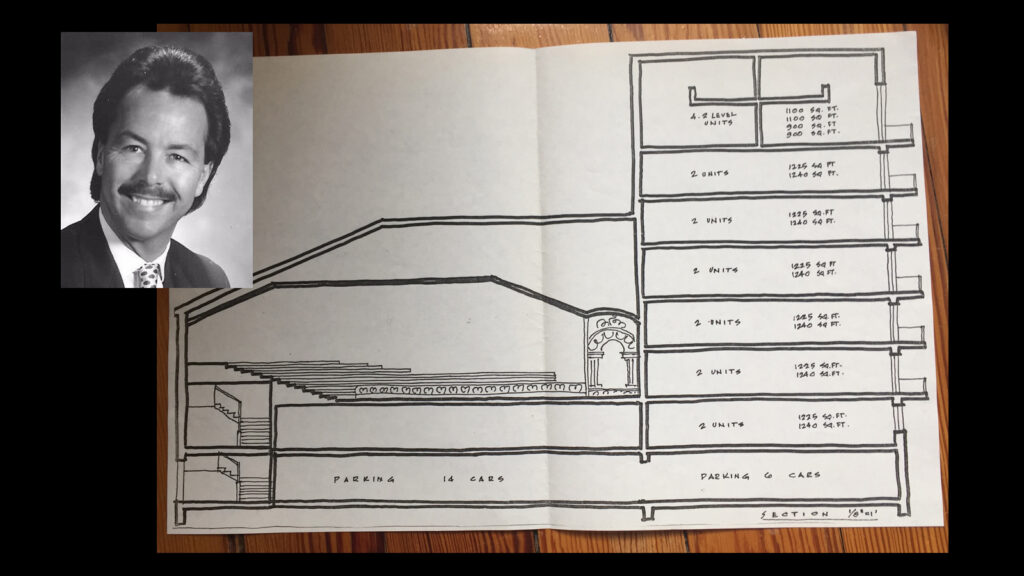
“It’s probably the worst financial deal I’ve ever gotten into in my life,” he told Foster’s Daily Democrat. Insurance, maintenance, debt service and taxes were costing him about $2,000 a week, the real estate mogul said.
To keep the theater open, Cabral told the press, the community would have to “step forward and share the burden.” The unspoken threat was clear. When Cabral took over The Music Hall, he also took over the previous owner’s lawsuit to reverse the city’s condominium ban on the property.
“While we’re not going to dismiss it,” Cabral’s lawyer warned of the pending lawsuit, “neither are we going to move forward on it at this time.” The time-bomb was ticking. In a few weeks, Cabral implied, he had to decide what to do with his theater.

You’ve got a friend
Rather than partner with Richard Cabral, the Friends made plans to buy The Music Hall outright. Concerned that an all volunteer nonprofit group could succeed, the owner continued looking for more secure and lucrative backers. In late July, NH Business Review noted the developer’s “rocky romance with the city of Portsmouth has more sour notes than planners have regulations.” His efforts to personally raise financial support from local businesses for his Musical Hall had “bombed big time.” Days later on Aug. 3, Cabral’s attorney sent Friends’ president David Choate III a letter. The man from Nashua was ready to sell.
On Sept. 19, the Friends proudly announced they had reached an agreement to buy The Music Hall. There would be no wrecking ball – unless the little volunteer group failed to pay the piper. They needed to secure a loan for $650,000 to reimburse Cabral’s investment, and repay the creditors of the previous owners.
Bank Meridian agreed to the risky loan with one caveat. To demonstrate that the public was truly ready to support The Music Hall, the Friends had to deliver a down payment of $200,000 within three months. Spearheaded by the group’s vice president, business owner Jameson French, the accumulated private, public and corporate donations poured in. But by the Dec. 15 deadline, the nonprofit was still $44,000 short. Thanks to an extension, on Dec. 23, 1988, delegates from Friends of The Music Hall delivered $194,000 to Bank Meridian. Although they were still $6,000 shy, in a burst of holiday spirit, bank officials accepted their offer. Once again, The Music Hall passed into new hands.
Cautious optimism reigned. Having squeaked past a formidable bank deadline, the Friends faced an estimated $3.5 million fundraiser in the coming years. That’s what it would take to restore the building, pay off the new mortgage, retire the old debt, and launch a fresh season of performances.
“Three and a half million is nothing for Jamey,” David Choate joked with his friend at a press conference – but everyone knew the task ahead was daunting. Pulling off a miracle was one thing, but sustaining it year after year, was something else entirely.
Copyright 2018 by J. Dennis Robinson, all rights reserved.
 Uncle Oscar Rides the Waves Again