


As a card-carrying Baby Boomer, I remember when cameras had film, telephones had cords, cars had no seatbelts, and television went off the air at midnight. We used to “paste-up” newspapers by gluing images together using hot wax. In grammar school, I used to build radios from kits using a hot soldering iron. I won the science fair with a “computer” made from a cigar box that could translate ordinary numbers into binary code.
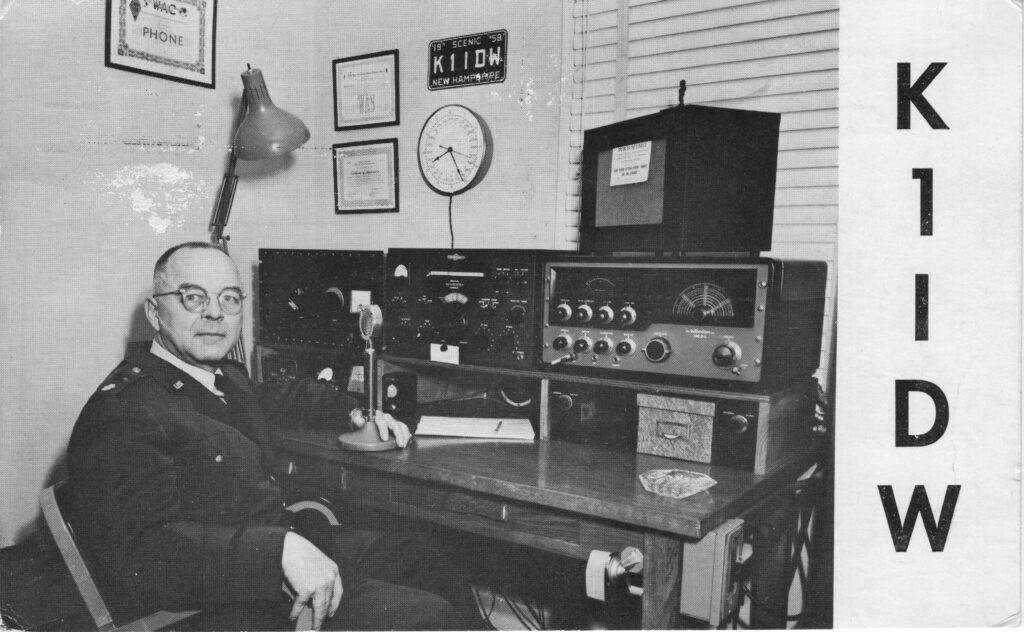
But I knew nothing about QSL cards until earlier this week. This sample shows Major Fred. G Allen with his “ham radio” set-up at Pease Air Force Base in 1961. Long before the Internet, dedicated radio enthusiasts spent countless hours trying to contact one another using equipment like this. These radios could both send and receive signals. The better and more powerful your hardware and the longer your antenna–the further your signal could reach–based on atmospheric conditions.
Each amateur broadcaster had his or her own radio station license. In 1961 Major Alden (K1lDW) made contact with another “ham” (W7GK) in Ashland, Oregon. These operators could communicate using abbreviated “Q-codes” much like text message codes today. One ham might ask “QRZ” (Who is calling me?) or “QRZ” (Is my signal fading?) They kept QSO logs of all the people they had contacted.
To confirm their successful transmission, Alden mailed this QSL card with three cents postage to his new buddy in Oregon. Long before Facebook and Twitter and other social media, it was a rare chance to chat with people, often anonymously, from around the globe. A lot of ham operators built their own equipment from scratch.
My father, John B. Robinson, had a fancy multi-frequency radio back in the 60s that could pick up police and fire department signals. We could also tune in on ham radio broadcasts from around the globe. Hearing voices IRL (in real time) in different languages was pretty thrilling for a little kid spinning the dials late at night.
“We used to listen, but we never got into sending,” dad said.
Not all the hobbyists are gone. You’ll find vintage radio enthusiasts on sites like HamNation.com. According to one source, there are over 600 websites online run by amateur radio geeks. And if something goes wrong, with a battery and an antenna, these guys can still operate, which is why they often show up in post-apocalyptic science fiction movies.
“In a real major catastrophe, either natural or power failure every one of them hops on the air and attempts to provide emergency calling,” dad says. “They are always standing by.” Shortwave is also a major political force these days, according to an NPR podcast by the same name.
Copyright J. Dennis Robinson
 Appledore Guest Artist: Hassam & Hunt