



Back in the late 20th century, I was chatting with a college professor at Prescott Park when the topic turned to American slavery. I noted, having recently interviewed historian Valerie Cunningham, that the first enslaved African in New Hampshire had arrived at this very spot in 1645.
Slavery isn’t just a “Southern thing”
“That can’t be true,” my scholarly companion replied, or something to that effect. He seemed offended by the very idea. “There was no slavery around here. That was a Southern thing,” he corrected.
“In fact,” I pressed on, “it turns out there were hundreds of enslaved Africans living and working right here in Portsmouth by the time of the American Revolution. Many of the wealthy white merchants and ministers in town not only kept enslaved servants, I pointed out, but some trafficked in the slave trade, even buying and selling African children.”
It was more than my companion could handle. And back then, I could understand. Most of us Yankees were marinated in the myth that American slavery began in Virginia and Maryland. It was exclusively a Southern thing, we were told. White New Englanders were the good guys who ran the underground railroad, fought to abolish slavery, and won the war that emancipated Africans from bondage. We had been telling ourselves these heroic stories for 150 years and, for some, learning the facts was a bitter pill.
Within days of being introduced to Valerie Cunningham’s Black Heritage Trail, I interviewed Prof. W. Jeffrey Bolster. According to his 1997 book “Black Jacks,” between 20 and 30 percent of American sailors in the Age of Sail were of African origin.
“How did they disappear from history?” I asked Bolster. We were seated at my office inside the carriage house of the John Paul Jones House Museum in downtown Portsmouth, NH.
“Great question,” Bolster said. “We only see, sometimes, what we’re looking for.” The memory of Black sailors, whitewashed by 19th-century historians and by 20th century books and films, had largely been lost, he explained. Maritime museums, established largely by wealthy white Easterners, tended to airbrush out stories of Black people. Over ten years of researching “Black Jacks,” Bolster, then a history professor at the University of New Hampshire, found what others had missed.
“When I began, I was told, ‘Don’t try to write a book about Black sailors,’” Bolster said. “You won’t find much material. Actually, I found a cascade of material. So I think it’s a story people are ready to hear all across the country.”
That was back in 1998. Bolster was right. His groundbreaking study was a critical and commercial success. Valerie Cunningham’s decades of research led to the Portsmouth Black Heritage Trail and an inspirational book, “Black Portsmouth” (written with Mark Sammons). That work sparked the creation of the $1.5 million Portsmouth African American Burying Ground Memorial Park. Today, the mission has grown statewide as the newly formed Black Heritage Trail of New Hampshire, among the most lively nonprofits in the region, now works from its own office building in the city’s downtown.

Creating African history resources
The amount of exciting new African American history currently being uncovered by town historical societies, by university students and teachers, and by independent scholars is mind-boggling. Ona Judge, who was once enslaved by first lady Martha Washington and who escaped to Portsmouth, has become a household name. Harriet Tubman got her own superhero Hollywood film and, was considered for the $20 bill. In Portsmouth, long-forgotten African characters have become familiar friends, They include musician Cuffee Whipple, educator Dinah Whipple, patriot Prince Whipple, bakers Pomp and Candace Spring, magician Richard Potter and printer Primus Fowle, to name a few.
In 1997, when I launched a local history website, I combed the newborn internet for further proof that New England was also bound up in the slave trade. Back then, the key reference was a World War II-era study called “The Negro in Colonial New England” (1942) by Lorenzo Greene – and not much more. Today, the evidence is everywhere. Books with titles like “Jim Crow North” (2020) by Richard Archer and “Slavery and the Underground Railroad in New Hampshire” (2016) by Michelle Sherburne continue to point the way.
I’m listening this week to the audio version of Wendy Warren’s book “New England Bound: Slavery and Colonization in Early America” (2016). Warren reminds us that through the “discovery” of America and the 19th century, 13 million Africans were abducted, transported across the Atlantic Ocean under horrific conditions, sold and enslaved. From 2 to 4 million Native Americans were also enslaved, Warren writes. And while the topic of slavery rarely appears in early histories of New England, a close look at the founding of the North looks much like the founding of the rest of the Americas.
A careful look at the “Great Migration” of 20,000 to 30,000 Puritan immigrants from 1620 to 1640 shows how much this group was as interested in making money as they were in exercising religious freedom. “Piety and profit worked hand in hand in the region,” Warren said. The sudden burst of industry created a need for a greater labor force, and while colonization advocates like Capt. John Smith and Sir Ferdinando Gorges warned against the dangers of slavery, it quickly took root in every New England province.
English immigrant Samuel Maverick, who settled on an island in Boston Harbor, is infamous today for enslaving the first known African in New England. His goal was to create “a breed of Negroes” as a low-cost labor force. When an enslaved woman refused to cooperate, Maverick “ordered her raped,” Warren reports. Maverick is intimately tied to the history of Portsmouth since he was the second husband of Amias Thompson. Amias, with her first husband David Thompson and their son John, were the founding European family of New Hampshire in 1623. She remarried in 1628, the year David mysteriously disappeared, and the same year Maverick purchased his first slave.
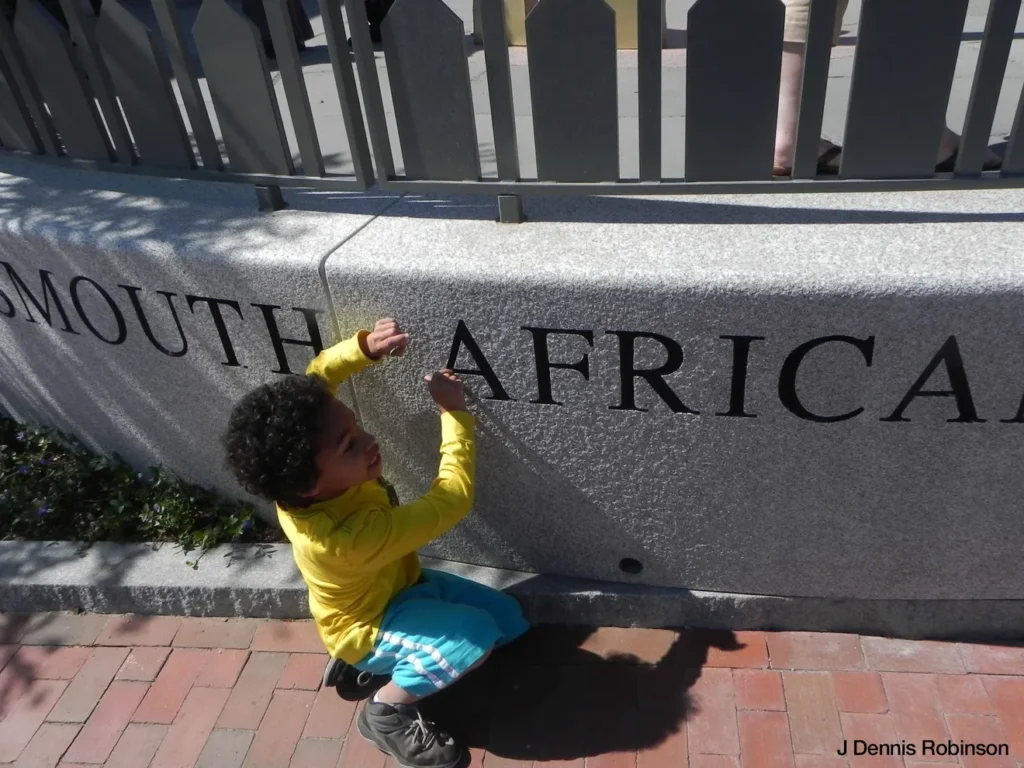
Enslaved Indigenous People
Slavery served a double purpose in the colonization of New England, according to Dr. Jared Ross Hardesty. “It was not just about labor after all,” he said during an online lecture. Slavery also served the purpose of “removing indigenous people from the land … That, of course, opened the land to English settlement.” It was following the Pequot War (1636-38) that the defeated Native Americans were driven from their ancestral lands in New England by white settlers. Many were enslaved and shipped to the West Indies and Bermuda.
Hardesty, an associate professor of history at Western Washington University, is the author of the first major overview of slavery in New England published since the study by Lorenzo Greene in 1942. He recently delivered a virtual lecture and teaching session through the Moffatt-Ladd House here in Portsmouth.
“Why write this book at this time?” Hardesty asks. Because the last 25 years have produced a “massive outpouring” of scholarship and source material about slavery in the North, he says. Much of that data, however, is hidden behind paywalls in academic journals, which led Hardesty to spend the last decade working on “Black Lives, Native Lands, White Worlds: A History Of Slavery In New England” (2019), a readable guide to a complex topic.
Historical societies are pulling out and re-examining artifacts and documents in light of the latest research. Private and public documents are being digitized and made available online. We are at the beginning of an “historical reckoning of places and institutions exploring their ties to slavery,” Hardesty says. And then there is the ongoing work of community activists and public historians.
Nowhere is that more true than here in Portsmouth, along the Piscataqua, in New Hampshire and Maine amd Massachusetts. Patricia Wall’s recent book, “Lives of Consequence” (2017), for example, turned up evidence of hundreds of previously unknown Africans who once lived in “Old Kittery.” Wall, like so many of us, was switched on by the game-changing work of Cunningham and Bolster, by the unflinching work of the local NAACP and groups like the Seacoast African American Cultural Center.
In 1997, when I first posted work by Cunningham and Bolster online, the feedback from website readers was encouraging, but there were skeptics galore. Today, African American history has moved out of the shadows and scholarly footnotes into the nightly news. A greater understanding of how slavery and colonization served the white population from its earliest days is critical to an understanding of both the roots of racism and the its prevalence today.
From the NASCAR ban on Confederate flags to the toppling of statues that glorify slavery, our growing understanding of the racial inequity of the nation’s founding has become the nightly news. It lives inside the protests over the death of George Floyd and in the election of the first woman of color to the office of Vice President of the United States. It informs us, at long last, that white supremacists are, indeed, domestic terrorists. It fuels the rise of the Black Lives Matter movement.
When Hardesty was asked to speak about slavery in New England back in the pre-COVID fall of 2019, he expected the usual cluster of history buffs. He was surprised to learn that 4,000 people expressed interest in attending his lecture. So yes, Virginia, there really was slavery here, too. And the first step toward a solution is admitting we’ve been part of the problem all along.
Copyright 2021 by J. Dennis Robinson, all rights reserved.
 Celia Thaxter’s Kaleidoscopic Appeal, Part 1