



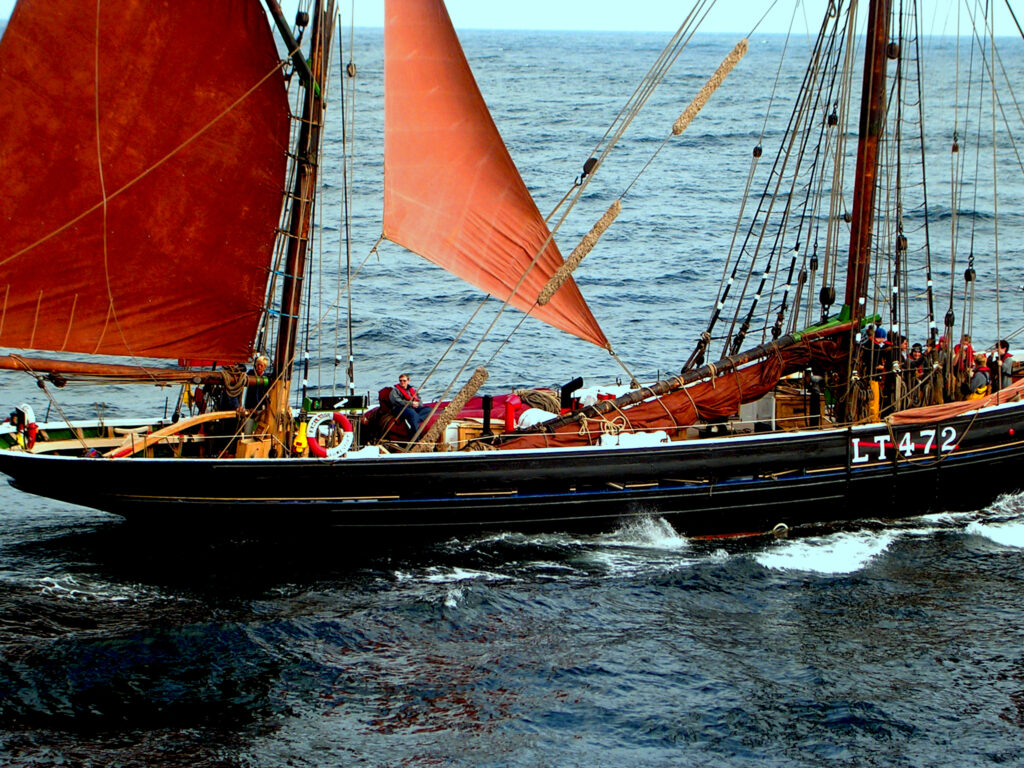
Leland Pollock was itching for adventure as he clambered over the bowsprit and onto the cold and dismal deck of a two-masted fishing smack in Boston Harbor. It was an hour before midnight on April 19, 1911, and the boat, Pollock later wrote, was “as dark as a tomb and as silent as one too.”
Suddenly, the small engine of the Valentinna throttled to life, breaking the stillness. Pulleys rattled and sails fluttered as the small fishing boat and her laconic crew slid past the dark hulls of huge five and six-masted schooners at rest. Approaching the flickering lighthouse, they broke from the shelter of the harbor and headed north on the black open sea towards Portsmouth.
Pollock was a landlubber of the highest order. Born in 1887 he had spent his youth working on his family’s cantaloupe farm in Colorado. In 1911, embarking on his first sea voyage, he was a freshman at Harvard Law School. It was during spring break that the athletic young student volunteered his services aboard a New England fishing boat headed to Portsmouth, NH. His unpublished autobiography now belongs to his son, who lives in Kittery, Maine. A retired professor of Biology from Drew University, Leland Pollock Jr. offered the author an exclusive first look at his father’s memoir.
The Nor’easter
Despite his total inexperience at sea, by morning the Harvard freshman found himself at the wheel of Valentinna, her sails billowing in the chilly wind. By 2 pm, the veteran fishermen were baiting thousands of hooks strung on long trawl lines and coiled into large wooden tubs. Arriving at their appointed fishing grounds off the coast of York, Maine, a small fleet of a dozen wooden dories was lowered into the waves. Pollock was amazed at the agility of the fishermen as each man jumped into his boat, set a marker buoy with an anchor, and drifted away. Each dory carried four tubs of baited hooks that, once unwound, extended a distance of two miles. After picking up each man and hauling the dories back aboard, the captain steered his boat to Portsmouth for the night.
At 3 am the next morning, the captain shouted down to the sleeping crew, “Under way! Under way!”
What had been perfect weather for setting lines the previous down now turned blustery. The waves rolled higher and higher, Pollock reported, as the dories were lowered one by one. The fishing smack rocked so fiercely that the men in their dories disappeared with every wave. Like a bucking bronco, Pollock later wrote, the trawler dipped down “plunging the bowsprit into the huge sea ahead, scooping up a wall of water which would swirl back along the deck and out the scuppers.”
Although it was reportedly one of the worst storms of the season, the men in the dories continued to haul in their catch. They pulled on the lines and flicked the heavy fish off the hooks and into their boats as if there was no danger at all. One wave struck so hard that it scooped everything out of a dory–tubs, lines, floats, and fish–leaving only one drenched but unperturbed fisherman clinging to the rails.
Keeping track of a man in a tiny dory in a rolling sea required great skill. On deck in the fresh air with the horizon in sight, Pollock was able to function. But as soon as he closed his eyes or ventured below deck, he became violently ill. Exhausted, he curled into his bunk as water splashed through the hatch, objects flew around him, and the ship rolled.
Back in Portsmouth by 1 pm, the young adventurer immediately went ashore. “I will take an oath any time that the sidewalks and buildings of that fool town swayed and heaved just like that schooner for 10 hours–it was a strange phenomenon,” Pollock wrote. “I wondered that the papers never spoke of it.”
Jumping ship
During the afternoon, Pollock took a ferry to Kittery and a trolley up to Old York, where he wandered happily through the woods and along the rocky shore. He was back in Portsmouth by evening, where he joined the crew in dressing the fish. The haul was mostly cusk, with a smattering of cod, hake, and haddock, with fish weighing up to 100 pounds. The livers were saved for cod liver oil, and the cleaned fish were packed in ice.
Leland Pollock had no love for the crew of the Valentinna whom he described as rough and hard set. The boat was messy, and he found their food “indigestible for anything short of a concrete mixer.” On Friday, having been paid well, the men went ashore and stumbled back blind drunk. Pollock, a man of strong Christian morals, found their behavior untenable. The next morning, instead of heading back to sea, Pollock jumped ship to join the crew of the Olive F. Hutchins, a larger, cleaner vessel with an admirable captain and better food– broths, steaks, pies, cakes, and fresh fruit.
Despite rough choppy weather, the landlubber found the larger boat more stable. Now familiar with the routine, he actually enjoyed a hard day’s work as the youthful crewmen lept into their dories and set their lines. Back again in Portsmouth, to Pollock’s horror, his new companions headed for “Mame Decker’s Cat House” where they danced and drank the night away.
The combat zone
For decades, Portsmouth had been renowned for a string of perhaps a dozen bordellos, mostly along Water Street (now Marcy) just a few strides from the crumbling wharves in the South End. By 1911 the city’s red light district had become a hotbed of crime and a political liability in an era when the police turned a blind eye and an open hand to the thriving sex trade. A year later, after four marines were found dead during a 10-day period in the South End, the bordellos were shuttered by official decree.
Little is known about life in the city’s combat zone, which makes the next few paragraphs of Leland Pollock’s memoir stand out. As the fishing boat rocked gently against the dock, “a strange thing happened.”
“Five girls, aged 16, 15, 14, 13, and eight came aboard and actually climbed down into the forecastle among the men,” the shocked Harvard student wrote. “They had not had the least invitation, so most of the men did not like it, but they didn’t dislike it enough to protest.”
We get only a PG-13-rated summary of the events that followed. In Pollock’s words: “The things that happened in that cabin were enough to make a man with any love of right simply sick with pity and shame. Those girls and some of the men were utterly shameless. The brazen actions, terrible language, etc. grew worse until I had to go down aft…The entire gamut of immorality was run in that forecastle that night.”
At midnight, after the girls were gone, another gang of drunken fishermen returned to the ship. Pollock, who later became active in the Christian Temperance movement, refused to join in their drinking games. The men were a sorry sight when, just a few hours later, they returned to their fishing grounds to haul in their lines and process their catch at sea. By evening they were back in Boston. “What a miserable existence,” Pollock wrote, “worse even than the Colorado miners, who I had always thought were hopeless.”
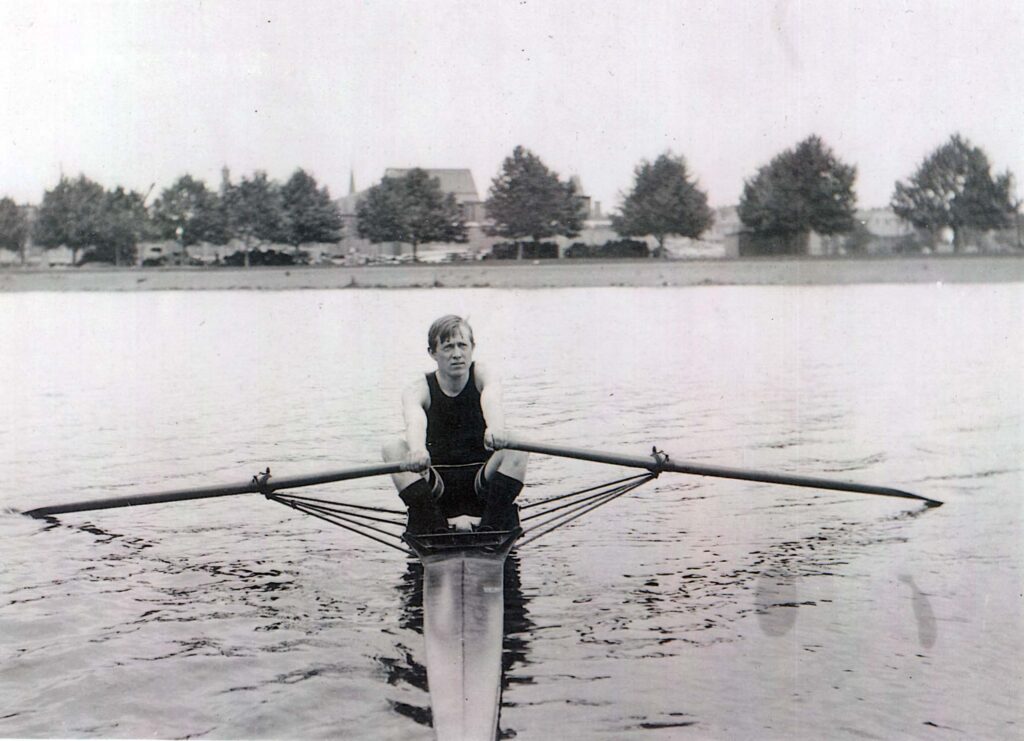
Leland Pollock, Sr. did not become a professional fisherman. Nor did he complete his law degree at Harvard. He found some success as a mail-order life coach through the Self-Improvement League of America. But he remained an outdoorsman–rowing, hunting, white water canoeing, skiing, and mountain climbing–often writing about his adventures for newspapers.
As to working aboard a New England fishing smack, Pollock found it “a hard, perilous life.”
“No wonder they run riot when they touch shore where all the pleasures and temptations are found in profusion, and nobody knows them, or cares what they do,” he concluded.
Source: Thanks to Leland W. Pollock, Jr. for access to his father’s unpublished memoir. A retired professor of marine biology/ecology from Drew University, he has taught at the Shoals Marine Lab, at Woods Hole, in Jamaica, and in Belize. The author of “A Practical Guide to the Marine Animals of Northeastern North America,” Pollock, now lives in Kittery, Maine. Copyright © 2017 by J. Dennis Robinson, all rights reserved.
 Richard Potter, America’s First Magician Reappears