


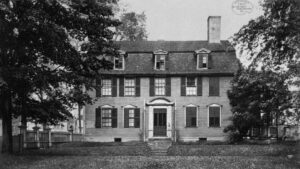
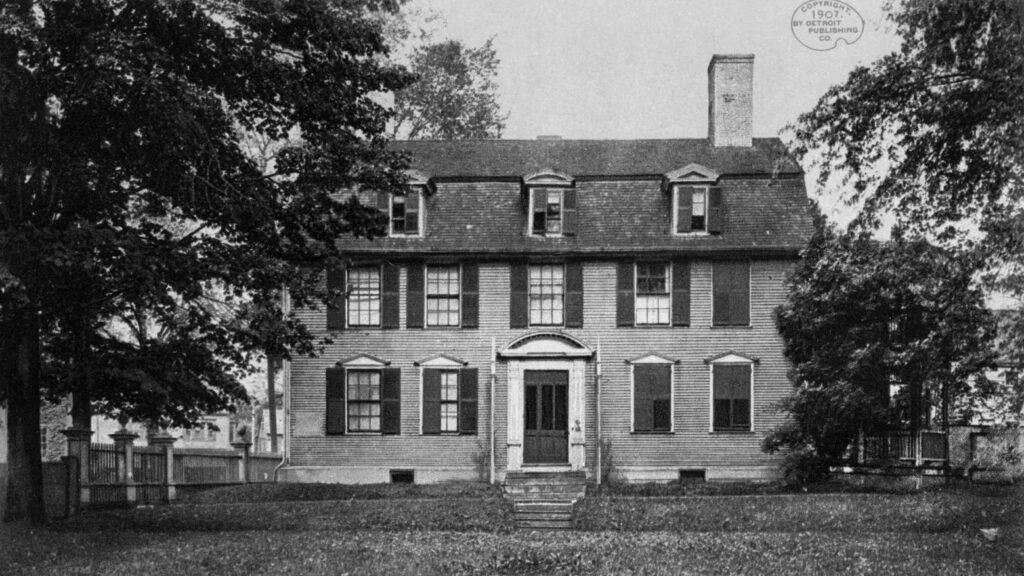
It doesn’t look revolutionary, but it is. The tiny gold “mourning ring,” newly obtained by the Portsmouth Historical Society, marks the death of a colonial merchant named Gregory Purcell. You may not know his name, but you know his house intimately. You have likely toured his bedroom, wandered through his parlor, and admired the blossoms in his beautiful walled garden.
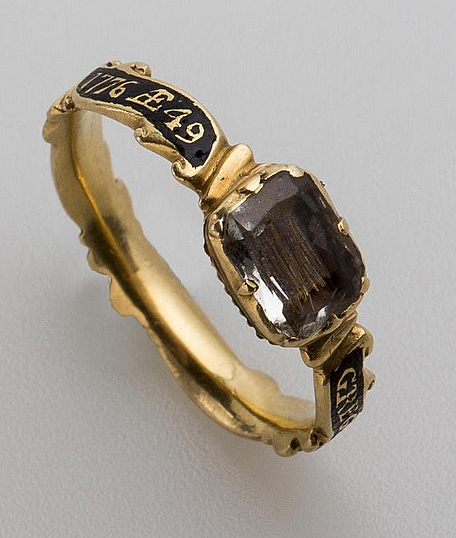
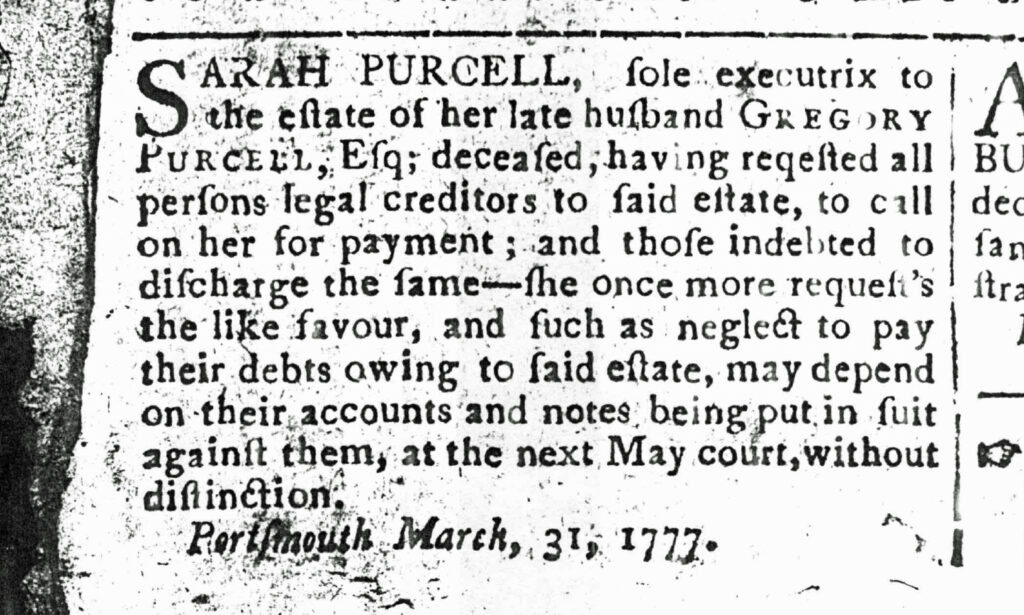
The date of Captain Purcell’s death, October 31, 1776, is inscribed on the ring. Beneath a square embedded crystal is what appears to be a few strands of human hair. Purcell’s death at age 49 left his wife Sarah with eight surviving children (out of 11 or 12) and their grand colonial home on State Street in Portsmouth. She also inherited her husband’s crushing debt, with lingering lawsuits and liens to prominent Portsmouth businessmen. Overdue bills to a local doctor suggest the Captain may have suffered a protracted illness.
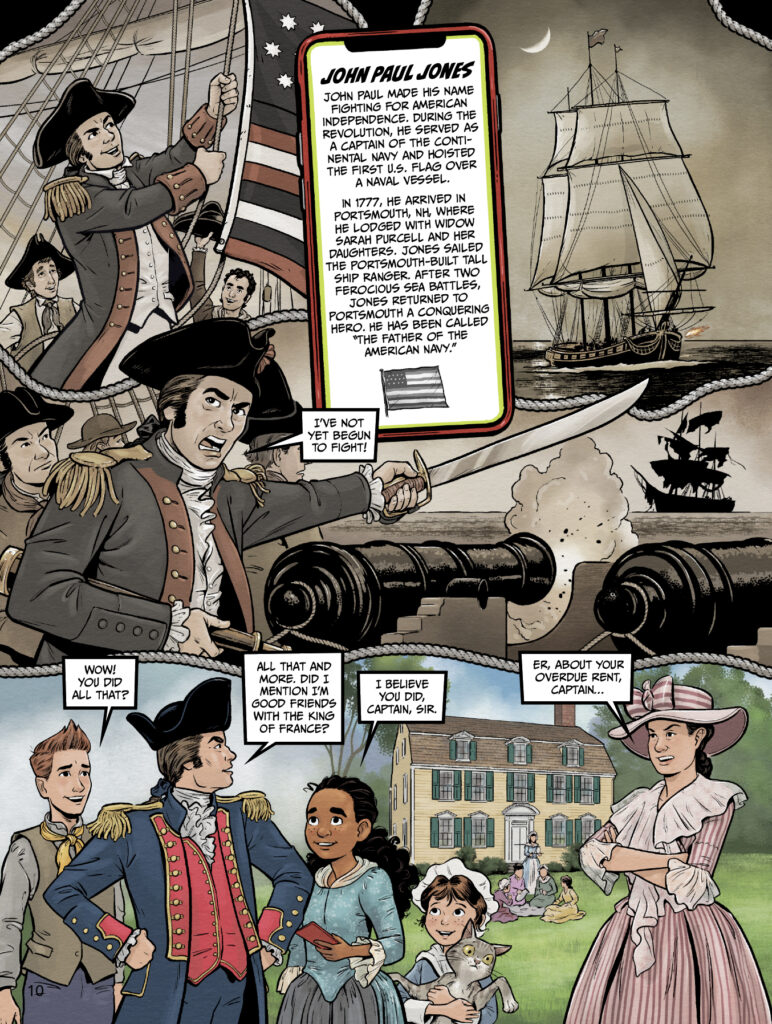
A niece of the former royal governor Benning Wentworth, Sarah Wentworth Purcell was forced to take in boarders to pay her bills. The following year, in 1777, legend tells us she rented rooms to John Paul Jones of the Continental Navy, whose name now overshadows the original homeowners.
The ring of truth
The Purcell ring, acquired at a recent auction, is a dramatic addition to the collection of the John Paul Jones House Museum. A detailed 1777 inventory of Capt. Purcell’s possessions shows a wealth of items–from ceramics, fabrics, and furniture to shoe buckles and tea canisters. But none of these items, many sold to pay off family debts, have remained in the house or even in the region. A Purcell family prayer book, a mirror, and a table are part of the collection, but they were owned by later generations.
(Portsmouth Historical Society)
“Since all the known Purcell objects except the house itself are from much later,” says historical society president Richard Candee, “this mourning ring is the one object — from immediately after Capt. Purcell’s death–that speaks to his widow’s need to create a business.”
That business, Sarah Purcell’s first boarding house, has become one of the most important stories in the maritime history of New Hampshire. The house remains the nation’s only museum named for john Paul Jones.
“We don’t know exactly who owned this ring,” says Gerry Ward, the museum’s new consulting curator. Well known for his work at the Museum of Fine Arts in Boston, Ward says the appearance of the Purcell ring is “fortuitous.”
The creation of mourning jewelry was at its peak in the late 18th and early 19th centuries. Several rings were made to memorialize Captain Purcell’s death, Ward says, possibly by silversmiths in Portsmouth or Boston. The number and quality of the rings made, the curator says, were an indication of the wealth of the family.
“Most people lived their lives below the level of historical scrutiny,” Ward notes. Few people could afford to have their portrait painted in an age before photography. Mourning jewelry not only reminded people of their lost loved ones but also acted as a reminder of their own mortality.
Informed that the rare item would be offered at Northeast Auctions in March, members of the historical society quickly contributed $3,360 to purchase it.
“As more and more pieces of the Portsmouth story appear,” Candee says, “we really need both donations to the collection and special funds to allow us to keep objects and artworks that might otherwise disappear from the area.”
Ward hopes to feature the Purcell ring in a future exhibit, ideally in a secure case with a high-powered magnifier, so that museum visitors can admire its craftsmanship and fine detail.
A brief house history
In 1714, the plot of land where the Purcell House stands was part of a 30-acre pasture known as Hunkins’ Orchard. It was, even then, well-positioned at the intersection of two unpaved highways (now Middle and State streets), one leading to the “Portsmouth Plains” and another to “Islington Creek.” The owner leased the pasture to George Jaffrey, a prominent citizen, who willed it to his daughter Ann. Ann married Nathaniel Peirce, whose family mansion still stands across Haymarket Square. Peirce then sold the land (though he didn’t exactly own it) to Gregory Purcell, described as a merchant from Ireland.
Gregory wooed and won Sarah Wentworth, and in 1758 built their three-story home. It is likely they hired noted builder Hopestill Cheswell, who was part African American.
In March 1783, the Purcell House was sold to Judge Woodbury Langdon for 1,060 pounds. Woodbury was the brother of New Hampshire “president” John Langdon, who had built the warships Ranger and America for John Paul Jones. Langdon’s brick mansion next door is the site of today’s Rocking ham Hotel.
Over the next 30 years, the house changed hands four times. Both of Woodbury Langdon’s sons owned it after his death. One of them sold it to a wealthy local family named Ladd, who rented it to John Parrott, a Portsmouth postmaster and later US Senator.
In 1826, the house was purchased by Samuel Lord, a prominent Portsmouth banker, industrialist, insurance man, and stockbroker. Lord added a two-story porch, now removed, plus a barn and carriage house. His daughter Mary stayed in the house until the dawn of the 20th century.
Widow and tavern keeper
So what became of Sarah Purcell? After selling her marriage home to the Langdons in 1783, Sarah and her daughters continued in the hospitality trade. She managed the Parker House on Pleasant Street, where George Washington would later stay during his tour of New England. Curiously, this is now the site of Northeast Auctions, where the Gregory Purcell mourning ring was recently offered for sale.
In 1783, the final year of the American Revolution, a copy of the Portsmouth Mercury includes an advertisement for Sarah Purcell’s latest venture. According to her newspaper ad, Sarah had taken over management of the famous Bell Tavern on Congress Street. She offered to entertain guests with “as reasonable terms as any tavern in America.” Sarah died in 1789.
The Jones connection
The Rockingham Hotel, adjacent to the Purcell/Lord property, burned in 1884. Ale tycoon Frank Jones, who owned the Rockingham, rebuilt the hotel. Jones wanted to tear down the dilapidated colonial house next door. He planned to replace the Purcell House with a brick office building for his newest insurance business, the Granite State Fire Company.
Jones died in 1902. Mrs. Morison, the daughter of Samuel Lord, died the following year. The Lord House passed to some short-term residents, including two doctors, who kept an office and a two-bed dispensary in what had been Capt. Purcell’s counting room.
Despite local protest, the Lord House at 43 Middle Street went on the auction block on Monday noon, April 16, 1917. Judge Calvin Page, coincidentally, president of the Granite Fire Insurance Co, was the official auctioneer. Bids came in at $500, $800, $1,000, and $1,200. The winner was “Cappy” Stewart, who, according to the Portsmouth Herald purchased the building “for wrecking purposes.”
Stewart was best known as the former owner of “houses of ill repute” in the city’s South End. When the bordellos were officially shut down in 1912, Cappy Stewart went into the lucrative “antiques” business, selling off historic Portsmouth artifacts and homes to collectors and museums.
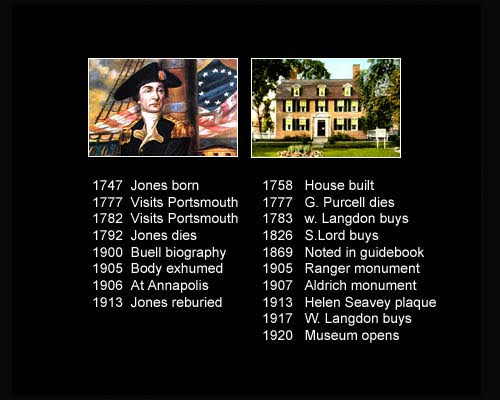
But in 1905, the body of John Paul Jones had been discovered in Paris and later shipped with great pomp to its final resting place at Annapolis, MD. Portsmouth citizens, recalling Jones’ connection to the Lord House, protested its destruction. At the urging of his wife, Woodbury Langdon III of New York, a descendant of Judge Woodbury Langdon, who had purchased the house from Sarah Purcell, stepped up and saved the day. Langdon purchased the property from Cappy Stewart for a reported $10,000.
That same year, in 1917, the Portsmouth Historical Society was formed to preserve the famous building. The new organization inherited an aging structure stripped bare of everything that wasn’t nailed down. The Society put out a call to the people of Portsmouth to bring their historic family treasures to the new museum.
People responded with vigor, donating hundreds of artifacts. Those items are still on display, much as they were when the museum opened almost 100 years ago. Captain Purcell’s mourning ring joins this unique collection as one more piece of Portsmouth’s puzzling history falls into place.
FOR MORE INFORMATION: Read In Death Lamented: The Tradition of Anglo-American Mourning Jewelry by Sarah Nehama (2012). Copyright © 2015 by J. Dennis Robinson, all rights reserved.
 Rethinking Benedict Arnold with Nathaniel Philbrick