


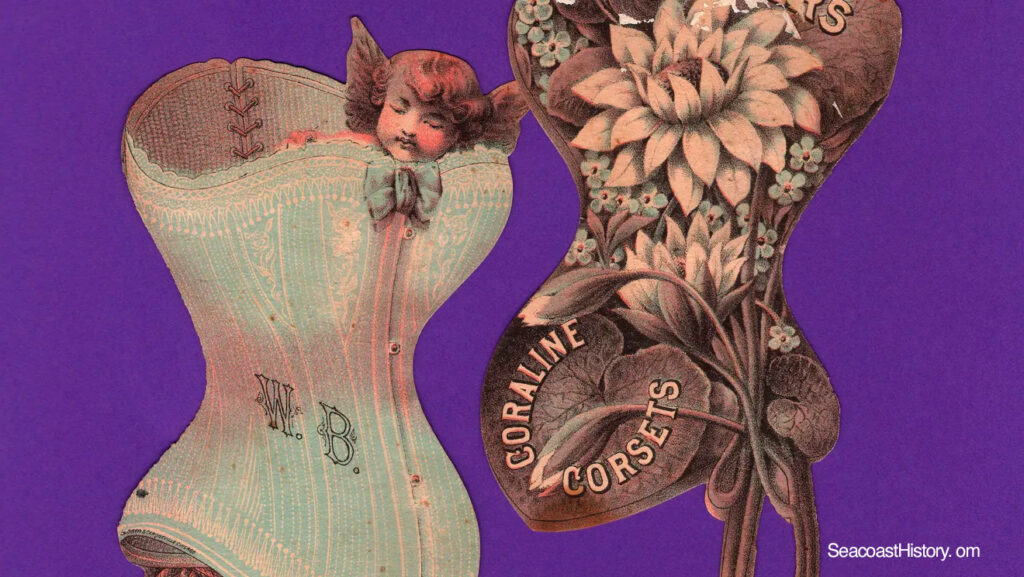
The perception that our Victorian ancestors were all prudes is overrated. They knew what was going on behind locked doors. And they invented the ubiquitous in-your-face advertising that surrounds us today. These two trade cards for the C.C. Corset made by Warner Brothers Corset Company, for example, were delicately die-cut to create a curvy design reminiscent of paper dolls.
The backs are imprinted with advertising for M.C. Foye, a downtown Portsmouth, NH shop. The cards read, in part: Dear Madam, It is with great pleasure that we call attention to the C.C. Corset, and extend to you an invitation to call and examine it at your earliest convenience…This Corset is manufactured from a single thickness of fine Coutil, and is made throughout as light as is consistent with strength and durability. It is bound with fine strips of Coraline…”
“Coutil” is a tightly woven stretch-resistant cloth made mostly of cotton and designed to prevent the “bones” of the corset from breaking or breaking through. Corsets braced with whalebone (or baleen) replaced hourglass bodices from the Middle Ages that were stiffened with paste. “Coraline” was a brand name of the Warner Brothers Corset. It was made from “Ixtle,” a stiff plant fiber from Mexico now used mostly in brushes and cords.
Portsmouth women who bought a corsets from N.C. Foye in Portsmouth were promised a $10 reward if the Coraline fibers broke within six months of ordinary wear. Coraline was replaced by metal bracing that evolved into rubberized 20th century girdles, elasticized panythouse, and other “waist trimming” products.
Not wanting to get caught in the corset crossfire and the controversy over the hourglass female silhouette, it’s safe to say the debate over these undergarments (and sometimes overgarments) continues. For the commercial view, readers may want to visit Corset-Story.com or check any early version of the Sears & Roebuck Catalog.
Victorian protests against “corseting” depicted women as “fashion’s slaves,” potentially injuring their health in an effort to conform to sexist stereotypes. A 32-page pamphlet published in 1892 by muckraking journalist Benjamin Orange Flower (unfortunately best known as “B.O. Flowers”) is often quoted. In his appeal for women’s dress reform, Mr. Flower wrote:
“It is difficult to imagine a slavery more senseless, cruel, or far-reaching in its injurious consequences than that imposed by fashion on civilized womanhood during the past generation. Her health has been sacrificed, and in countless instances her life has paid the penalty; while posterity has been dwarfed, maimed, and enervated, and in body, mind, and soul deformed at its behests. … [T]he tight lacing required by the wasp waists has produced generations of invalids and bequeathed to posterity suffering that will not vanish for many decades. By it, as has been pointed out by the authorities cited, every vital organ in the body has been seriously affected.”
Dr Lucian Warner’s Coraline corset was, in its time, considered a positive alternative to whalebone corsets and 19th century “stays” that were often laced too tight. An 1883 article in a popular woman’s magazine notes the Warner Brothers’ corset had “…demonstrated that tight lacing is not essential to grace or beauty of form; and while impractical dress reformers have been preaching reforms which no one would adopt, Warner Brothers, by introducing properly fitting corsets, have given practical aid to the health and comfort of several million ladies.”
“Coraline,” by the way, should not be confused with a freaky 2009 stop-action horror film. And the Warner Brothers Corset Company, coincidentally, is not affiliated with the well-known Warner Brothers movie production house.
Copyright J. Dennis Robinson, all rights reserved.
 The Last Poem of Caroline Jenness