


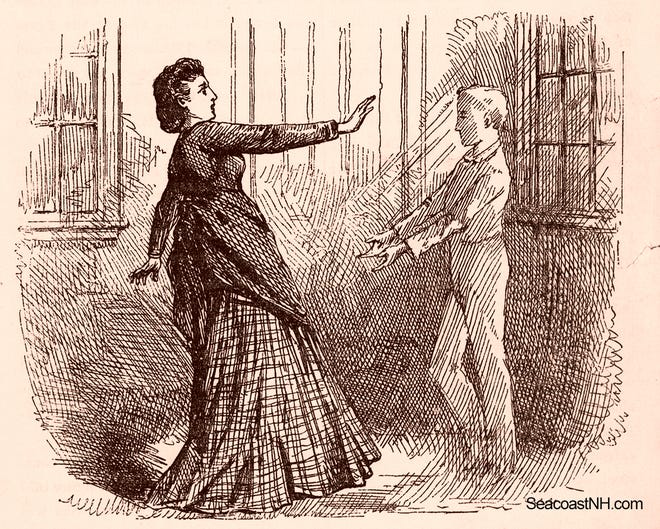
(Author’s Collection)
In 1912, according to the Portsmouth Herald, a Portsmouth woman brought a complaint to Marshal Thomas Entwistle. A group of “tramps,” she reported, had torn off the doors of the old almshouse off Thornton Street. Strange lights and eerie “cavernous sounds” were emanating from the dilapidated building. The almshouse “ghosts,” the newspaper jokingly reported, “might move from their gloomy surroundings into the highways of Christian Shore at night.”
Entwistle, according to the Herald, “does not consider that his men are adept at catching ghosts, particularly those for whom they have no warrants.” The police chief turned the matter over to City Clerk Guy E. Corey, who passed the issue on to the City Council’s committee on public buildings. John Leary, chair of that committee, hired a locksmith who fastened the doors of the almshouse shut. The strange lights fled. The haunted cries ceased. And the much more frightening true crime headlines resumed.
Today’s illustration comes from an equally imaginary tale of a ghostly boy who appeared to a classroom of students in Newburyport, Massachusetts. Young Lucy Perkins, the classroom teacher, reported the apparition at her one-room schoolhouse soon after the traumatic Civil War. After a series of odd, but easily explainable events occurred in her one-room class filled with prankish boys, Ms. Perkins had a vision. A translucent boy-shaped image appeared, hand outstretched. She grasped at the spectral figure, but could not touch it. A police investigation followed.
The Newburyport Herald trumpeted the appearance of “a real old-fashioned ghost.” Boston and regional newspapers spread the story widely. Two illustrated pamphlets about the haunted schoolhouse sold briskly for 20 cents. Letters poured in from believers and skeptics alike.
Lucy told reporters that she was not a Spiritualist, nor a medium, but she was certain she saw the ghost of a melancholy little boy roughly eleven years old, who appeared and then disappeared in her classroom. “When I reached forward to grasp him,” Lucy wrote to the editor of The Springfield Republican, “he seemed not like the boy, but vapory, or, as I can only describe it, like a thin cloud scudding across the room, still he seemed to have the boy form.”
Newburyport officials were unimpressed. The ghost story, according to city historian John Currier, was “quickly exploded.” Local police concluded that a trio of small boys, unnoticed in the overcrowded classroom, had perpetrated the mysterious sights and sounds. When a town committee substituted another teacher for two weeks, there were no incidents. The group declared the rumors and published reports to be “baseless and purely sensational.” The mysterious figure never returned.
Copyright J. Dennis Robinson, all rights reserved.
 In Search of the Bonhomme Richard