


CAMPUS CHAOS May 5, 1970
When you stand too close to history, sometimes all you see is smoke. That’s how it was for many University of New Hampshire students the day after the Kent State shootings when American colleges were set to explode. In the middle of the chaos, three members of the Chicago Seven arrived late to lay out their radical plan for student revolution.
I was a mere freshman in May 1970 when the fecal material hit the air circulation unit during the famous student strikes. One minute, we were fighting over wearing beanies at Freshman Camp, and the next, students were getting shot in Ohio while schools were shutting down across the nation. It was the closest I’ve been to American history in the making, and all I recall is a blur.
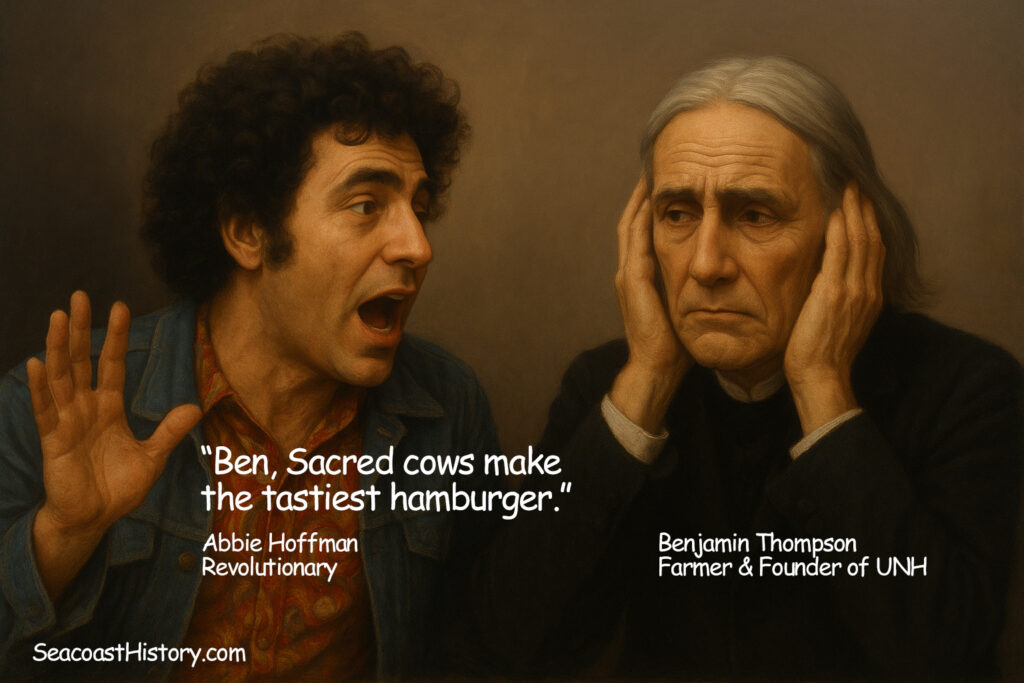
It’s been over half a century since Abbie Hoffman waggled a lit joint in front of thousands of cheering University of New Hampshire students. On that day, May 5, 1970, Hoffman was officially a felon, recently convicted of conspiring with crowds to riot at the 1968 Democratic National Convention. Hoffman had gotten in trouble for, among other things, trying to measure the Pentagon. Then a group of Vietnam War protesters encircled the world’s largest building and attempted to levitate it with their combined brain waves. It didn’t budge.
Hoffman’s appearance onstage at the rural Durham, New Hampshire campus that evening with Chicago 7 co-conspirators Jerry Rubin and David Dellinger also ran afoul of the law. Under pressure from the Manchester Union Leader, UNH trustees had originally banned the talk. Then, fearing violent student protests, the trustees, aided by a student court injunction, agreed to let the three Yippies have their say, providing they spoke between 3:30 p.m. and 6:30 p.m.. The activists made sure to arrive late, throwing the already tense campus into a state of hysteria.
Are you going? Are you going? Kids were bouncing off the walls, unsure whether to join the swelling crowds outside the Field House, while another 4,500 waited inside. Are they coming? Are there a lot of cops? Will they let them speak? The front page of the morning Union Leader predicted trouble.
“They’re here!!” Someone screamed. “C’mon, it’s all coming down!”
Suddenly I was alone in the dorm a few hundred yards from ground zero, abandoned by my friends, lying on the tiny bed. There was violence in the air and in my stomach. WUNH, the student radio station, covered the event like it was the only news on Earth and the Earth was about to explode. Underground newspapers pictured T-Hall, the administration building named for founder Benjamin Thompson, in flames. Mandatory military draft to the left, Canada to the right. Was this why I went to college? I felt like I was going to puke.
It is my theory that history looks less clear as one approaches the actual event horizon. My father says that about World War II; the soldiers were the last to know. Freshman psychology professors prove it every year by staging mock crimes of violence right in front of the class. Stats show that most eyewitnesses have no clue what really happened. Memories contradict. Perceptions vary.
Lucky for history, there was one cool head among us. Seacoast cinematographer Gary Anderson turne the whole mess into an amazing little documentary entitled “Mayflowers.” His film has been kicking around in one format or another since its release in 1971. My copy is on a thing called VHS.
It’s all there in glorious black and white, like footage from the Paleolithic Era. We see the scraggy hair, the bell-bottomed-ripped jeans, the teach-ins, the power salutes. We hear the raging voice of Jerry Rubin telling students that a college education was nothing more than advanced toilet training. We see the placid oval face of Union Leader publisher William Loeb, my high school boss in my early journalism days, comparing the convicted speakers to Nazi stormtroopers. What I had forgotten, and what Mayflowers preserves, is how all those pieces came together.
Life was already tense in those days, what with riots and moon walks and assassinations. Famous for his provocative right-wing editorial, William Loeb wanted the state legislators to cut off funds to a university that allowed what he imagined to be co-ed dorms and seditious gatherings. Rubin and Hoffman hoped our whole imperfect society would come crashing down. The war dragged on. The Beatles were kaput. Watergate was still in our future.
Gary’s film captures both the drama and the foolishness, set to a psychedelic musical score by his own New Hampshire band, the Spectras. His doc peels back the pages of the story and the layers of the emotional onion at the same time. A 1969 UNH graduate, Gary should have been as confused as the rest of us. But his clarity makes this a compelling film even today.
What I had forgotten was the timing of Kent State. Just one day before the Chicago 3 arrived in NH, four Ohio student protesters had been shot and killed by the National Guard. No wonder we were agitated, fearful, angry, confused, empowered, and in my case, nauseous. No wonder the UNH trustees, state legislators, our parents and maybe even William Loeb felt the same. It is a sickening fact that the death of a few innocent students on American soil galvanized us as much as the slaughter of so many brave soldiers overseas. The more they fought and died, the less we understood what was going on, and so our brains were set to pop, like overloaded fuses.
Suddenly, Abbie Hoffman was on our stage, pacing like a caged cat. What I pictured lying on my dorm bed years ago, I finally saw in Gary’s film. Adding a third infraction to his growing list, taunting the police and mugging for the news cameras, the king of the Yippies took a very public and illegal toke on what appeared to be a marijuana cigarette.
“Tonight, the Granite State is going to crack!” he shouted. “Tonight the Old Man in the Mountain is going to blow his [expletive deleted] brains out!” Ironically, in time, Hoffman proved to be right about that. ,
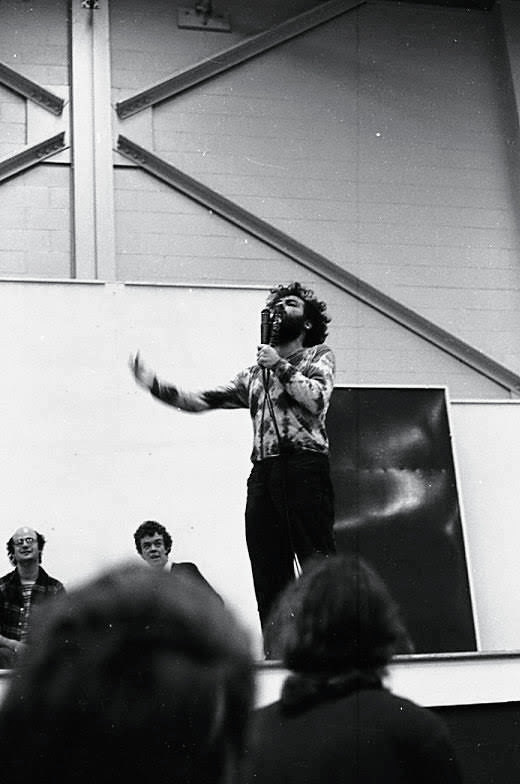
(Courtesy Bill Roy)
No one died at UNH that night, despite the violent call to arms, the dry powder keg of passion, and the spark at Kent State. The speakers left quietly. The crowds disbursed. Charges were filed against student body president, Mark Wefers, who authorized the speech, but the charges were dropped. Charges against the Chicago “convicts” were dropped too. The strike closed campuses all over the nation. Most final exams never happened. I quit school to join a rock band in New York, but the following fall I was back. Nixon was re-elected. The war dragged on. Abbie Hoffman was later busted for possessing cocaine, served a little jail time,and eventually killed himself.
Gary Anderson says the film “Mayflowers” just sort of created itself. “There was so much footage,” he told me, “and people didn’t really want it around. They were afraid it might get subpoenaed. I knew where things got tossed. …We knew something should be done with the footage, and sooner rather than later.”
The film was released one year after the incendiary event, then chopped from an hour to half an hour and re-released a year later. It went into limited distribution, won a few film festival awards, and was mentioned in Saturday Review.
Many of the people from my freshman dorm still live around here; UNH grads tend to stick pretty close. So I called a few the other day to test my theory about the danger of trusting history to eyewitnesses.
“I think I was there,” a local artist recalls. “Yes, I’m sure I was there, either inside or outside. I think outside. Didn’t they pump the sound outside?”
“I remember a lot of protesting,” says a Massachusetts senior computer salesman. “People were carrying signs and candles. I know I went and saw the Chicago Three speak. I think I remember a teacher coming into a Physics class with a shotgun and telling us to go out and join a peace rally or something. Maybe it wasn’t a shotgun.”
A prominent Portsmouth businessman, once a semi-stoned longhair, recalls sitting in his room and watching crowds gathering. The protest group, he says, ended up on the lawn outside UNH President McConnell’s home. The student body president and others used a bullhorn to call the university leader out for a confrontation.
“They were trying to really provoke an aggressive approach, to get us to go into the president’s house and take over,” a friend recalls. “They couldn’t get the crowd to do it. I had just been down to a protest in Washington, DC, and expected there might be some violence here, too. Hey, you’re not going to use my name on this, are you?”
And so it went from one fuzzy interview to the next; my peers, my pals, my colleagues–everyone went to the famous rally except me. According to reports, 7,500 students were there. But none of my fellow freshmen remembers much. The history bomb landed too close.
“We were just babies,” a female friend and now a teacher in Maine, told me. “Sure, I was there. Abbie Hoffman was so close that he was spitting on me. Later, we tried to levitate T-Hall. What do I remember? Not much. But hey, I was at Woodstock too, and all I remember was heading out and coming back. The rest is a blur.”
Copyright © 2005 by J. Dennis Robinson, updated 2025. All rights reserved. For more information on “Mayflowers” (1972), visit NHmovies.com.
 1900 Fannie Sprague Murder Still Unsolved