



Was Martin Pring the first white man to set foot in the Piscataqua River region in 1603? If so, why had he traveled the wild Atlantic only to dig up a few trees? The true story of the European “discovery” of New Hampshire is one rarely whispered by the history books.
Historians often Pring’s quick visit as the founding visit to the region, ignoring 12,000 years of Indigenous occupation. It was, at least, an early documented journey recorded in English. Accounts note that Pring was in search of sassafras, a valuable homeopathic medication. But early authors rarely noted that sassafras was prized as a cure for syphilis, then raging through Europe.
Martin Pring of Bristol, England, most scholars agree, documented an early visit to what is now our seacoast region. While New Hampshire historians tend to blur the simple truth, Pring was specific. In his own published report of the 1603 voyage to what was then known as Northern Virginia, he wrote that sassafras was “a plant of soveriegne vetrue for the French Poxe.”
The New Hampshire seacoast is tied to England. Almost all local towsn, from POrtsmouth, Durham, Dover, and Hampton, to Newmarket, New Castle, and Rye are derived fron English towns. Portsmouth is an English town to its roots. It was named for an English city, as are most of the towns in the New Hampshire coastline – Hampton, Durham, Dover, Newmarket, New Castle, and on. Refering to syphillis as a French disease shows this was one of many times the two nations were on the verge of war. The French had beaten the English to Norembega, the early name for the American continent. Pring’s visit was an early attempt to establish British influences in the unclaimed area between French territory to the north and Spanish claims to the distant south.
Baldness produced by syphilis was called a “French crown”. The French, in turn, called the disease after the Italians. The Russians named it after the Poles. The Japanese named it after the Portuguese. Even in the 1600s, it seems, venereal disease was always someone else’s fault.
Nathaniel Adams, Portsmouth’s first official historian, was unaware of Martin Pring’s visit. His 1824 “Annals of Portsmouth” opens with Captain John Smith, who charted this region in 1614. Smith coined the name “New England”. By the mid-1800s, Portsmouth journalist Charles Brewster had included Martin Pring’s search for sassafras in his “Rambles About Portsmouth,” Brewster imagined the arrival of the first white man to step onto Portsmouth soil with a spiritual fervor that modern historians use to describe Neil Armstrong’s first footfall on the Moon.
The Search for Sassafras
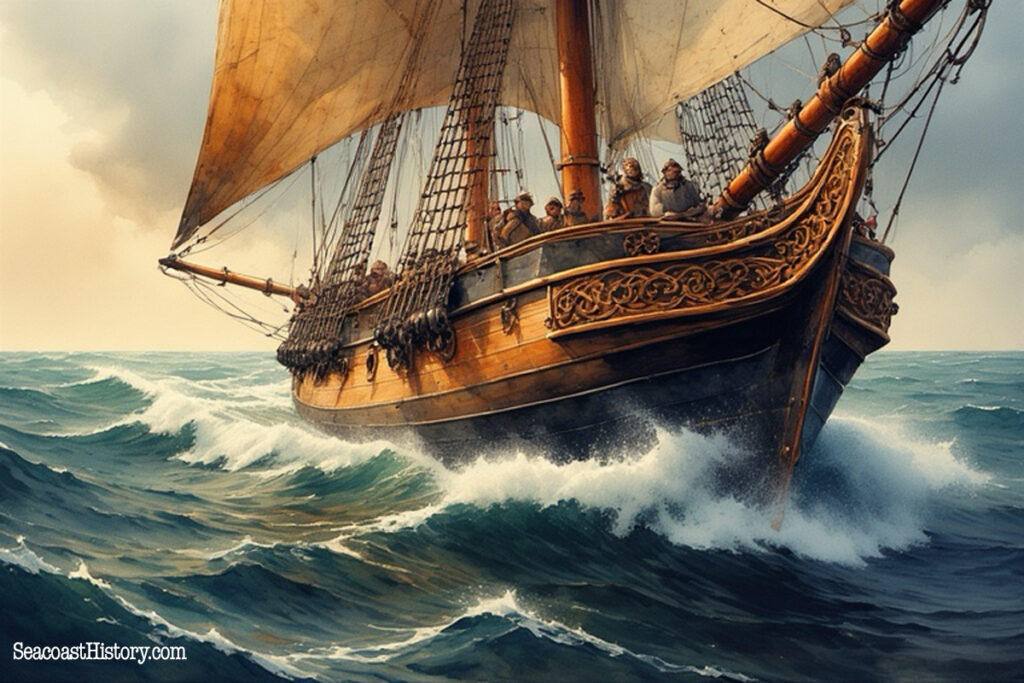
Brewster mentioned the search for sassafras which he admits was the prime reason for Pring’s 3,000 mile journey from England in two small sailing ships, the Speedwell and the Discoverer, with combined crews of 56 men and boys. In Rambles, he described the slender sassafras tree with the orange-brown bark as “that valued tree whose medical virtues in that age were regarded as the elixir of life.” Brewster was, after all, a devout church-goer, a loyal husband, and the dedicated father of eight children. VD was not on his radar.

To make a short story even shorter, Pring found no sassafras here. Indeed, there is no positive evidence that Pring was here at all. His account describes a spot along the coast with four rivers, of which only one was deep and wide enough to penetrate about 12 miles. Historians agree that it sounds as if Pring passed the Saco, the Kennebec, and the York rivers, then traveled in the smaller boat down the fast-lowing Piscataqua, beyond “the Narrows” and into Great Bay. If so, he passed back out quickly and traveled south to Cape Cod where his men found and harvested sassafras trees for the next six weeks.
Pulitzer prize winning biographer Ola Elizabeth Winslow devoted an entire chapter to Pring in her 1966 book for children, “Portsmouth, the Life of a Town.” Again, the sassafras story received a G-rating. The story only gets interesting when Pring arrives in what was to become Massachusetts. There we get an amazing picture of pre-colonial contact with Native Americans. Scores of Indians, attracted to the odd sight of white men digging up 20-foot tall trees, clustered around the English group’s wooden barricade. When a young sailor began playing his guitar, the Natives danced in a circle, made “savage” gestures, and sang “la, lo, la, lo, la, la, lo.” The guitar player received tobacco, pipes and a six-foot dried snake skin from the hospitable Indians.
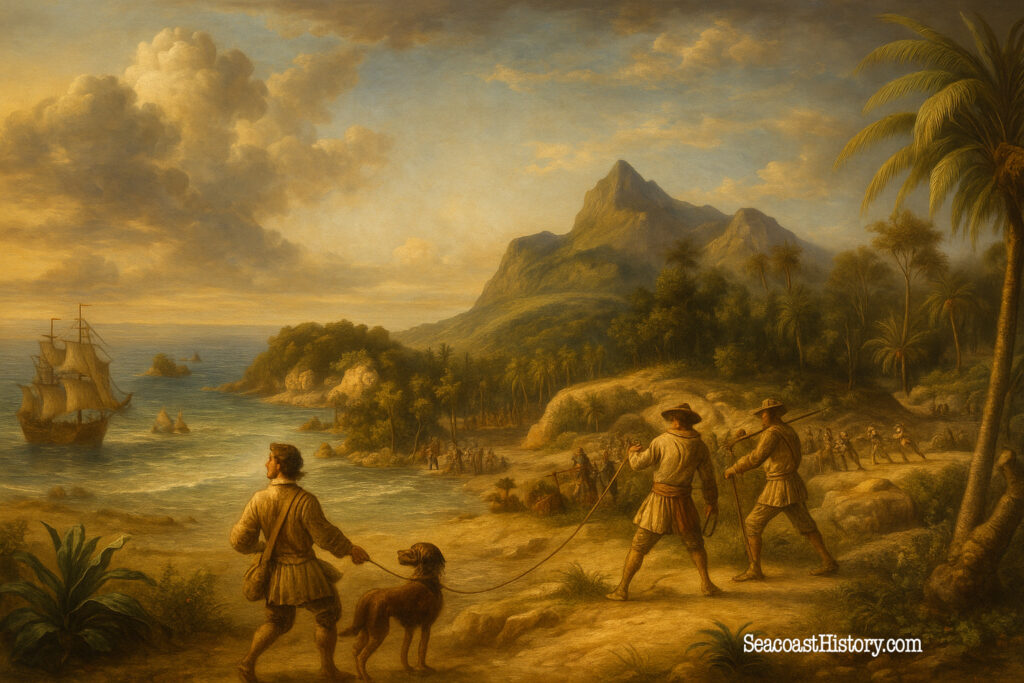
Pring’s account offers brief but exquisite detail of the Native people and of local plant, bird, fish, animal life, plus soil and seed-growing conditions. In the end, however, things went badly. In Pring’s report, 140 Indians surrounded the English barricade. They were driven back by a warning cannon blast and by two fierce mastiffs brought from England. We even know the dogs were named Foole and Gallant. After packing both Speedwell and Discoverer with the coveted sassafras, and after stealing a 17-foot long birch bark canoe from the Indians, Pring and his men departed.
Pring’s legacy
The Bristol merchants who sponsored the trip gained a huge return on their investment. Pring made two more trips to the New World, but not to the Piscataqua. The sassafras craze quickly faded when the remedy proved ineffective. The plant, apparently, has some dangerous qualities too. Sassafras tea was banned by the United States Food and Drug Commission in 1976 as carcinogenic. Pring, for the record, died in 1626, three years after David Thomson became the first white man to officially settle in New Hampshire at “Pascataway,” now Odiorne Point in Rye.
Martin Pring’s first voyage rarely rates more than a paragraph or two in the thick biographies of European explorers who sailed these waters before 1620. His name is lost among others whose trips made deeper dents in the British mind – names like Gosnold, Weymouth, Champlain, Cabot, and Smith. If Pring’s voyage proved anything special, according to New England histories, it was that safe, profitable sorties into the New World were possible.
Today, Pring reminds us that our region was a popular destination for European visitors long before the Pilgrims arrived at Plymouth. Europeans had been buying fish from the waters off Newfoundland since 1502. Historian David B. Quinn estimates that at least 650 European fishing and trading ships made the transatlantic journey to North America between 1492 and 1612. Captain Martin Pring was among them. Pring didn’t find what he was seeking along the Piscataqua River, but he proved as early as 1603 that there were valuable resources in the New World – on land as well as in the sea.
Copyright (c) 2005 by J. Dennis Robinson/ SeacoastNH.com. All rights reserved.
 Ghosts of the Sarah Mildred Long Bridge