

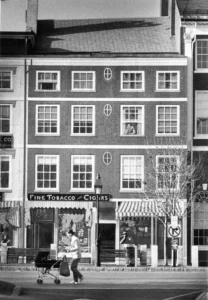
On the day before Christmas Eve in 1981, the Foye Building in Market Square collapsed. Okay, it shuddered and moaned and crunched a bit as an ancient brick wall gave way. There was a quick evacuation. No one was hurt.
To mask the reconstruction site and protect passersby, the builders put up a giant wall made from 50 sheets of 4-by-8-foot plywood. It was ugly. Every journalist in town, myself included, described it as a monstrous missing tooth, an unsightly gap in our beloved gentrified downtown. It hunkered there obscenely beside the Portsmouth Athenaeum, leering across the street at the Old North Church.
Five local artists decided to paint the plywood wall. They were nuts, of course. The planned two-week project took 12 weeks and the all-volunteer team sacrificed income, sanity, and friendships to paint over the gap. The historic plaque that isn’t there should read “With thanks to Cary Wendell, Steven Lee, Pat Splaine, Tom Cowgill, and Valerie Cooper.” Others helped and will go equally unrewarded.
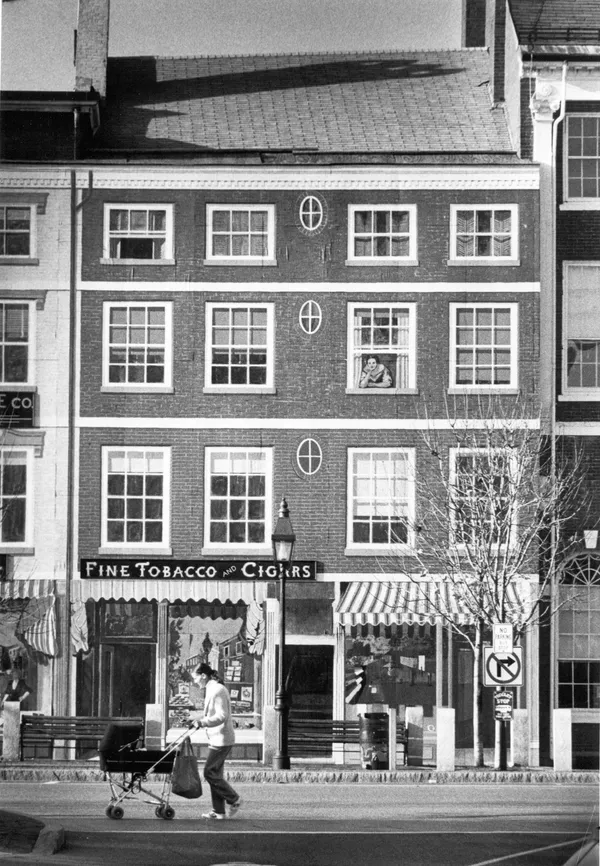
What they did was noble and brilliant. The muralists filled in the 1,600-square-foot space with a painting of the two buildings that had previously stood just behind the plywood wall. But they added a twist. They painted the former Foye and Pierce buildings as they had been nearly a hundred years earlier. Viewed from across the street, the painted buildings looked surprisingly real. It was as if time had stopped, but only in the middle of a city block.
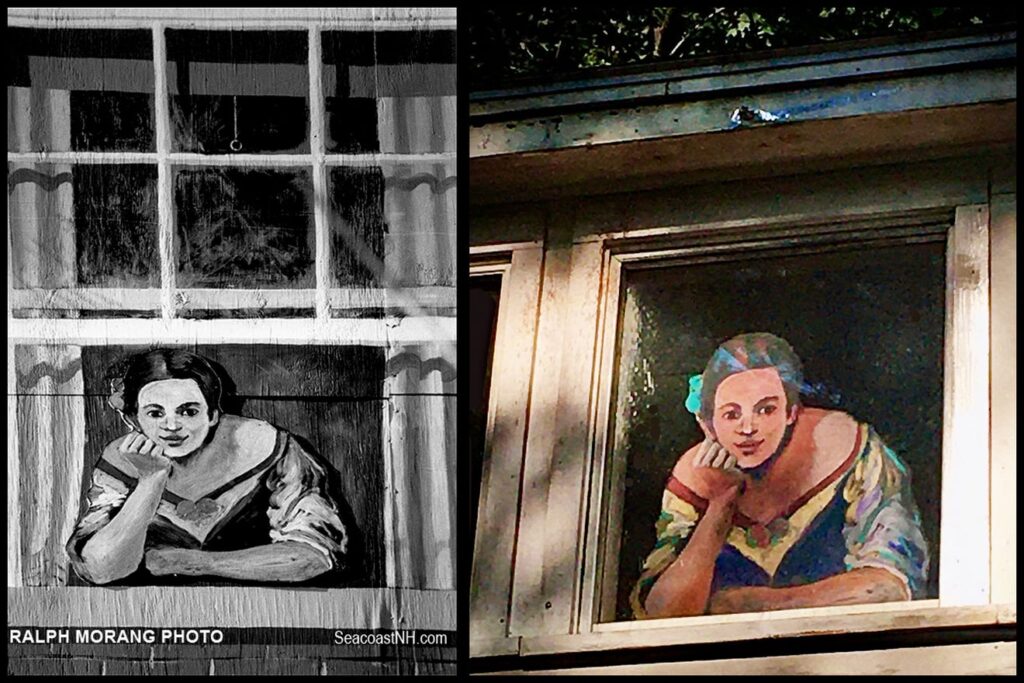
The town was enchanted by the image of a woman who appeared one day, peering down from the third floor. She seemed to be Spanish. She was young with soft skin and dark hair. She wore her dress wide open at the neck and a flower in her hair. Propping her head in one hand, she gazed with fascination into the street below. It was rumored that the woman had an unsavory reputation.
Many months later, the real building was repaired and the fake building came down. The woman in the window showed up on the top floor of the Button Factory in the city’s West End, where the mural artists kept a studio. Then one day she was gone.
“Do you know where she went?” I asked artist and masonry expert Steven Lee earlier this week.
“You mean the courtesan in the window?” he asked.
“So the rumors of her occupation were true?” I said, trying to clear up a 40-year-old mystery.
“Ya,” Steve confirmed. “I thought the mural was beautiful, but boring. So I appropriated an image from a Spanish painter named Bartolomé Esteban Murillo. That’s what gave the mural its personality and identity. It was the psychological identifier of the whole thing.”
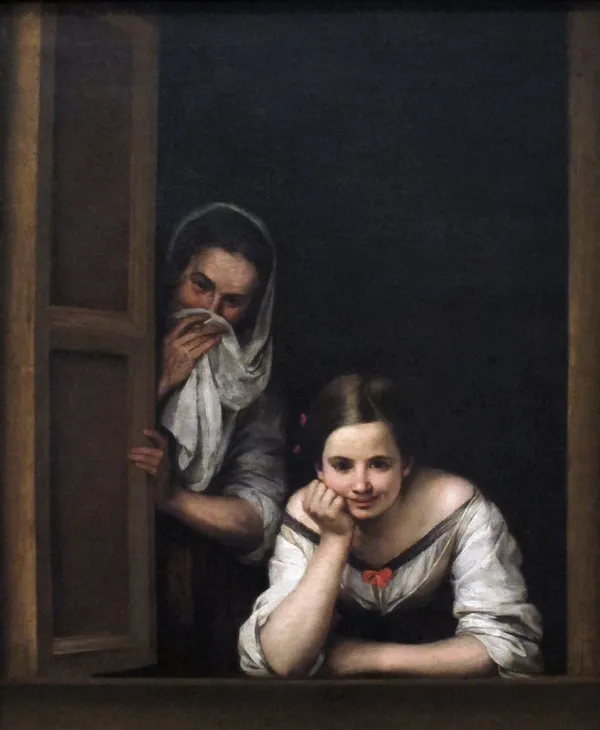
There was no Wikipedia back in 1982. But it only took me a few clicks to locate “Two Women at a Window” from the National Gallery of Art online today. Murillo, born in 1617, painted her and other courtesans from Seville when Portsmouth was merely a cluster of farms and fishing villages that stretched from Greenland to Newington.
Steven Lee has a lot on his mind. It took about an hour to unwind the story of the missing courtesan. In a nutshell, Steven was born in North Dakota of Scandinavian stock. His grandfather and father were masons. I’m skipping past a fascinating tutorial on the evolution of the American railroad and the treatment of indigenous people in the Midwest that Steve provided. After college, Steve found himself living in South Berwick, Maine.
“I set off one day to make my fortune in Portsmouth,” Steve said, and we both laughed. This was the era of the so-called “Portsmouth Renaissance” when all things seemed possible to young creative arrivals willing to starve for art. He and friends ran the Ceres Street Gallery and later the Alley Gallery on Daniel Street next to the Press Room.
With Tom Cowgill and artist Gordon Carlisle, Steven Lee worked on a series of mural “gigs,” often in Polish Orthodox churches. The clients were deeply devout and drawn to traditional iconography. The creation of large realistic trompe-l’œil murals (French for “deceive the eye”) may sound glamorous, he says, but is extremely hard work.
“I actually went to Poland,” Steve added, and our conversation was off on a journey to Kraków and then to Auschwitz where the artist wandered, ruminated, and sketched. Back in Portsmouth, he bought a bit of land on Dodge Street in 1987 where he built a home and studio. He has worked as a mason, a sculptor, and a painter ever since. In 2019, he was seriously hurt in a fall from scaffolding. He broke his heel in nine places, fractured two vertebrae, broke his wrist and damaged a shoulder.
“I’m quasi-functional,” Steve jokes, “but I don’t do what I did. I’m sort of a professional consultant now.” He does design sketches, draws, and offers masonry advice. “You could call me a stone wall facilitator,” he says. He meets weekly in his studio to sketch with a group of artists he calls the “Dodge Avenue Drawing Association” or DADA. It’s the ultimate in Steven Lee humor.
Eventually, after a long nostalgic tour of downtown Portsmouth in the 1980s, we wend our way back to the courtesan of Market Square. She was painted on masonite, Steve recalls. She disappeared from the Button Factory decades ago. Turns out she was residing at the home of former mural artist and now sculptor Tom Cowgill.
“Last year he showed up at my house with the lady,” Steve says of Cowgill. “I told him I was wondering what happened to her. But I didn’t wonder a lot.”
“He handed her to me,” Steven Lee says as we near the end of our sentimental journey. “And now I have it in the second story window of my studio at the bottom of a dead end road and down a driveway.”
“She’s pretty much the same as she was before,” Steven Lee says. “She’s looking out a window, dreaming. It’s exactly what it was before, but in a different window. It’s what it was always supposed to be.”
Text copyright 2021 by J. Dennis Robinson, all rights reserved
 Surviving Pandemics in Our Past