

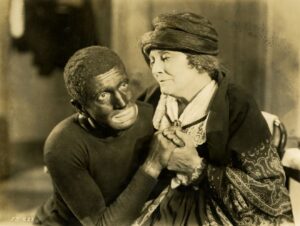
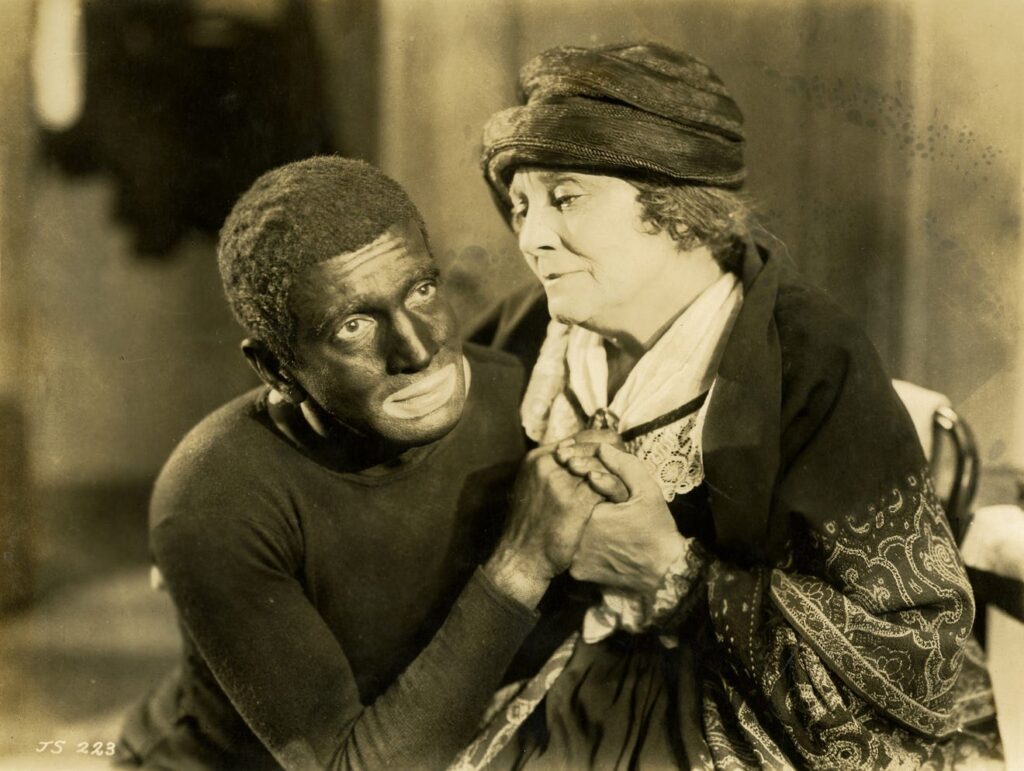
What do a Virginia governor, a Canadian prime minister and a reality TV tattoo artist have in common? They are all white men recently outed for donning “blackface” make-up when they were young. The public was outraged. The three men apologized. Critics wondered how could they be so bigoted, cruel and clueless?
The ugly truth is that we have been marinating in racist blackface images for almost two centuries. Blackface minstrelsy started in the early 1830s, historians tell us, when a white actor from New York named Thomas Dartmouth Rice gained fame dressed in a ragged hat, pants, and shoes. Rice “blacked up” his face and hands. The actor spoke and danced in what he considered the imitation of enslaved Africans from the South. Borrowing the name of a black folk character, Rice called himself “Jim Crow.”
Fueled by racial prejudice, the Civil War and emancipation, Rice’s distorted depiction of black culture became ubiquitous. White musicians and performers in blackface, their mouths and eyes enlarged with make-up and wearing “woolly” black wigs, were pervasive on the American stage in the 19th century. In the first half of the 20th century, the mocking stereotype was promoted on the silver screen.
The movie phenomenon went far beyond the 1920s when Al Jolson sang “Mammy” in the early talking film “The Jazz Singer” or the eye-rolling vaudevillian Eddie Cantor crooned “If You Knew Susie Like I Knew Susie.” Hundreds of popular film, stage, and TV performers wore blackface. They include Orson Welles, Bing Crosby, Fred Astaire, Shirley Temple, the Marx Brothers, Judy Garland, Doris Day, Laurel & Hardy, Desi Arnez, the Three Stooges, Robert Downey Jr., Mickey Rooney, Johnny Carson, Jack Benny, Billy Crystal, Dan Aykroyd, and even Bugs Bunny. Blackface minstrelsy has been called “the first uniquely American entertainment form.”
Minstrels come to town
While celebrities including Abraham Lincoln and Mark Twain expressed a fondness for black minstrels, former slave and abolitionist Frederick Douglass pulled no punches. He called such performers “the filthy scum of white society, who have stolen from us a complexion denied them by nature … to make money and pander to the corrupt taste of their white fellow citizens.”
Whether Douglass echoed these comments when he spoke in New Hampshire is unknown. America was in the thick of its gruesome Civil War when Douglass appeared on March 15, 1862, at the 1,000-seat Portsmouth Lyceum stage, known as “The Temple” on the site of today’s Portsmouth Music Hall. That same year 25 black sailors took the Temple stage to sing sacred songs and deliver their opinion about the detestable conditions of slavery.
But Portsmouth audiences applauded with equal enthusiasm on evenings when white singers dressed in blackface performed the same songs. Frederick Buckley, one of the most famous blackface minstrels of his day, gave his final performance at the Portsmouth Temple on June 22, 1864. A member of an English family troupe known as Buckley’s Serenaders, Frederick was also a composer of popular tunes like “Break It Gently to My Mother,” “Lily White,” and “Come in and Shut the Door.” After holding the crowded Temple audience spellbound with the “sweet strains of Negro music,” the 31-year-old white performer returned to Boston and died the same day. The Temple burned and was quickly replaced by a grand new Music Hall in 1878.
Portsmouth audiences likewise cheered and wept to at least a dozen different productions of Uncle Tom’s Cabin, adapted from Harriet Beecher Stowe’s best-selling abolitionist novel. As many as 400 traveling companies staged versions of the famous “Tom Show” across the nation from the 1850s to the early 20th century. Over time the anti-slavery message was muted by special effects including floating angels, blackface minstrels, and live dogs chasing barefoot runaways across the stage. One production staged at the Music Hall promised a supporting cast of “30 colored children” happily dancing and singing against the painted backdrop of a southern plantation.
Racist family fare
There’s no running from the truth. The most popular form of mass entertainment in America in the late-1800s was blackface minstrelsy. A typical show opened with dancing, joking, and singing, followed by slapstick routines, a “plantation skit,” or a parody of a popular stage play. During its first two decades The Music Hall showcased at least 30 different minstrel groups. Companies like Duprez & Benedict’s Gigantic Minstrels filled the stage. Other troupes described themselves as mammoth, mastodon, monster, magatherian, or gigantean and could include up to 100 cast members.

Asked to explain why white audiences were enthralled by minstrelsy, professor Eric Lott, author of “Love and Theft,” suggested a mix of four powerful forces – envy, fascination, desire and fear. Having enslaved an entire race for more than two centuries, minstrelsy and Jim Crow segregation were tools that helped white populations maintain a sense of separation between races. The mocking stereotypes of minstrels perpetuated the myth of Africans as inferior “others” who were living happy, comic lives in their own world.
Scholars have suggested that blackface minstrelsy was, at one level, homage to African music and dancing that was more rhythmic, more lively, more original, more heartfelt, more tuneful, and therefore more entertaining than what white audiences were used to. But it came freighted with mocking and hurtful caricatures that were repeated and reinforced by a flood of toys, movies, postcards, food items, advertisements, lawn statues, books, artwork, songs, sheet music, laws, signs, news reports, plays, and eventually film, radio, and television productions.
Ripping off the mask
From the Civil War until the mid-20th century blackface minstrelsy was accepted as good clean fun and wholesome family entertainment. Troupes of black minstrels, usually with white managers, also performed at The Music Hall. These black groups were often billed as “true Ethiopian” or “all-colored” or “jubilee” acts. They offered more authentic versions of “Negro songs,” some written by African American composers.
The Original Georgia Minstrels, popular in Portsmouth, were unique in that their founder and manager, Charles B. Hicks, was a light-skinned black. Billed as “The Only Simon-Pure Negro Troupe in the World,” their success and international tours led the way for other black minstrels to make a living. Hicks’ players, however, were sometimes branded as “race traitors” by their peers for pandering to white audiences. The Original Georgia Minstrels were welcomed onto the Portsmouth stage, but still banned from patronizing local hotels and restaurants even into the 20th century.
The practice continued into vaudeville and film where even African American performers were forced to “black up” with greasepaint. While the rise of television and the Civil Rights movement made blackface entertainment improper and unprofitable, the genre did not immediately disappear. Minstrel shows, once performed by a hundred professionals, were replaced by amateur white performers in blackface sponsored by a local Portsmouth church, by Portsmouth Naval Shipyard, by the Kiwanis Club, and the Boy Scouts of America.
While incidents of “blacking up” are met today with shame and blame, they are only one example of institutional racism. An inescapable part of American history, blackface deserves to be studied and talked about rather than hidden. It will never be an easy conversation, but we can only face the truth by peeling off the mask.
Copyright 2020 by J. Dennis Robinson, all rights reserved. Portions of this article are excerpted from Dennis’s most recent illustrated hardcover book, “MUSIC HALL: How a City Built a Theater and a Theater Shaped a City.”
 Tanker Crashes at Pease AFB in 1964