


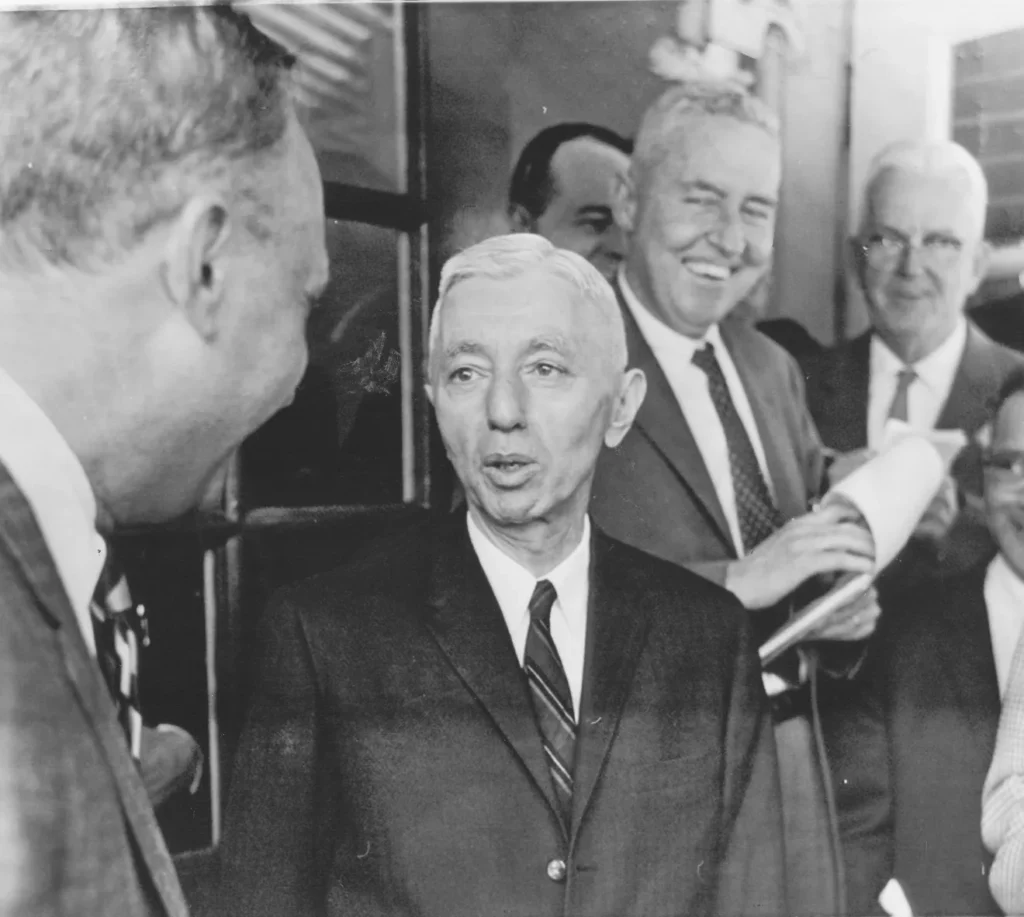
The smiling newspaper reporters in this photograph belie the seriousness of the moment. The elfin figure in the center is none other than Vice Admiral Hyman G. Rickover, the man in charge of the U.S. Naval Nuclear Propulsion Program. This AP photo was taken at Portsmouth Naval Shipyard on April 19, 1963, nine days after the Portsmouth-built submarine USS Thresher sank in deep waters east of Boston. All 129 crew and shipyard personnel aboard were killed. It was among the saddest days in local history.
Rickover, now considered “the father of the atomic submarine,” was in town to testify about the tragedy at a closed door session of the Navy Board of Inquiry. He spoke to reporters during a 15-minute lunch break at the hearing – a meeting that remains controversial to this day.
According to the Portsmouth Herald, Admiral Rickover told reporters that there was no reason to believe the sunken nuclear attack submarine could create a radiation hazard. Rickover told the press water samples taken from the area of the accident showed “no indication” of radiation. It was less than a grieving city wanted to hear.
Exactly what Rickover said minutes after this photo was taken has been classified for almost 60 years. A transcript of the inquiry was finally released by the U.S. Navy following a Freedom of Information Act request. Asked whether the reactor core had been the cause of the Thresher sinking, we now know Rickover said:
“Before answering that question, if I may, Mr. President, I would like to say something about the crew. I’m sure that everyone in this room knows how I feel about the men who were on the Thresher. I, and members of my Group, knew many of them personally. We had selected them, trained them, encouraged them. We knew their problems. We can only hope that in giving their lives for their country they have contributed to our greater safety. It is a personal loss to me. l feel for their wives, their children, their fathers and their mothers.”
As he spoke to the media during the lunch break, Herald reporter Bob Norling described Rickover as “a 125-pound wisp of a man.” True to his contempt for naval regulations, the reporter noted, Rickover was dressed in civilian clothing. The testimony of the 63-year-old admiral, according to the Herald, “shed little new light on the fate of Thresher.” After the session, Rickover explained that he was bound by the Atomic Energy Act of 1954 not to discuss classified information in public.
It was a decade earlier in 1954, two years after the successful launch of his USS Nautilus, the world’s first nuclear-powered submarine, that the admiral was featured on the cover of Time magazine. Referring to his record in World War II, Time wrote: “Sharp-tongued Hyman Rickover spurred his men to exhaustion, ripped through red tape, drove contractors into rages. He went on making enemies, but by the end of the war he had won the rank of captain. He had also won a reputation as a man who gets things done.”
Admiral Rickover’s rise to power
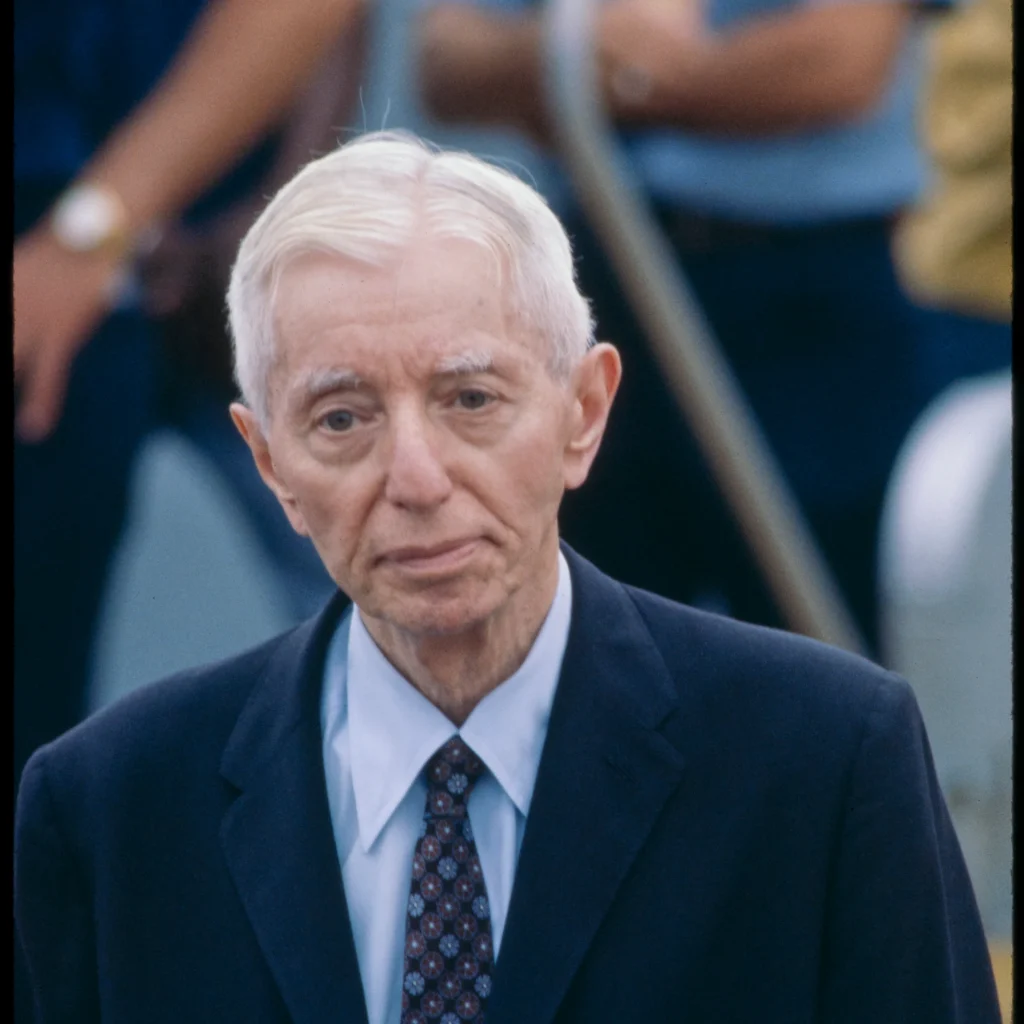
Born in Russian-dominated Poland in 1900, the son of a tailor, Hyman G. Rickover remains a powerful and controversial figure. Hyman, derived from the Jewish name “Chayyim,” arrived in the United States at age 6 and attended the U.S. Naval Academy at Annapolis.
According to one profile, Rickover was “stubborn, quick to judge, and without pity for those who were lazy or even simply less-intelligent than he was.” As an engineer, he recognized that submarines were really surface ships that could only submerge for short periods. Diesel-powered submarines, although quiet when submerged and running on batteries, had limited endurance and power.”
As the Cold War began in 1947, Rickover imagined atomic-powered submarines that could remain submerged for months, travel anywhere at top speed, while maintaining life support and weapons systems. He designed the original nuclear reactors and trained the men who commanded the nation’s first nuclear submarines.
Was the Thresher’s nuclear reactor at fault?
Decades after the loss of the Thresher, questions about what caused the deadly accident still linger. In 1963, at the dawn of his nuclear Navy, Rickover was primarily concerned in reducing any speculation that the accident had been caused by his nuclear reactor. He stressed that the sunken ship offered no environmental risk to the oceans. His promotional efforts succeeded. Today the United States operates 83 nuclear-powered ships, 72 submarines, 10 aircraft carriers, and one research vessel. In 2015, the U.S. Naval Nuclear Propulsion Program claimed “over 157 million miles safely steamed on nuclear power” with zero accidents.
According to a recent article in The Day, a Connecticut newspaper, “Rickover’s concern with reactor safety was justified as a submarine reactor accident had the serious potential to damage or even force the cancellation of the Navy Nuclear Propulsion Program, which was undeniably critical to national security and winning the Cold War.”

If the nuclear reactor was not at fault, what was? It was an emotional time in Portsmouth. Days after the sinking several witnesses had testified that “the work at the shipyard on the Thresher had been sloppy and that parts had been put in backward,” according to UPI news. In June 1963, after interviewing 120 witnesses, the Navy issued a press release stating it was “most likely that a piping system failure had occurred in one of the Thresher’s salt water systems, probably in the engine room.” Sea water probably affected electrical circuits that caused a loss of power, causing the ship to sink, exceeding her collapse depth. Other theories have been offered.
The Navy later released a report saying that “conditions and standards existing at the time were short of those required to insure safe operation of the Thresher.” According to the AP report, the Navy said 14 percent of the 155 [piping] joints on the Thresher failed to meet standards. Rickover later claimed the tragedy was caused by “an inadequate ballast tank blowing system.” The big problem, according to the Navy’s atomic propulsion chief, was people, or what he called “the lack of individual responsibility” and “shoddy workmanship.” Rickover was also making headlines in 1963 for his effort to root out what he called “educational mediocrity” that stifled the minds of American school children.
“I would like to look at the Thresher as a providential warning rather than a means for assigning blame to anyone,” Rickover walked back his comments seven months after the accident. “Everyone concerned was well intentioned. If we look at it as a means for learning how to be better, then the loss of the Thresher will have served a useful purpose. I only hope we do learn the true lessons.”
He had “the charisma of a chipmunk”
Rickover was notorious for refusing to adhere to Navy protocol which he called “all that nonsense.” Twenty years after the still-controversial Thresher tragedy, Rickover appeared in a “60 Minutes” television interview with Diane Sawyer. It was 1984 when the admiral was 84 years old.
“Oh, for crying sakes, what the hell is there about standing up and saluting and dressing up in uniforms? You can put dummies to do that job,” Rickover fumed when asked about his distaste for Navy regulations.
“I have the charisma of a chipmunk,” the admiral said. His skill was in doing his job successfully.
“I never thought I was smart,” he told Sawyer. “I thought the people I dealt with were dumb, including you.”
“I’ll tell you, to be called dumb by you is to be in very good company,” Sawyer responded.
Asked about serving under Rickover as an ensign in the Navy, former President Jimmy Carter told Sawyer, “There were a few times, ya, when I hated him because he demanded more of me than I thought I could deliver.” Rickover later confessed to Carter that he wished atomic power had never been invented.
In an appearance before Congress late in his career, Rickover was asked what he thought were the prospects for a global nuclear war. “Oh, I think we’ll probably destroy ourselves,” the admiral responded. “So what difference will it make? Some new species will come up that might be wiser than we are. … In the eyes of the Lord, we are not the most important thing in the universe.”
 John Elwyn: Portsmouth’s Eccentric Scholar