


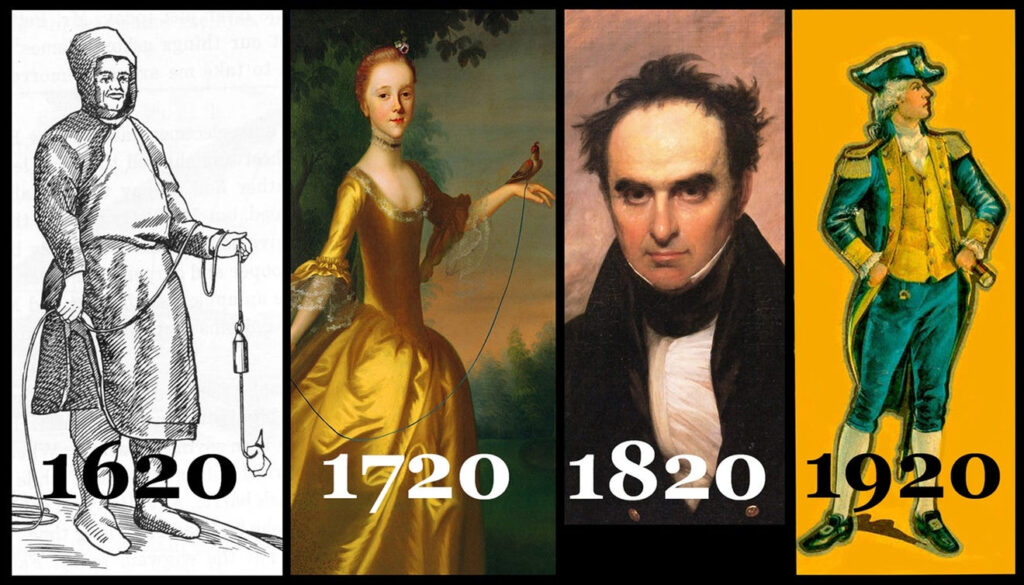
EDITOR’S NOTE: As the new decade began, we had no clue what was coming. This article appeared in December 2019 as COVID lurked only a few months over the horizon.
400 years ago
Portsmouth has a love-hate relationship with the arrival of the Pilgrims aboard the Mayflower in 1620. This city likes to think of itself as the second-oldest settlement in New England. Thanks to fishing family founders David and Amias Thompson, New Hampshire has branded its starting date as 1623. Gloucester, MA, also set up a fishery in 1623. But the Thompsons were long gone by 1628. David was reportedly dead and Amias was remarried. The Gloucester fishery, too, was abandoned the following year in 1629, so neither town gets the bronze medal.
Founding dates aside, Thompson’s connection to the band of religious Separatists may be deeper than commonly known. Four centuries ago in 1620, Thompson was in Plymouth, England as the Pilgrims were preparing to leave for the frightening New World. Thompson was well connected with Sir Ferdinando Gorges, the governor of Plymouth, England. Gorges had made a number of attempts to plant a profitable colony in New England without success. He was also head of the Council of New England that granted the Pilgrims their charter to settle in America.
It has been suggested, but never proven, that in 1620 Thompson was returning from an exploratory voyage to this region where he visited the fishery on the Isles of Shoals. Did he then consult with Pilgrim leaders about what to expect in the wilderness of the New World? Maybe, but the Pilgrims were originally headed to the Hudson River area in what would become New York before they “accidentally” landed in Massachusetts.
The departure of the Pilgrims from London in 1620 certainly got Sir Ferdinando Gorges and other Plymouth investors excited about setting up their own American colony. In 1622, the Council of New England granted David Thompson a patent to 6,000 acres and an island of his choice in the wilderness of the New World. Thompson arrived at what is now Rye, NH, in the very early spring of 1623 and almost immediately delivered a boatload of fresh fish to the starving Pilgrims at Plymouth, MA.
300 years ago
By 1720, Portsmouth, the provincial capital of New Hampshire, was becoming a key port for international trade. We exported timber and imported fine goods from Europe. Beyond a few “depredations” by Native Americans, Portsmouth historian Nathaniel Adams reports no major events in 1720. But combing through local accounts, here are a few memorable moments.
First, there was a real Ocean Born Mary. Mary Fulton was born in the hold of a ship at Boston Harbor on July 28, 1720. According to legend, privateers attacked the ship and threatened to kill all the passengers until, hearing the cries of the newborn baby, they relented. That’s it for the possible facts. Stories about young Mary wandering the streets of Portsmouth and later marrying the same pirate are the stuff of fiction.
It was also two centuries ago that the famous murals were installed at the historic Warner House on Daniel Street. Added in 1720, they are now the nation’s oldest colonial wall paintings still in their original place. The images include a man riding a full-sized horse, the biblical tale of Abraham offering up his son Isaac, a dog, an eagle carrying off a chicken, and two regal Mohawk Indian chiefs. The house was built around 1716 by wealthy Portsmouth merchant Archibald Macpheadris for his teenage bride, and the murals are part of the museum tour.
It was in 1720 that John Pickering, who owned a huge chunk of Portsmouth’s south end, deeded the city the land to build a church at the high point on Water Street (now Marcy Street). Built from trees cut down on site, the church was finally finished in 1731 and used until it was demolished in 1866. It was replaced by the current building that, although it looks like a church, was built as a Ward Hall and school just after the Civil War. It also served as our first African American church. It has since been used as a clubhouse for disabled veterans, a meeting and concert hall, art gallery, children’s museum, and a television studio.
The year 1720 also marks the construction of the beautiful Buckminster House on the corner of Islington and Bridge Street (across from Portsmouth Historical). It was originally built by Daniel Warner and occupied by privateer Eliphalet Ladd and popular Portsmouth minister Rev/ Joseph Buckminister. It has since served as a boarding house, funeral parlor, bookstore, and insurance agency.
200 years ago
It was in 1820 that Daniel Webster, who had served 10 years as a lawyer in Portsmouth, gave his famous address at a bicentennial festival for the arrival of the Mayflower at Plymouth, MA. The Plymouth event would, in a roundabout way, change the future of Portsmouth.
Gesturing toward the mythical “Plymouth Rock,” the great orator claimed that, before the arrival of the pious Pilgrims, there was nothing in the New World but a wilderness “peopled by roving barbarians.” In a single phrase, Webster ignored 12,000 years of Native American civilization. Plymouth, Webster claimed, was the cradle of American history, Christianity, morality, and human civilization.
To his credit, Webster also used his speech to speak out against “a traffic at which every feeling of humanity must forever revolt. I mean the African slave-trade,” Webster proclaimed to his white audience. “Neither public sentiment, nor the law, has hitherto been able entirely to put an end to this odious and abominable trade.”
Three years later, with its heyday as a world trading center ended, Portsmouth needed a booster shot. So in 1823 the city hosted a copycat bicentennial in honor of its founding fisherman, David Thompson. Again Daniel Webster was the guest of honor. The event featured floral displays, decorative arches, a solemn parade, lots of speeches, a fish dinner, and a gala ball. The 1823 celebration spawned a series of tourist-friendly homecoming festivals including the Portsmouth400 anniversary in 2023.
100 years ago
With World War I over and work at the Portsmouth Naval Shipyard slowing down in 1920 the city settled back into a blue-collar routine. The bustling tourist business of the Victorian era, like its burgeoning beer industry and ancient maritime trade had all faded. The “Old Town by the Sea” was really looking its age. It was time, many believed, to tear down the old and bring on the new.
In 1920, the George Jaffrey mansion on Daniel Street, site of the controversial McIntyre Building today, was razed. Many architectural treasures would follow. Like so many of its colonial neighbors, the 1758 home of Sarah Purcell on State Street was threatened by the wrecking ball of progress. But rumors that naval hero John Paul Jones had lodged there during the American Revolution attracted an out-of-town buyer who saved the historic structure and its garden from destruction in 1917.
The house was given to the newly formed Portsmouth Historical Society. According to the Portsmouth newspaper, “several well known citizens…intend to preserve the building for future generations.” They inherited an aging building stripped bare of its contents by a local antiques dealer. The society reached out to the residents of Portsmouth, asking them to donate or lend their historic family treasures to the new museum. People responded and the renovated John Paul Jones House Museum opened its doors in 1920.
Rev. Arthur Gooding, the nonprofit society’s first president, vowed they would do their best “ to preserve Portsmouth history from the growing powers of commercialism.” His mission was to spread knowledge about the city, to foster respect for traditions, and to instill “a real affection for the ancient things that make Portsmouth the most delightful of all early American towns.” A century later, those artifacts are still on display, the ancient house preserved, and the downtown gardens lovingly maintained by the nonprofit Portsmouth Historical Society.
Copyright © 2019 by J. Dennis Robinson, all rights reserved. Updated 2025.
